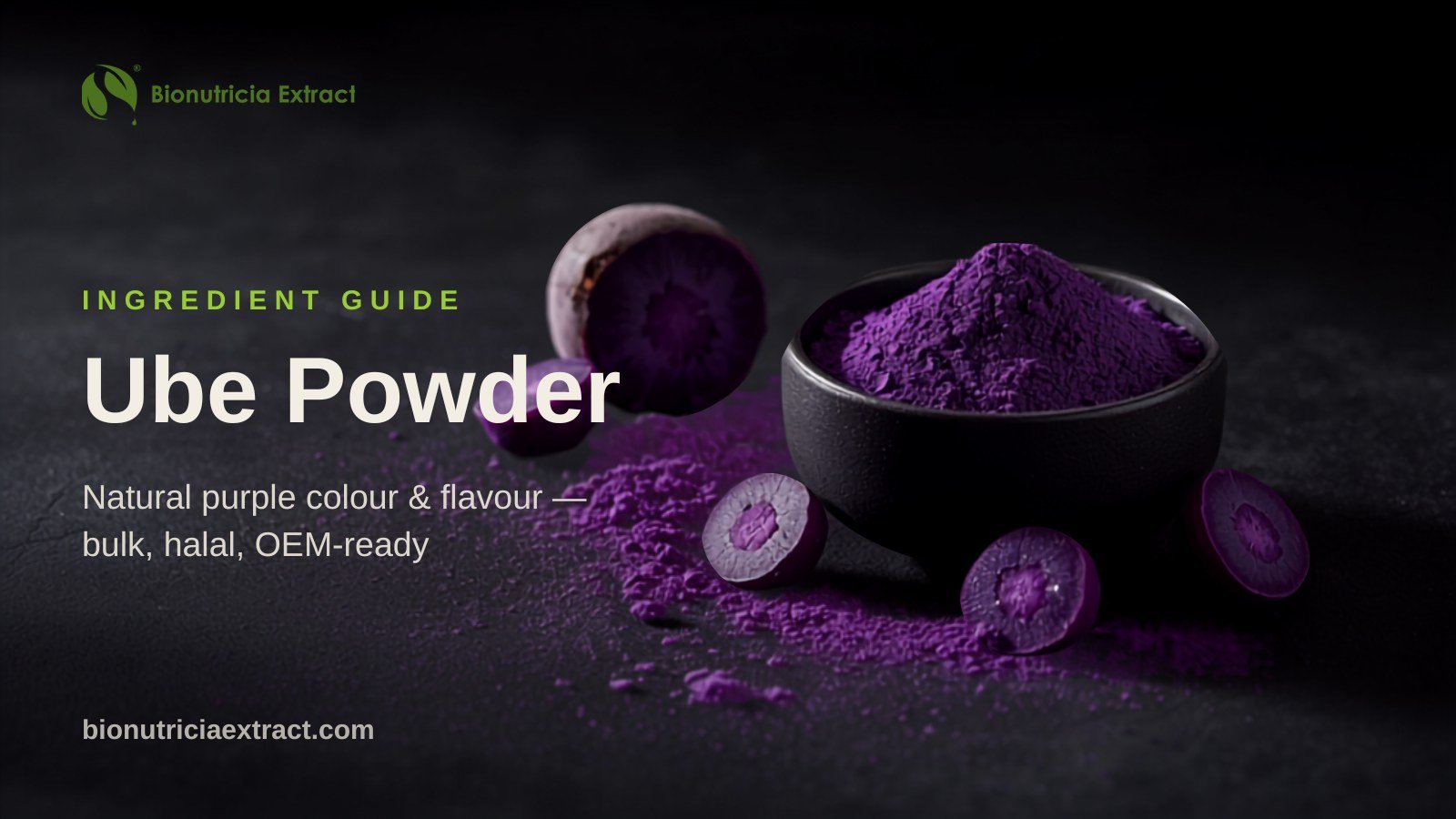
Ube powder is purple yam (Dioscorea alata) that has been washed, cooked or steamed, dried and milled into a fine violet powder. It is used as a natural colouring and flavouring ingredient in beverages, ice cream, bakery, desserts and supplement formulations, prized for its naturally sweet, vanilla-like taste and vivid purple anthocyanin pigment. Good ube powder is uniformly violet, free-flowing, and comes with a certificate of analysis covering identity, heavy metals and microbial limits.
What is ube powder?
Ube (pronounced oo-beh) is the purple yam of Southeast Asia and the Philippines — a tuber whose deep violet flesh carries anthocyanins, the same class of pigments found in blueberries. Ube powder is simply that tuber in shelf-stable powdered form: the yam is cleaned, cooked, dried (spray-dried or drum-dried depending on grade) and milled. Unlike synthetic purple colourants, the colour and the mild sweet flavour arrive together in one clean-label ingredient.
Ube is often confused with purple sweet potato (Ipomoea batatas) and taro. All three are different crops: ube is a true yam, has a deeper violet colour and a distinctive sweet, nutty-vanilla profile, and is the ingredient behind the global ube latte and ube dessert trend.
Ube powder vs ube extract
Whole ube powder is the dried, milled tuber — it keeps the fibre, starch and native flavour, and doses at percent levels in a recipe. An ube extract powder is concentrated: the soluble pigment and flavour fraction is extracted, then spray-dried onto a carrier, giving stronger colour intensity, better solubility in beverages, and lower usage rates. Bakery and food-service applications usually want the whole powder; beverage premixes, gummies and colour-critical applications usually want the extract. Our detailed spec comparison lives in the Purple Yam (Ube) Extract Powder buyer’s guide and the bulk purple yam extract powder page.
What does ube powder taste like?
Mildly sweet and starchy with a nutty, vanilla-like note. It is far gentler than fruit powders, which makes it easy to formulate: it colours a latte, soft-serve base or mochi dough purple without pushing a strong flavour on top of the recipe.
How to use ube powder
Typical applications: ube lattes and blended beverages, ice cream and soft serve, bakery (breads, cakes, cookies, mochi, doughnut glazes), fillings and jams (ube halaya), pancake and waffle premixes, smoothie mixes, and natural colouring for confectionery. In beverages, extract-grade ube disperses cleanly; whole powder suits batters and doughs where its starch contributes body. Colour is anthocyanin-based, so it shifts toward red under acidic conditions and toward blue-grey at higher pH — test at the finished product’s pH.
How to buy ube powder in bulk: a checklist
- Species identity — confirm Dioscorea alata, not purple sweet potato or taro sold as “ube”.
- Grade — whole tuber powder vs extract powder; ask for colour value and solubility data for beverage use.
- Certificate of analysis — identity, moisture, heavy metals, microbial limits per batch.
- Additives — check whether the powder is 100% ube or blended with maltodextrin or colour boosters, and that the label declares it.
- Colour stability — request pH and heat stability data if your application is baked or retorted.
- Certifications — halal (JAKIM or recognised body), GMP/HACCP or FSSC 22000 site certification.
- MOQ, lead time and packing — foil-lined 1 kg / 5 kg / 25 kg options and shelf life (typically 18–24 months unopened).
Ube powder from a Malaysian manufacturer
Bionutricia Extract manufactures ube (purple yam) powder and extract powder in Malaysia for B2B buyers — beverage brands, bakery and dessert manufacturers, cafe chains and supplement OEMs. Production runs under GMP and HACCP with FSSC 22000 food-safety certification, and products are JAKIM halal-certified, which simplifies market access across Malaysia, Indonesia, the GCC and other halal-regulated markets. Every batch ships with a certificate of analysis, and we support OEM and private-label projects from pilot quantities to container volumes, with technical documentation for export registration.
Frequently asked questions
Is ube powder the same as ube extract?
No. Ube powder is the whole dried tuber, milled; ube extract powder is a concentrated soluble fraction on a carrier, with stronger colour and better solubility at a lower dose.
Is ube powder halal?
Ube itself is a plant ingredient. Certification depends on the facility — Bionutricia Extract’s ube powder is produced in a JAKIM halal-certified plant with halal documentation available for buyers.
Is ube the same as purple sweet potato or taro?
No. Ube is a true yam (Dioscorea alata); purple sweet potato is Ipomoea batatas, and taro is Colocasia esculenta. They differ in colour, flavour and labelling requirements.
How should ube powder be stored?
Sealed, in a cool dry place away from light. Anthocyanin colour degrades with heat, moisture and prolonged light exposure; unopened shelf life is typically 18–24 months.
What is the MOQ for bulk ube powder?
MOQs vary by grade. Bionutricia Extract supports low pilot MOQs for product development through to 25 kg drums and container orders — contact us for current pricing and lead times.
Ready to formulate with ube? Talk to our team for specifications, samples and bulk quotations.