Ginger extract powder is a 100:1 extract of Zingiber officinale rhizome, standardized to not more than 1% 6-gingerol (its marker phenolic, measured by HPLC). Bionutricia Extract supplies it in bulk to B2B and OEM formulators from a JAKIM Halal, FSSC 22000, US FDA-registered, GMP, HACCP and MeSTI facility in Malaysia, with a Certificate of Analysis on every lot.
Quick facts for formulators
- Botanical / part: Zingiber officinale, rhizome
- Extraction ratio: 100:1
- Standardisation marker: 6-gingerol not more than 1% (HPLC)
- Form / colour / odour: free-flowing light-brown powder, characteristic ginger
- Moisture: 2–8% · Solubility: soluble in water · Dosage: 200–1000 mg
- Particle size: > 95% through 60 mesh
- Pack sizes: 1 kg · 5 kg · 20 kg
- Certifications: JAKIM Halal · FSSC 22000 · US FDA registered · GMP · HACCP · MeSTI · COA per lot
- Clean label: vegan, non-GMO, gluten-free (<20 ppm), not irradiated
- Shelf life: 24 months sealed, cool & dry · Origin: Malaysia
What is ginger extract powder?
Ginger (Zingiber officinale) is a flowering tropical plant grown across Asia for its aromatic underground rhizome — one of the world's oldest culinary and traditional-use spices. Bionutricia's ginger extract powder is a 100:1 concentrate of the rhizome that carries the plant's warm flavour, aroma and characteristic pungent phenolics — chiefly 6-gingerol — into a stable, free-flowing powder. For a formulator this converts variable fresh-rhizome inputs into a consistent, easy-to-transport raw material with a defined marker level, simple to dose and store.
Active compound & standardisation
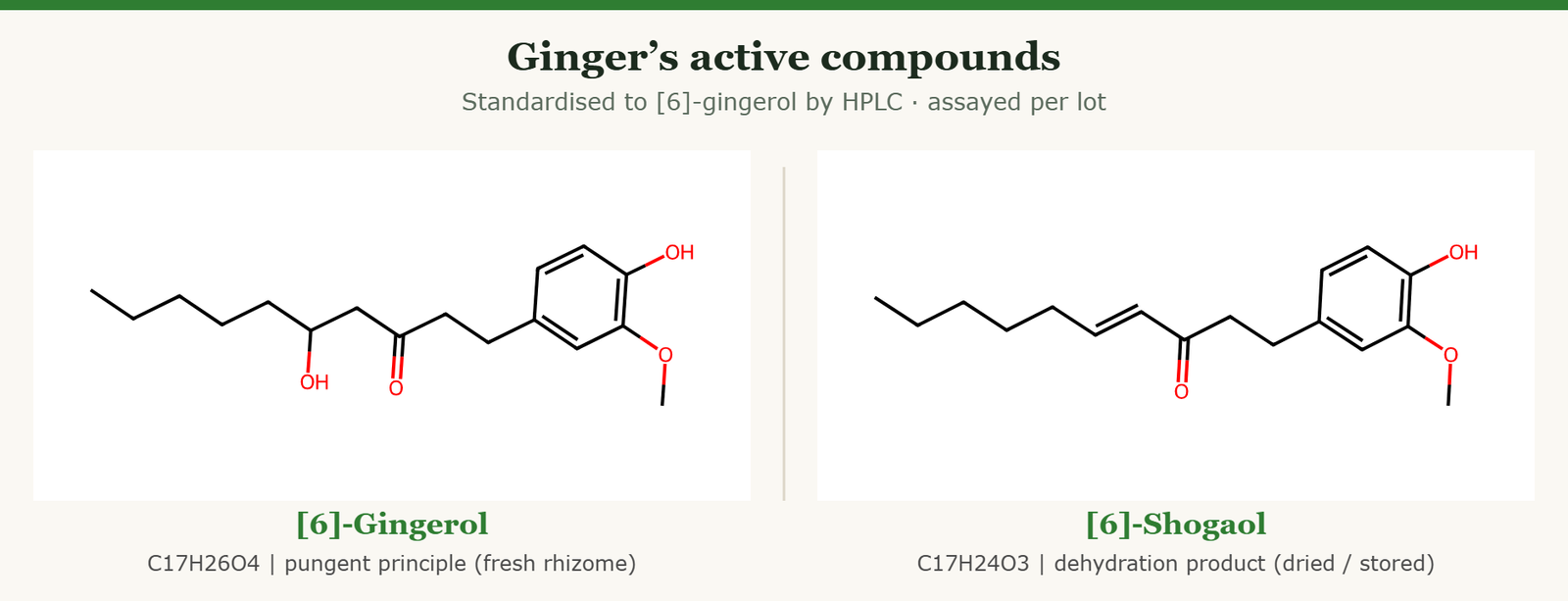
The pungent, bioactive phenolics of ginger are the gingerols and shogaols. 6-gingerol predominates in fresh and dried rhizome; on heating or drying, gingerols dehydrate to the more pungent 6-shogaol. Bionutricia standardises to not more than 1% 6-gingerol measured by HPLC, so 6-gingerol serves as the identity-and-consistency marker for every lot — a defined figure a brand owner can carry through to their finished product, rather than relying on undefined ground ginger.
How ginger works in the body (mechanism)
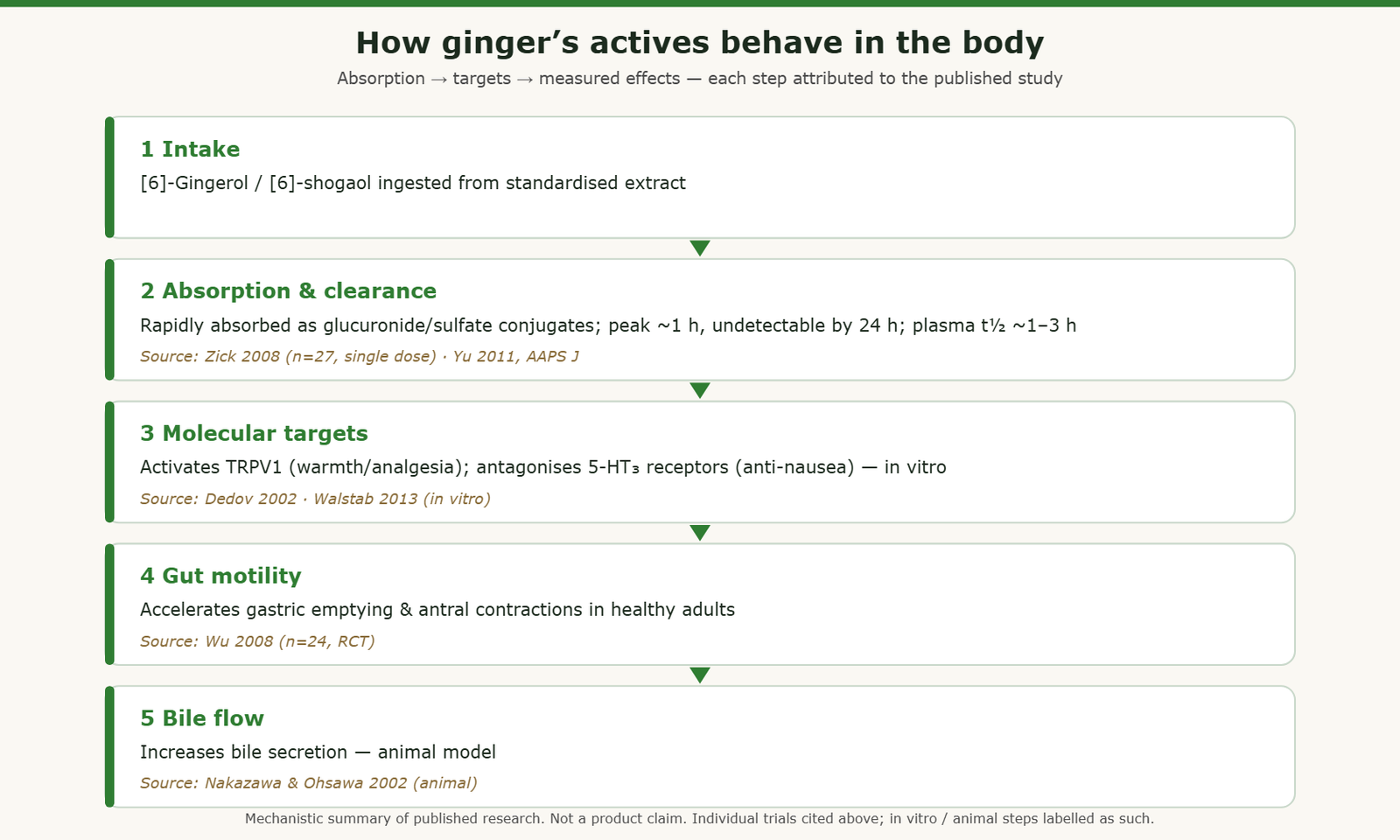
Ginger's marker phenolics are well characterised pharmacologically. 6-gingerol and 6-shogaol are agonists at the TRPV1 (transient receptor potential vanilloid-1) ion channel — the same warmth/pungency receptor engaged by capsaicin — which underlies ginger's warming sensory profile and contributes to its traditional digestive use. In the gastrointestinal tract ginger acts as a prokinetic, accelerating gastric emptying and antral motility, and its constituents show 5-HT₃ (serotonin) receptor antagonism — the same molecular target as several anti-nausea medicines — which is the mechanistic basis most often cited for ginger's effect on nausea. Gingerols also modulate the arachidonic-acid cascade (COX / LOX enzymes) and NF-κB signalling, the pathways behind the plant's long traditional use for comfort. Mechanism is provided as scientific background on the botanical; it is not a claim that this ingredient treats, cures or prevents any condition.
Clinical evidence on ginger
Ginger is one of the most studied culinary botanicals. The strongest evidence is at the meta-analysis level and is summarised below. These studies were conducted on ginger preparations (typically 0.5–2 g/day of dried ginger or defined extracts) by independent researchers; they are attributed to those studies and are provided as scientific context for formulators — not as performance claims for this ingredient.
| Area studied | Best available human evidence | Result (attributed to the study) |
|---|---|---|
| Post-operative nausea & vomiting | Meta-analysis, 5 RCTs, n=363 (Chaiyakunapruk 2006) | Nausea RR 0.69 (0.54–0.89); vomiting RR 0.61 (0.45–0.84) for ginger ≥1 g |
| Nausea in pregnancy | Systematic review & meta-analysis, ~12 RCTs (Viljoen 2014, Nutr J) | Ginger significantly improved nausea vs placebo; no increase in adverse events |
| Knee/hip osteoarthritis | Meta-analysis of RCTs, n≈593 (Bartels 2015, Osteoarthritis Cartilage) | Physical-function SMD −0.22 (−0.39 to −0.04, P=0.01); modest pain benefit; mild GI adverse events |
Effect sizes are modest and the trials used varying doses and preparations; results describe the botanical in research settings and are not extrapolated to any Bionutricia finished product.
Typical specification
| Parameter | Value |
|---|---|
| Botanical source / part | Zingiber officinale, rhizome |
| Extraction ratio | 100:1 |
| Appearance / colour | Free-flowing powder, light brown |
| Odour | Characteristic ginger |
| Standardisation marker | 6-gingerol, not more than 1% (HPLC) |
| Moisture | 2–8% |
| Solubility | Soluble in water |
| Particle size / mesh | > 95% through 60 mesh |
| Dosage | 200–1000 mg |
| Heavy metals (As, Pb, Cd, Hg) | As ≤ 1 ppm, Pb ≤ 2 ppm, Cd ≤ 1 ppm, Hg ≤ 0.05 ppm |
| Microbial (APC, Y&M, coliform, E. coli) | APC ≤ 10⁴ cfu/g, Y&M ≤ 10³ cfu/g, coliforms ≤ 10² cfu/g, E. coli absent |
| Certifications | JAKIM Halal, FSSC 22000, US FDA registered, GMP, HACCP, MeSTI |
| Shelf life | 24 months sealed, cool & dry |
| Pack sizes | 1 kg, 5 kg, 20 kg |
| Country of origin | Malaysia |
Full specification and a batch Certificate of Analysis are provided on request. Figures are typical values; confirm the current lot COA for release data.
Applications
As a water-soluble 100:1 concentrate dosed at 200–1000 mg, ginger extract powder blends into both powder and liquid systems. Bionutricia supplies the bulk ingredient for B2B formulation; brand owners and manufacturers formulate it into their chosen finished format — capsules, tablets, sachets and stick-packs, functional and instant beverages, teas, chews and gummies, bakery, confectionery and savoury systems — carrying ginger's characteristic warmth and a documented 6-gingerol level.
Why source ginger extract from Bionutricia?
Bionutricia Extract has manufactured standardized Malaysian botanical extracts since 2006 under a full halal and international food-safety stack (JAKIM Halal, FSSC 22000, US FDA registration, GMP, HACCP, MeSTI), issuing a Certificate of Analysis on every lot. Its enzymatic-and-ultrasonic extraction process is patented (MY-188945-A), concentrating ginger's natural flavour and marker phenolics — standardized to not more than 1% 6-gingerol — with no added colourants, fillers or preservatives. Bulk OEM, custom standardisation and spray-dry/packing are available. See the live ginger extract product page for ordering.
Frequently asked questions
Standardized to what / is a COA available? 100:1 extract of Zingiber officinale rhizome standardized to not more than 1% 6-gingerol by HPLC, moisture 2–8%; batch COA per lot.
Is it halal? Yes — JAKIM Halal certified; the facility is also FSSC 22000, US FDA-registered, GMP, HACCP and MeSTI. Halal documentation issued with each shipment.
Is it water-soluble? Yes — soluble in water; intended for mixing/blending into water, beverages and food systems, dosed 200–1000 mg.
What does the 6-gingerol figure mean? It is the marker used to verify identity and batch-to-batch consistency, so a brand can document a defined active level in the finished product.
What formats can I make? We supply the bulk ingredient; you formulate it into capsules, tablets, sachets, beverages, teas, chews, bakery or confectionery.
MOQ & lead time? Pack sizes 1 kg, 5 kg, 20 kg; pre-order packing ~1–2 weeks. MOQ & pricing on quotation.
Samples? Paid samples for serious B2B enquiries.
Storage & shelf life? Sealed, cool & dry, away from pests; 24 months when properly stored.