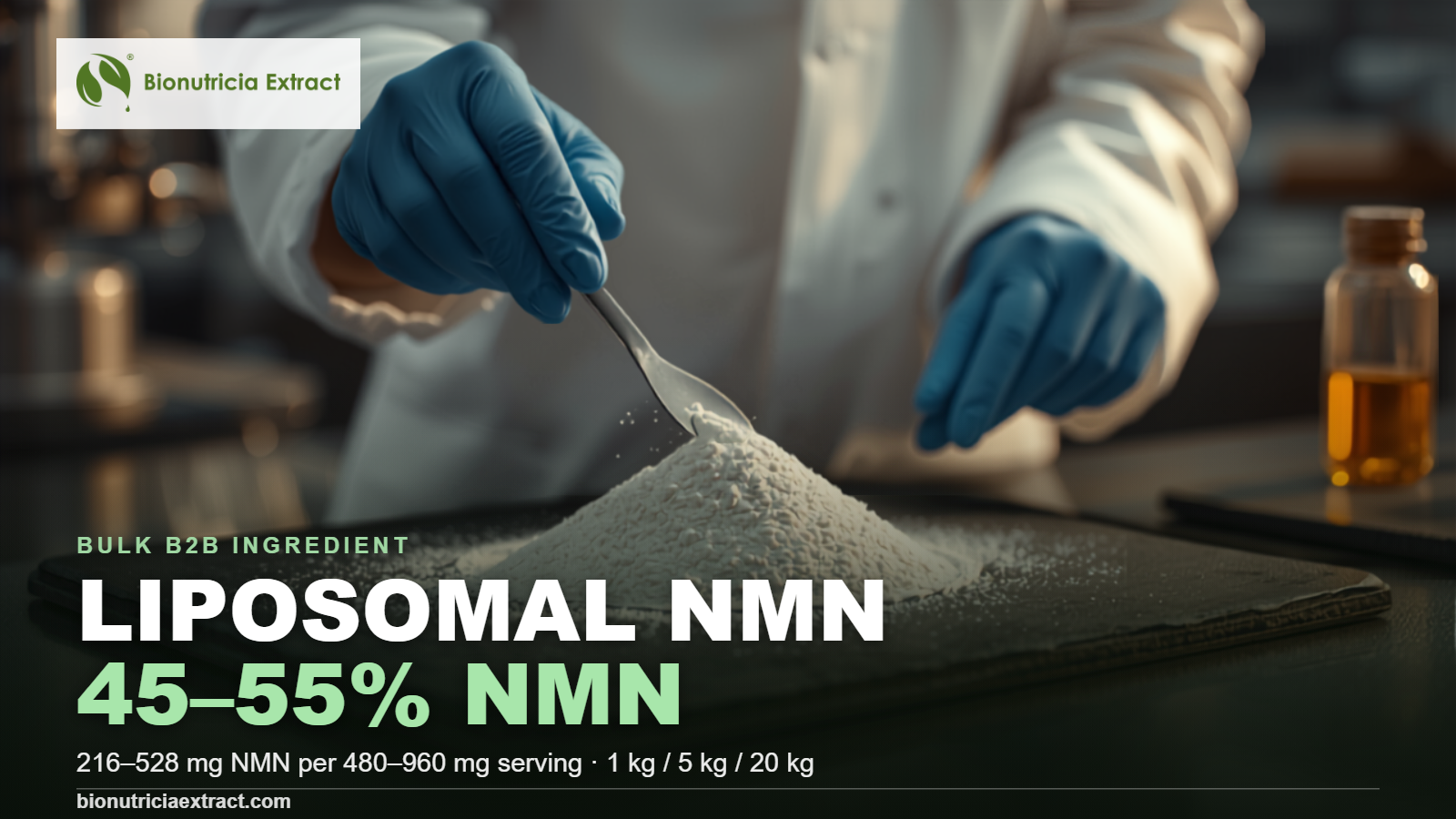
Liposomal NMN powder is a water-soluble β-nicotinamide mononucleotide ingredient standardised to 45–55% NMN and encapsulated in a phospholipid bilayer. Bionutricia manufactures it in Malaysia as a bulk B2B raw material at 1 kg, 5 kg and 20 kg. A 480–960 mg serving of the powder delivers roughly 216–528 mg of NMN — the range used in the published human trials.
Quick facts
- INCI / chemical name: β-Nicotinamide mononucleotide
- Assay: NMN 45–55%
- Form: White, non free-flowing powder; soluble in water
- Particle size: >95% passes 20 mesh
- Serving range on spec: 480–960 mg powder
- Pack sizes: 1 kg, 5 kg, 20 kg
- Shelf life: 2 years, properly stored
- Origin: Malaysia (Sungai Buloh, Selangor)
- Suitable for: vegetarians and vegans; non-GMO; not irradiated; gluten-free <20 ppm; no Annex II allergens
What is liposomal NMN powder?
β-Nicotinamide mononucleotide (NMN) is a nucleotide precursor in the salvage pathway that cells use to make nicotinamide adenine dinucleotide (NAD+), the coenzyme that carries electrons in energy metabolism. Interest in NMN as a supplement ingredient comes from a simple observation: tissue NAD+ concentrations decline with age, and NMN is one of the direct precursors the body can use to replenish them.
As a raw material, NMN is hygroscopic and physically awkward. It picks up moisture, it can cake in a blend, and it is unpleasant to dose accurately in an open powder line. Encapsulating it in a phospholipid bilayer addresses the handling problem first — the finished powder is free-flowing enough to blend, water-soluble, and far more stable in a sachet or stick pack than raw NMN salt.
Bionutricia manufactures the powder under the granted process patent MY-188945-A, Process for Preparing Nutritional Powder Extract, which covers the powder-preparation route rather than a botanical extraction step.
What is the active compound, and how is it assayed?
The active is β-nicotinamide mononucleotide itself — there is no botanical marker to argue about, which makes this one of the cleanest specifications in the catalogue. Bionutricia standardises the powder to NMN 45–55%, assayed by HPLC, with the figure for the lot you receive stated on the batch certificate of analysis.
That assay range is the number your formulation must be built on. Worked through:
| Powder serving | At 45% assay | At 55% assay |
|---|---|---|
| 480 mg | 216 mg NMN | 264 mg NMN |
| 720 mg | 324 mg NMN | 396 mg NMN |
| 960 mg | 432 mg NMN | 528 mg NMN |
Always formulate to the assayed lot value, not to the midpoint. A brand that dials in its label claim against 55% and then receives a 45% lot is 18% short on the finished product.
What does the human clinical evidence show?
NMN has an unusually large body of randomised, placebo-controlled human trials for a modern nutraceutical ingredient. The studies below are published findings attributed to their authors, conducted on the specific materials and doses stated. They are reported here so formulators can position a dose against the literature — not as claims for this ingredient.
| Study | Design & n | Dose | Reported outcome |
|---|---|---|---|
| Yi et al., GeroScience 2023 | Randomised, multicentre, double-blind, placebo-controlled, dose-ranging; n = 80 middle-aged healthy adults; 60 days | 300, 600, 900 mg/day | Blood NAD+ increased; efficacy on NAD+ and physical performance highest at 600 mg/day; safe and well tolerated to 900 mg/day |
| Igarashi et al., npj Aging 2022 | Placebo-controlled, randomised, double-blind, parallel-group; healthy older men; 6 and 12 weeks | 250 mg/day | Significantly raised whole-blood NAD+ and related metabolites; partial improvement in gait speed and grip strength |
| Liao et al., J Int Soc Sports Nutr 2021 | Randomised, double-blind; amateur runners; 6 weeks | 300, 600, 1200 mg/day | Dose-dependent increase in aerobic capacity alongside exercise training |
| Fukamizu et al., Sci Rep 2022 | Safety evaluation, healthy adult men and women | up to 1250 mg once daily, 4 weeks | No hepatotoxicity and no vasodilative flushing observed |
| Double-blind RCT, older adults, 2024 | Randomised, placebo-controlled | oral NMN | Raised blood NAD, maintained walking speed, improved reported sleep quality |
| Systematic review of RCTs, 2024 | Review of randomised controlled trials | — | Improvement in physical-performance parameters across the included trials |
The practical read for a formulator: the clinically studied window sits at roughly 250–600 mg NMN per day, with 600 mg the point at which the dose-ranging trial saw the strongest effect and no additional benefit at 900 mg. Our 480–960 mg powder serving lands inside that window at typical assay. Doses above roughly 1200 mg/day have been studied mainly for safety, not for added benefit.
Claims made on a finished product are determined by that product, its dose and its registration route in the destination market — not by this ingredient. Bionutricia supplies the bulk raw material.
How does liposomal delivery differ from plain NMN powder?
A liposome is a closed vesicle whose wall is a phospholipid bilayer — the same architecture as a cell membrane. Each phospholipid has a water-loving head and two water-fearing tails; in water they self-assemble tails-inward, forming a sphere with an aqueous core. A water-soluble molecule such as NMN sits in that core, shielded from moisture, oxygen and the gastric environment until the vesicle is broken down.
Cross-section of a liposome: a phospholipid bilayer enclosing an aqueous core carrying the NMN payload.
For a bulk buyer the encapsulation matters for three practical reasons, in this order of commercial importance:
- Handling and stability. Raw NMN is hygroscopic. The encapsulated powder blends, doses and stores far more predictably in sachets, stick packs and beverage premixes.
- Taste and odour masking. The bilayer moderates the characteristic taste, which matters in any format the consumer actually tastes.
- Delivery. Liposomal delivery is widely researched as a route to protect a payload through the gastric environment. Any specific bioavailability figure must come from a study on the finished product, so we do not publish one for this material.
Related reading: What is Herbosomal® encapsulation? — Bionutricia’s registered-trademark encapsulation and sustained-release technology (patent-pending, PI2023005773).
Liposomal NMN specification
| Parameter | Specification |
|---|---|
| Product name | Liposomal NMN |
| Constituent | Phyto-nutrient |
| Form | Powder |
| Colour | White |
| Appearance | Non free-flowing powder |
| Odour | Characteristic |
| NMN assay | 45–55% |
| Moisture content | < 10% |
| pH value | 6 – 7 |
| Solubility | Soluble in water |
| Particle size | >95% passes 20 mesh |
| Serving range | 480 – 960 mg |
| Arsenic | < 0.1 ppm |
| Lead | < 0.2 ppm |
| Mercury | < 0.05 ppm |
| Cadmium | < 0.5 ppm |
| Antimony | < 0.5 ppm |
| Aerobic plate count | < 104 CFU/g |
| Yeast and mould | < 103 CFU/g |
| Coliforms | < 102 CFU/g |
| Escherichia coli | Absent (1 g) |
| Staphylococcus aureus | Absent (1 g) |
| Pack sizes | 1 kg, 5 kg, 20 kg |
| Shelf life | 2 years when properly stored |
| Country of origin | Malaysia |
Storage: sealed hygienic containers, cool and dry, away from pest infestation. The powder can be consumed directly or dispersed in water with constant stirring.
Applications in finished formats
Bionutricia supplies the bulk ingredient for B2B formulation; brand owners and manufacturers formulate it into their chosen finished format. Because the powder is water-soluble and blends predictably, it suits:
- Sachets and stick packs — the most common NMN format, and the one that benefits most from the stability improvement
- Effervescent and instant beverage premixes
- Capsules and tablets made by the customer
- Gummies and soft chews, where taste masking matters
- Functional shots and RTD beverages
Regulatory status a buyer must know before ordering
NMN’s regulatory position moved recently, and it moved in the industry’s favour — but not to a free pass.
United States. The FDA had, since 2022, taken the position that NMN was excluded from the dietary-supplement definition. In late 2025 the agency reversed that position, concluding on the “race to market” provision that NMN had been marketed as a dietary supplement before it was authorised for drug investigation. NMN is therefore lawful for use in US dietary supplements again. It remains a New Dietary Ingredient, so a marketer must still satisfy NDI premarket notification — typically by filing an NDIN, or by sourcing from a supplier covered by an existing notification. Verify the current position with your own regulatory counsel before you build a US launch on it.
Malaysia and other markets. Classification and permissible claims are decided at your finished product, by its dose, format and registration route — not by the bulk ingredient. We are happy to supply the documentation your regulatory team needs to make that assessment.
Halal. Bionutricia holds JAKIM halal certification, and this ingredient is halal certified. The halal certificate is supplied with your documentation pack on request.
Certifications and documentation
Bionutricia manufactures under FSSC 22000, GMP, HACCP, MeSTI, holds US FDA facility registration, and is NanoVerify certified. The facility and this ingredient are JAKIM halal certified. Documentation available on request: product specification, batch certificate of analysis, MSDS, GMO and allergen statements, and a flow chart under NDA.
Declarations on the current specification: non-GMO; not irradiated; not a novel food under Regulation (EC) No 258/97; suitable for vegetarians and vegans, free of animal products and derivatives; gluten-free (<20 ppm) under Regulation (EC) No 41/2009; no Annex II allergens under Regulation (EC) No 1169/2011. Not classified as dangerous under Regulation (EC) 1272/2008 (CLP).
Sourcing, pack sizes and how to order
Manufactured in Sungai Buloh, Selangor and exported through Port Klang. Available in 1 kg, 5 kg and 20 kg. MOQ and pricing on quotation. Request the current specification and batch CoA with your enquiry — formulate to the assayed lot value, not to the midpoint of the range.
Frequently asked questions
Q: What is the NMN content of your liposomal NMN powder?
A: The powder is standardised to 45–55% NMN, assayed by HPLC, with the exact figure for your lot stated on the batch certificate of analysis.
Q: How much powder delivers a clinically studied NMN dose?
A: The published trials cluster at roughly 250–600 mg NMN per day. At 45–55% assay, a 480–960 mg serving of the powder delivers about 216–528 mg NMN. Calculate against your actual lot assay.
Q: Is liposomal NMN more bioavailable than plain NMN?
A: Liposomal delivery is widely researched as a way to protect a payload through the gastric environment, and the encapsulation measurably improves handling, stability and taste. We do not publish a bioavailability multiplier for this material, because a credible figure has to come from a study on the finished product, not on the raw ingredient.
Q: Is NMN legal to sell in the United States?
A: As of the FDA’s late-2025 reversal, NMN is lawful for use in US dietary supplements. It remains a New Dietary Ingredient, so NDI premarket notification requirements still apply. Confirm the current position with your regulatory counsel.
Q: Is this product halal certified?
A: Yes. Bionutricia is a JAKIM-certified manufacturer and this ingredient is halal certified. The certificate is included in the documentation pack on request.
Q: Is it suitable for vegans?
A: Yes. The specification states the product is suitable for vegetarians and vegans and is free of any animal products or derivatives.
Q: What pack sizes and MOQ do you offer?
A: 1 kg, 5 kg and 20 kg. MOQ and pricing on quotation.
Q: How should it be stored, and what is the shelf life?
A: Two years properly stored — sealed hygienic containers, cool and dry, away from pest infestation. Because NMN is hygroscopic, reseal part-used containers promptly.
Related guides
- What is Herbosomal® encapsulation?
- Liposomal Vitamin C powder — bulk ingredient guide
- Liposomal B-Complex powder — bulk ingredient guide
Technically reviewed by Dr Yong Yi Yi, Operation Manager, PhD Food Science & Technology (Microbiology & Chemistry), Monash University. Published by Bionutricia Manufacturing Sdn Bhd, founded 2006 by Ts. Ng Kuak Ping.