Nanoemulsion vs Liposomal Encapsulation: Which Delivery System for Your Actives?
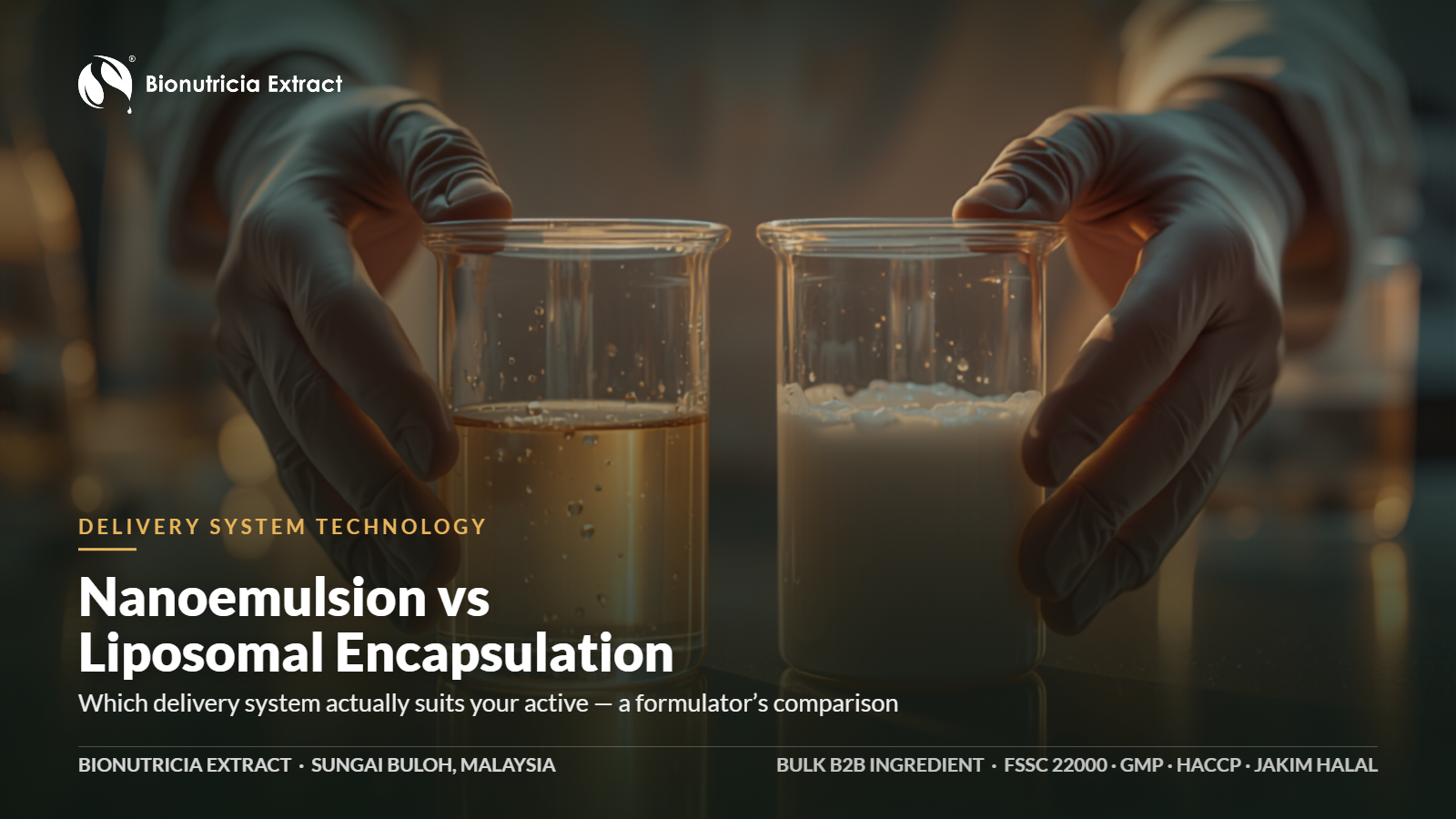
The short answer: choose by where the active has to sit. A nanoemulsion is an oil droplet with a single surfactant boundary, so it carries oil-soluble actives in its core. A liposome is a phospholipid bilayer vesicle enclosing a watery centre, so it can carry water-soluble actives inside and oil-soluble actives within the membrane itself. Nanoemulsions are cheaper and simpler to make; liposomes are more versatile and more demanding to verify. If your active is water-soluble, the decision is already made for you.
What is a nanoemulsion?
A nanoemulsion is an emulsion whose droplets have been reduced to the nanometre range, typically somewhere between 20 and 200 nm, by high-shear or high-pressure homogenisation. Structurally it is very simple: a core of oil, a shell of surfactant molecules, and a continuous water phase around it. The surfactant sits at the interface with its water-liking head outward and its oil-liking tail inward, which is what stops the droplets from coalescing back into a separate oil layer.
Because the droplets are so small, a nanoemulsion is usually translucent rather than milky, scatters little light, and resists creaming and sedimentation far better than a conventional emulsion. For a beverage formulator that matters commercially — it means an oil-soluble ingredient can go into a clear drink without turning it cloudy.
The limitation is structural, not technical. There is only one compartment, and it is oily. A nanoemulsion has nowhere to put a water-soluble active.
What is a liposome?
A liposome is built differently. Phospholipids in water spontaneously arrange themselves into a bilayer — two sheets of molecules tail-to-tail, water-liking heads facing outward on both sides. That bilayer closes into a sphere, and the result is a vesicle with two distinct environments: a watery interior enclosed by the membrane, and the oily interior of the bilayer itself.
That dual architecture is the whole point. A liposome does not force you to choose a solubility class. It is also the same basic architecture as a biological membrane, which is why phospholipid vesicles have been studied as delivery systems for decades across pharmaceutical, cosmetic and nutritional applications.
Side by side
| Consideration | Nanoemulsion | Liposome |
|---|---|---|
| Structure | Oil core + single surfactant layer | Phospholipid bilayer vesicle + aqueous core |
| Carries water-soluble actives | No | Yes — in the aqueous core |
| Carries oil-soluble actives | Yes — in the oil core | Yes — within the bilayer |
| Typical particle size | ~20–200 nm | ~50–500 nm depending on process |
| Key raw material | Carrier oil + surfactant | Phospholipid (e.g. sunflower-derived lecithin) |
| Processing | High-shear / high-pressure homogenisation | Controlled vesicle formation, often ultrasonic or microfluidic |
| Relative cost | Lower | Higher — material and process |
| Clarity in beverages | Often translucent | Usually slightly hazy |
| Critical QC parameter | Droplet size & distribution | Encapsulation efficiency, size, PDI, zeta potential |
| Main failure mode | Ostwald ripening, phase separation | Vesicle fusion, leakage of payload, oxidation of phospholipid |
How to choose — a decision path
1. Start with the solubility of the active
This single question eliminates most of the debate. Vitamin C, B vitamins, amino acids, minerals and many botanical glycosides are water-soluble; they need an aqueous compartment, so a nanoemulsion is structurally the wrong tool. Carotenoids, tocotrienols, CoQ10, curcuminoids and essential-oil actives are oil-soluble and will sit happily in either system.
2. Then look at the finished format
A clear ready-to-drink beverage puts a premium on optical clarity, which favours a well-made nanoemulsion. A powdered sachet, a capsule or a gummy does not care about clarity at all, which removes one of the nanoemulsion’s advantages and lets the decision fall back to solubility and stability.
3. Then look at what you can actually verify
This is where buyers get caught. “Liposomal” is an unregulated marketing word, and a great deal of material sold under it has never been shown to encapsulate anything. Insist on encapsulation efficiency as a tested, per-lot parameter, alongside particle size, polydispersity index and zeta potential. If a supplier cannot produce those numbers or explain the method behind them, you are buying a claim rather than a technology.
4. Then look at cost in context
Liposomal systems cost more per kilo of ingredient. Whether that matters depends on inclusion rate and on what the delivery system is doing for the finished product’s positioning. A cheaper system that cannot carry your active is not cheaper.
Where Herbosomal® fits
Herbosomal® is Bionutricia’s registered trademark for its liposomal encapsulation and sustained-release technology, which is patent-pending under PI2023005773. It applies the liposomal principle — the bilayer vesicle described above — across a defined range of nutrients and botanical actives, and is manufactured in Malaysia under FSSC 22000, GMP, HACCP, MeSTI and US FDA registration.
Two things are worth being precise about, because the industry is loose with both. First, Herbosomal® is patent-pending, not patented; Bionutricia’s granted patent, MY-188945-A, covers a different thing entirely — the enzymatic and ultrasonic extraction and powder-preparation process. Second, a brand name is not evidence of encapsulation. The same QC questions in section 3 above apply to Herbosomal® material as to anyone else’s, and the answers should come on a Certificate of Analysis. If you want the longer explanation of the technology, start with our pillar guide: What is Herbosomal® encapsulation?
The question most buyers forget to ask
Neither system is inherently better. What separates a good ingredient from a bad one is far more often the discipline around it than the choice of architecture: whether the particle size is measured on every lot or once a year, whether the phospholipid source is documented, whether the material has been stability-tested in a matrix resembling yours rather than in a beaker, and whether the supplier will put the numbers on paper. Ask about the QC regime before you ask about the technology — it tells you more.
Frequently asked questions
What is the difference between a nanoemulsion and a liposome? A nanoemulsion is an oil droplet with a single surfactant boundary. A liposome is a phospholipid bilayer vesicle — the same architecture as a cell membrane — enclosing a watery interior. The liposome therefore has two carrying environments; the nanoemulsion has one, and it is oily.
Which should I choose for a water-soluble active? Liposomal. A nanoemulsion’s core is oil, so there is physically nowhere for vitamin C, a B vitamin, an amino acid or a mineral to sit.
Which is cheaper to manufacture? Nanoemulsions, generally — they need only homogenisation of oil, water and surfactant. Liposomes need phospholipid raw material and controlled vesicle formation. But the real question is which one suits your active.
How do I verify a liposomal ingredient is genuinely liposomal? Ask for encapsulation efficiency, particle size, polydispersity index and zeta potential — per lot, with the method stated. No encapsulation-efficiency figure means nothing has been shown to be encapsulated.
What is Herbosomal®? Bionutricia’s registered trademark for its liposomal encapsulation and sustained-release technology, patent-pending under PI2023005773, made in Malaysia under FSSC 22000, GMP, HACCP, MeSTI and US FDA registration.