Reviewed by Cindy Chua Shiu Sinn, Dietitian, Bionutricia
A botanical extract is not automatically vegan. The plant is only the starting point — animal-derived material commonly enters through the emulsifier, the carrier, the vitamin form or the capsule shell. Two choices decide most of it: whether an oil powder is emulsified on a milk protein or on arabic gum, and whether the vitamin D3 in a formulation comes from sheep wool or from lichen. This guide shows where animal inputs hide in a supplement supply chain and what evidence to ask for.
Quick facts
- Usual hidden inputs: caseinate emulsifiers, gelatin, lanolin-derived D3, carmine, shellac, bone-char-refined sugar
- Our emulsifier: arabic gum on every oil powder — never sodium caseinate, never a synthetic emulsifier
- Our vitamin D3: lichen-derived, not lanolin — potency >250,000 IU/g
- Overlap: animal-free inputs also simplify halal and vegetarian review
- Evidence: origin declaration per ingredient plus a batch-specific Certificate of Analysis
What makes an ingredient genuinely animal-free?
Buyers tend to assess vegan status at the level of the named ingredient — green tea extract, coconut water powder, vitamin D3 — when the question that actually matters is what else went into making that ingredient a stable, usable powder. A plant extract can pass through three or four processing decisions on its way to a drum, and any of them can introduce animal material without changing the ingredient’s name.
A genuinely animal-free ingredient means no animal-derived material in the active, the carrier, the emulsifier, the flow aid, the coating, the colour or the processing aids — and documentation that says so for each. It is a supply-chain statement, not a botanical one.
Where animal-derived material usually hides
- Emulsifiers in oil powders. Sodium caseinate, the industry default for converting oils into powders, is a milk protein. It is the most common reason a plant oil powder is not vegan — and because it appears only as “emulsifier” on many specification sheets, it is the easiest to miss.
- Vitamin D3. The overwhelming majority of the world’s cholecalciferol is made from lanolin, the grease recovered from sheep wool. It is animal-derived, and it is present in a very large number of products marketed as plant-based.
- Capsule shells. Standard hard capsules are gelatin, from bovine or porcine collagen. This is a finished-format decision rather than an ingredient one, but it undoes an otherwise vegan formulation.
- Colours and glazes. Carmine is derived from insects; shellac, used as a tablet glaze, is an insect resin.
- Proteins and peptides. Collagen, whey, casein and egg-derived proteins are all animal proteins, however they are presented on a label.
- Processing aids and refined inputs. Some refined sugars are decolourised over bone char, and certain enzymes and clarifying agents are animal-derived. These leave no material in the finished product but still matter to a strict vegan certification.
Arabic gum instead of caseinate
Every oil powder Bionutricia manufactures is emulsified on arabic gum, the dried exudate of Acacia species. We do not use sodium caseinate and we do not use synthetic emulsifiers. That is a deliberate choice rather than a default, and it is what allows our oil-powder range — black seed oil powder, tocotrienol, virgin coconut oil powder, MCT oil powder, sacha inchi oil powder, carotene oil powder — to be positioned as vegan-suitable and dairy-free.
The technical trade-off is worth being honest about: arabic gum is more expensive than caseinate and requires a properly designed emulsion to perform. What the brand owner gets in return is an ingredient with no milk allergen declaration, no animal-origin question at halal review, and a carrier that is itself a recognised soluble dietary fibre at 90% or more total dietary fibre.
Lichen-derived vitamin D3 instead of lanolin
Vitamin D3 is where most plant-based formulations quietly break. Cholecalciferol has historically been made by irradiating 7-dehydrocholesterol recovered from lanolin, and lanolin comes from sheep. Vitamin D2 from yeast is the usual vegan substitute, but D2 and D3 are not equivalent forms, so many brands accept an animal-derived D3 rather than switch.
Our vitamin D3 is lichen-derived. Lichen is a symbiotic organism of fungus and alga that produces the same cholecalciferol, with no animal input at any point. The practical differences for a formulator:
| Conventional D3 | Bionutricia D3 | |
|---|---|---|
| Origin | Lanolin (sheep wool grease) | Lichen |
| Vegan-suitable | No | Yes |
| Vitamer | Cholecalciferol (D3) | Cholecalciferol (D3) |
| Animal-origin review at export | Additional documentation | Not applicable |
| Potency | Varies by grade | >250,000 IU/g |
Because it is the same vitamer, no reformulation of the D3 contribution is required — the origin changes, the chemistry does not.
Vegan, halal and vegetarian: where they overlap
These three review pathways ask different questions but stumble over the same inputs. Halal certification scrutinises animal-derived material for species and slaughter method; vegetarian standards exclude slaughter-derived material; vegan standards exclude all animal derivation including milk, eggs and insect products. An ingredient built without any animal input satisfies the animal-origin question in all three at once, which removes a substantial documentation burden at export.
Our facility holds JAKIM Halal certification, and animal-free formulation is one reason halal review of our ingredients is straightforward. For a fuller treatment of halal documentation for export markets, see the GCC guide linked below.
How to verify a vegan claim from a supplier
Ask for five things:
- An origin declaration for every component of the ingredient — active, carrier, emulsifier and any processing aid — each stated as plant, mineral, microbial or animal.
- The emulsifier named explicitly. “Emulsifier” or “proprietary carrier system” is not an answer. If it cannot be named, treat the vegan status as unresolved.
- The vitamin form and its origin where vitamins are involved — particularly D3, where lanolin is the default unless stated otherwise.
- Cross-contact controls on shared equipment, since a vegan claim on the finished pack has to survive the whole line, not just the recipe.
- A batch-specific Certificate of Analysis, so the claim attaches to the lot you are actually buying.
A supplier who can answer the first three in a single email is telling you something useful about how well they know their own supply chain.
How Bionutricia approaches animal-free formulation
Bionutricia is a Malaysian botanical-extract manufacturer founded in 2006, with more than 20 years of R&D and 15 years of manufacturing behind a catalogue serving 239+ brand partners. Extraction runs on our patented enzymatic and ultrasonic process, MY-188945-A (“Process for Preparing Nutritional Powder Extract”), inside a system certified to FSSC 22000, with GMP, HACCP, JAKIM Halal, US FDA registration, MeSTI and NanoVerify.
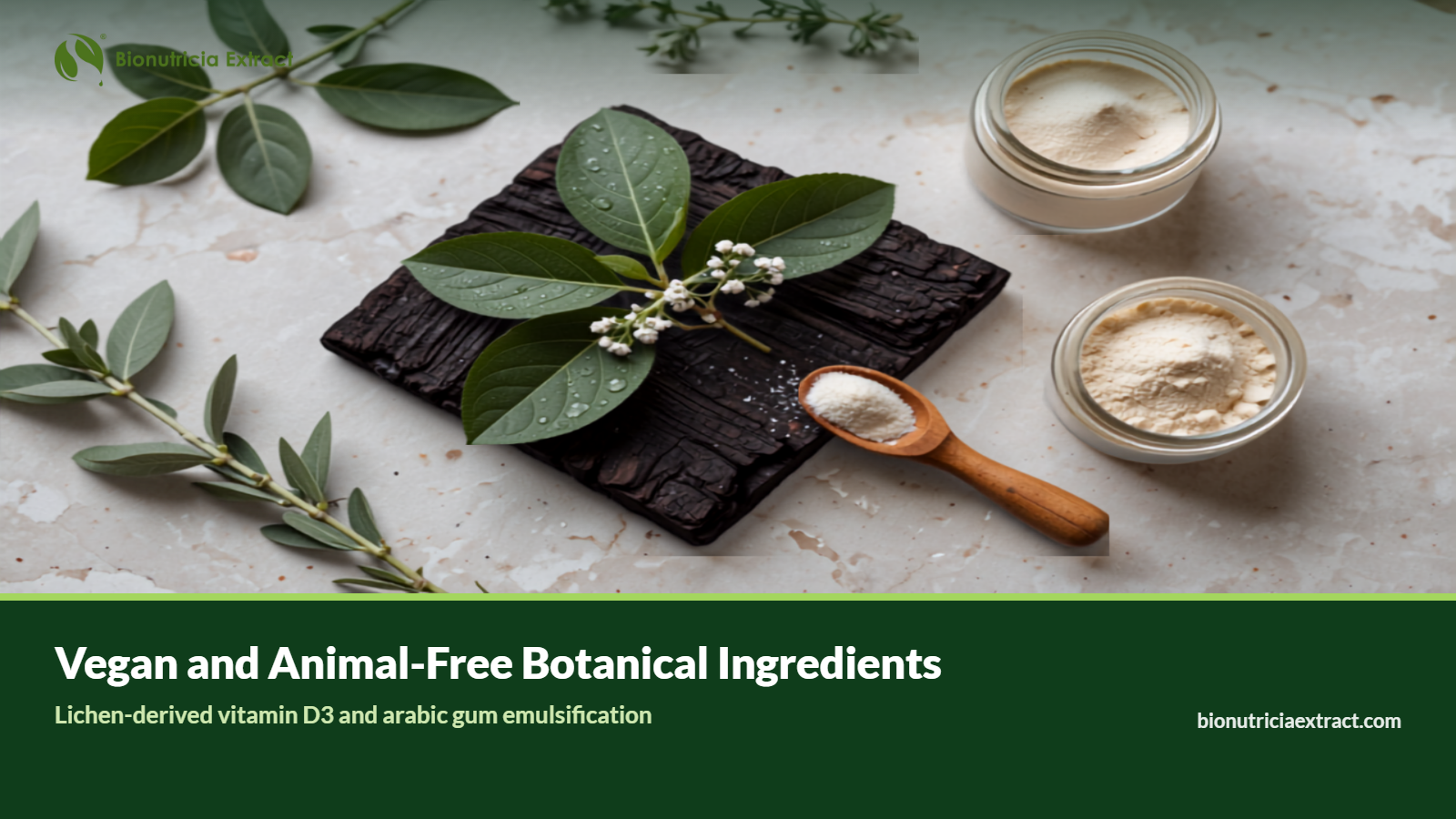
Arabic-gum emulsification across the oil-powder range and lichen-derived vitamin D3 are the two clearest expressions of an animal-free default. Bulk packs are 1 kg, 5 kg and 20 kg, each shipped with a batch-specific Certificate of Analysis and the origin documentation for the ingredient. We supply the bulk ingredient for B2B formulation; brand owners and manufacturers formulate it into their chosen finished format — and where a fully vegan finished product is the goal, the capsule shell or tablet glaze is the last decision to check, since that one sits on your side of the line.
Need origin declarations for a plant-based formulation?
Related guides
Frequently asked questions
Are botanical extracts automatically vegan?
No. The plant material is only part of the ingredient. Emulsifiers, carriers, colours, glazes and processing aids can all be animal-derived, so vegan status depends on the whole formulation of the ingredient, not on the botanical name.
Is vitamin D3 vegan?
Usually not. Most commercial D3 is made from lanolin, which comes from sheep wool. Lichen-derived D3 is the same cholecalciferol produced without any animal input, which is the form Bionutricia supplies at a potency of more than 250,000 IU per gram.
Why is sodium caseinate a problem for vegan products?
Sodium caseinate is a milk protein used to emulsify oils into powders. It makes the ingredient non-vegan and non-dairy-free, and it triggers a milk allergen declaration on the finished product. Bionutricia uses arabic gum instead across the whole oil-powder range.
Does vegan-suitable also mean halal?
Not by itself — halal certification covers more than animal origin. But an ingredient with no animal-derived material removes the animal-origin question from halal, vegetarian and vegan review at the same time, which simplifies documentation. Our facility holds JAKIM Halal certification.
What should I ask a supplier to prove a vegan claim?
An origin declaration for every component including the emulsifier named explicitly, the vitamin form and its origin, the cross-contact position on shared equipment, and a batch-specific Certificate of Analysis for the lot being supplied.