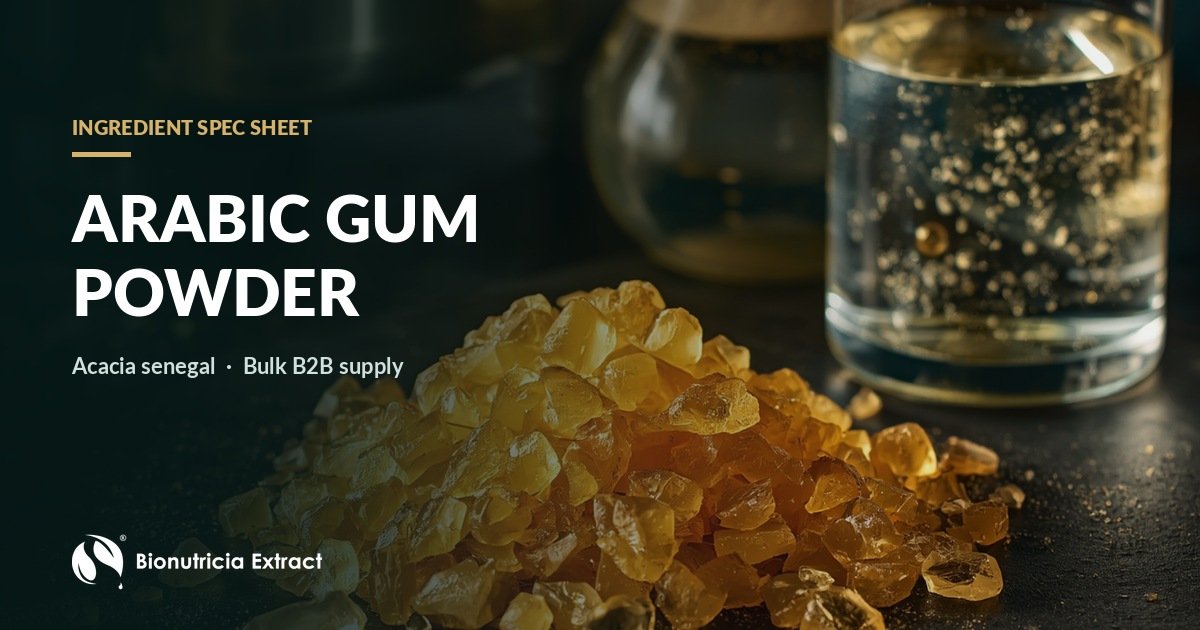
Arabic Gum Powder (Acacia senegal) — Bulk B2B Supplier
Arabic gum powder — also known as acacia gum — is a natural hydrocolloid produced from the hardened sap of the acacia tree, purified and instantised by spray drying into a free-flowing, cold-water-soluble powder. It is specified at ≥ 90% total dietary fibre and is used as an emulsifier, stabiliser and soluble-fibre ingredient, performing in low-pH systems where many hydrocolloids fail. Supplied in bulk from Malaysia by Bionutricia Extract under JAKIM Halal, FSSC 22000, US FDA registration, GMP, HACCP and MeSTI, with a Certificate of Analysis on every lot.
Quick facts for formulators
- Source: hardened sap (exudate) of the acacia tree
- Constituent class: phyto-nutrient — natural hydrocolloid (arabinogalactan polysaccharide + glycoprotein)
- Function: emulsifier · stabiliser · soluble dietary fibre
- Total dietary fibre: ≥ 90% — predominantly soluble fibre
- Process: purified and instantised by spray drying
- Form / colour / odour: free-flowing powder, light yellow to white, characteristic odour
- Solubility: soluble in water — forms a viscous solution
- Moisture: < 8% · pH: 4–5 · Dosage: 1–5% · Particle: >85% / 60 mesh
- Low-pH stable — suitable for acidic beverage and drink-base systems
- Pack sizes: 1 kg · 5 kg · 20 kg
- Certifications: JAKIM Halal · FSSC 22000 · US FDA registered · GMP · HACCP · MeSTI · COA per lot
- Clean label: vegan, non-GMO, gluten-free (<20 ppm), not irradiated, not a novel food, no listed allergens
- Heavy metals: As <0.1 · Pb <0.2 · Hg <0.05 ppm · Microbial: within limits
- Shelf life: 24 months sealed, cool & dry · Origin: Malaysia
What is Arabic gum powder?
Arabic gum — variously called acacia gum, gum acacia, Senegal gum or Indian gum — is a natural gum consisting of the hardened sap of the acacia tree. Chemically it is a combination of arabinogalactan-type polysaccharides and glycoproteins, built largely from the sugars arabinose and galactose. That unusual structure is what gives it its defining technical property: a highly branched polysaccharide backbone attached to a protein fraction, so a single molecule can anchor into both the oil phase and the water phase of an emulsion at once.
Bionutricia’s grade is produced from raw acacia gum, which is purified and instantised by spray drying into a light-yellow-to-white, free-flowing powder. Because it is instantised, it wets out and dissolves in water to form a viscous solution rather than clumping — a practical difference from milled raw gum, which formulators generally find slow and awkward to hydrate.
What is Arabic gum used for in formulation?
Arabic gum is one of the workhorse hydrocolloids of the food industry, and it is chosen for three distinct jobs.
1. Emulsification. Its protein–polysaccharide structure lets it stabilise the fat/water interface, which is why it is a standard choice for beverage emulsions, flavour emulsions and drink bases. In pastry work it is used in fillings and frostings for the same reason.
2. Stabilising, texture and finish. It contributes body, a clean mouthfeel and a smooth texture across confectionery, ice cream, jelly, jam, pudding, desserts and dressings, and it is traditionally applied to baked goods such as gingerbread to give a glossy, tacky shine.
3. Soluble dietary fibre. At ≥ 90% total dietary fibre — almost all of it soluble — Arabic gum is one of the most concentrated soluble-fibre ingredients a formulator can reach for, and unlike many fibres it adds neither grittiness nor significant viscosity at typical inclusion rates. That combination is why it is a standard choice for fibre-fortified beverages, drink mixes and functional-food formats. Brand owners positioning a finished product on fibre content should confirm the assayed value on the batch Certificate of Analysis and the claim wording permitted in their destination market.
It is dosed at 1–5% of total weight, adjusted to the target format. A particular advantage worth flagging to formulators: it can be used in low-pH products, which is exactly where many competing hydrocolloids lose their functionality.
Typical specification
| Parameter | Value |
|---|---|
| Source | Hardened sap (exudate) of the acacia tree |
| Constituent class | Phyto-nutrient — natural hydrocolloid (arabinogalactan polysaccharide + glycoprotein) |
| Process | Purified and instantised by spray drying |
| Function | Emulsifier, stabiliser, soluble dietary fibre |
| Certifications | JAKIM Halal, FSSC 22000, US FDA registered, GMP, HACCP, MeSTI |
| Appearance / colour | Free-flowing powder, light yellow to white |
| Odour | Characteristic |
| Solubility in water | Soluble — forms a viscous solution |
| Moisture | < 8% |
| pH | 4–5 |
| Particle size / mesh | > 85% through 60 mesh |
| Dosage | 1–5% |
| Total dietary fibre | ≥ 90% (predominantly soluble; assayed value per lot stated on the COA) |
| Heavy metals (As, Pb, Hg) | As < 0.1 ppm, Pb < 0.2 ppm, Hg < 0.05 ppm |
| Microbial (APC, Y&M, coliform, E. coli) | APC < 10⁴ cfu/g, Y&M < 10³ cfu/g, coliforms < 10² cfu/g, E. coli absent |
| Clean label | Vegan, non-GMO, gluten-free (<20 ppm), not irradiated, not a novel food, no listed allergens |
| Shelf life | 24 months sealed, cool & dry |
| Pack sizes | 1 kg, 5 kg, 20 kg |
| Country of origin | Malaysia |
A Certificate of Analysis is issued with every production lot. Safety Data Sheet available on request.
Why source Arabic gum powder from Bionutricia?
Arabic gum is a commodity in name only — grades vary widely in purity, solubility and emulsifying performance, and many powders on the market are cut with carriers that quietly dilute the functionality a formulator is paying for. Bionutricia Extract has manufactured standardised botanical and phyto-nutrient ingredients in Malaysia since 2006 under a full halal and international food-safety stack — JAKIM Halal, FSSC 22000, US FDA registered, GMP, HACCP and MeSTI — and issues a Certificate of Analysis on every lot.
For GCC, MENA and Muslim-majority markets, where Arabic gum is a staple of both the food industry and the traditional kitchen, a JAKIM-certified acacia gum with full export documentation removes a significant sourcing obstacle in one step. Bulk OEM supply, private-label manufacturing and custom packing are available, and paid samples can be arranged for serious B2B enquiries.
Powder preparation runs on Bionutricia’s granted Malaysian process patent — MY-188945-A, “Process for Preparing Nutritional Powder Extract” — the same patented platform used across its nutritional powder range.
Frequently asked questions
What is Arabic gum powder? A natural hydrocolloid made from the hardened sap of the acacia tree, purified and instantised by spray drying into a free-flowing, cold-water-soluble powder. Also called acacia gum, gum acacia or Senegal gum.
What is it used for? Emulsifier, stabiliser and soluble dietary fibre — in beverages and beverage emulsions, confectionery, bakery fillings and glazes, ice cream, jelly, jam, desserts, dressings and supplement premixes. Dosed at 1–5%.
Is it soluble in cold water? Yes — it is instantised, so it wets out and dissolves to a viscous solution. Particle size >85% through 60 mesh.
Is it stable at low pH? Yes — it can be used in low-pH products, which is a key advantage for acidic beverage systems. Powder pH is 4–5.
How much dietary fibre does it contain? Specified at ≥ 90% total dietary fibre, predominantly soluble — one of the most concentrated soluble-fibre ingredients available. Assayed value per lot on the batch COA.
Is it halal certified? Yes — Arabic Gum is covered by Bionutricia’s JAKIM Halal certification, alongside FSSC 22000, US FDA registration, GMP, HACCP and MeSTI.
Clean label? Vegan, non-GMO, gluten-free (<20 ppm), not irradiated, not a novel food; no allergens listed in Annex II of Regulation (EC) No 1169/2011.
Pack sizes, MOQ & lead time? 1 kg · 5 kg · 20 kg; freshly made pre-order packing ~1–2 weeks; bulk MOQ & tiered pricing on quotation.
Do you offer OEM / private label and samples? Yes — bulk supply, custom packing and OEM/private-label manufacturing; paid samples for serious B2B enquiries.