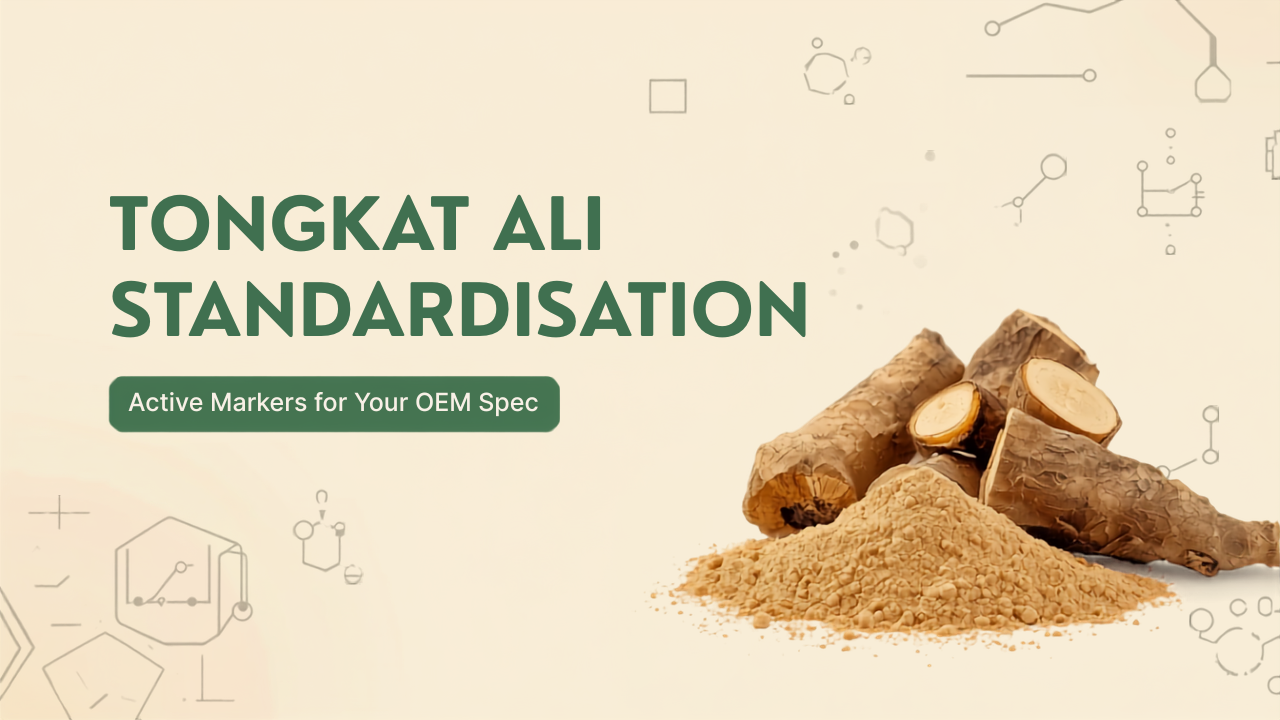
Tongkat Ali (Eurycoma longifolia) is the single most-asked-about botanical in our RFQ inbox. Brand-side R&D teams know they want it for their men’s-wellness or sports-recovery SKU, but most spec sheets we receive are vague on the most important question of all: which active marker should the manufacturer guarantee?
This guide walks through the four most-used active markers, when each one is the right choice, and the manufacturing implications of asking for each.
The four active markers in commercial use
1. Eurycomanone (quassinoid)
The most-cited single molecule in published Tongkat Ali research. A typical premium spec is 2% eurycomanone by HPLC. Lower-cost extracts run at 0.8–1.2%. Eurycomanone correlates with the molecule that most clinical studies are designed around.
2. Total quassinoids
Sum of eurycomanone, 13α-(21)-epoxy-eurycomanone, eurycomalactone, and related compounds. A spec of “≥ 6% total quassinoids” is roughly equivalent to “≥ 2% eurycomanone” in commercial practice, but more forgiving for the manufacturer because batch-to-batch ratio of the individual quassinoids varies.
3. Glycoproteins
The active fraction featured in some of the older Malaysian and Japanese clinical research. Glycoprotein-standardised extracts have a different feel and use case from quassinoid-standardised extracts — typically used for endurance and recovery rather than vitality positioning.
4. Saponins / total polysaccharides
The “broad-spectrum” spec. A 40% polysaccharide spec is common in lower-cost extracts. We don’t generally recommend this for premium positioning because polysaccharide content is partially correlated with non-active filler material.
How to choose
| If your brand positioning is… | Ask the manufacturer for |
|---|---|
| Male wellness, vitality, libido | ≥ 2% eurycomanone (HPLC) |
| Endurance, sports recovery | Glycoprotein-standardised, ≥ 30% |
| General supplement, value tier | ≥ 6% total quassinoids |
| Ayurvedic-style positioning | ≥ 40% total polysaccharides |
Manufacturing pitfalls to be aware of
- Adulteration with caffeine. Cheaper “Tongkat Ali” SKUs on Alibaba sometimes contain added caffeine to mimic the energy effect. Always require a caffeine assay result on the COA.
- Heat damage during extraction. Quassinoids are heat-sensitive. Spray-dry at < 180°C inlet temperature and require a post-extraction HPLC.
- Glycoprotein vs quassinoid trade-off. The two active marker profiles trade off against each other in the extraction process — you can’t maximise both in the same batch.
What we offer
Bionutricia produces standardised Tongkat Ali extract at our FSSC 22000-certified Sungai Buloh facility. We offer:
- ≥ 2% eurycomanone spec (premium tier)
- ≥ 6% total quassinoids spec (value tier)
- Glycoprotein-standardised at ≥ 30%
- All formats: bulk liquid extract (5 kg bottle / 25 kg drum), bulk spray-dry powder (5 kg / 10 kg pack), patent-pending liposomal extract. Brand-owner downstream finishing (capsule, chewable tablet, sachet) is handled by the brand owner or via our sister division bionutricia.com.
- MOQ 25 kg powder · FOB Port Klang · 4–8 week lead time
- Halal-certified raw material with full traceability back to Pahang and Perak harvest cooperatives
For full specs, COA samples, and pricing, see our Tongkat Ali OEM page or email sales@bionutricia.com with your target active-marker spec.