Pueraria mirifica (white kwao krua) is a Thai tuber unusual for containing the potent phytoestrogens miroestrol and deoxymiroestrol, plus the isoflavone puerarin. It works as an estrogen-receptor agonist, has small menopausal RCTs behind it, and — because it is genuinely estrogenic — carries safety considerations that must lead any commercial decision. This guide covers the active compounds, mechanism, evidence and, importantly, the safety framing.
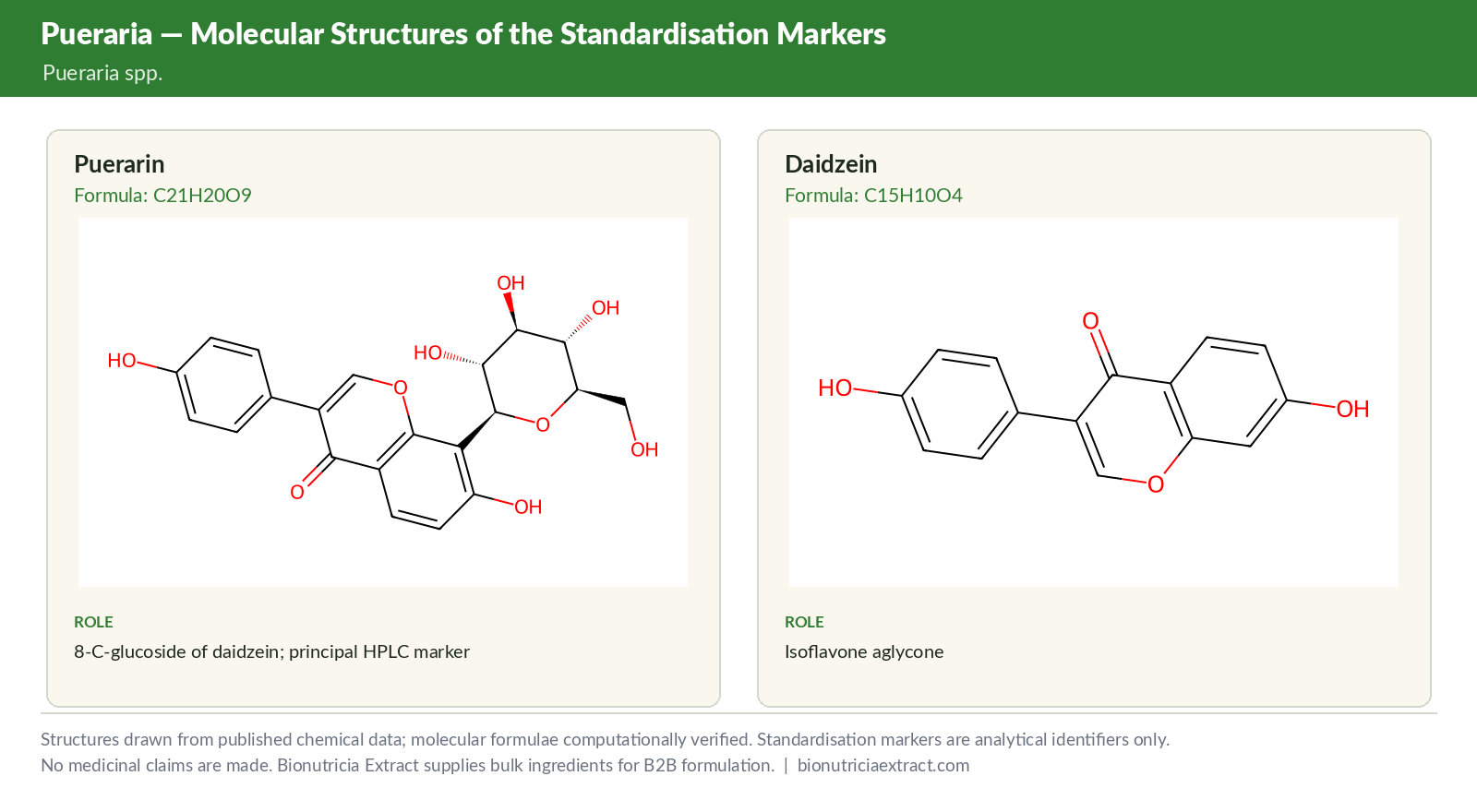
Active compounds & standardisation
Pueraria mirifica is defined by its chromene phytoestrogens miroestrol and deoxymiroestrol — among the most estrogenic plant compounds known — together with the isoflavone C-glycoside puerarin and isoflavones such as daidzein and genistein. Miroestrol and puerarin are the usual HPLC markers; because potency varies greatly with the marker profile, a defined standardisation is essential rather than optional.
How Pueraria mirifica works (mechanism)
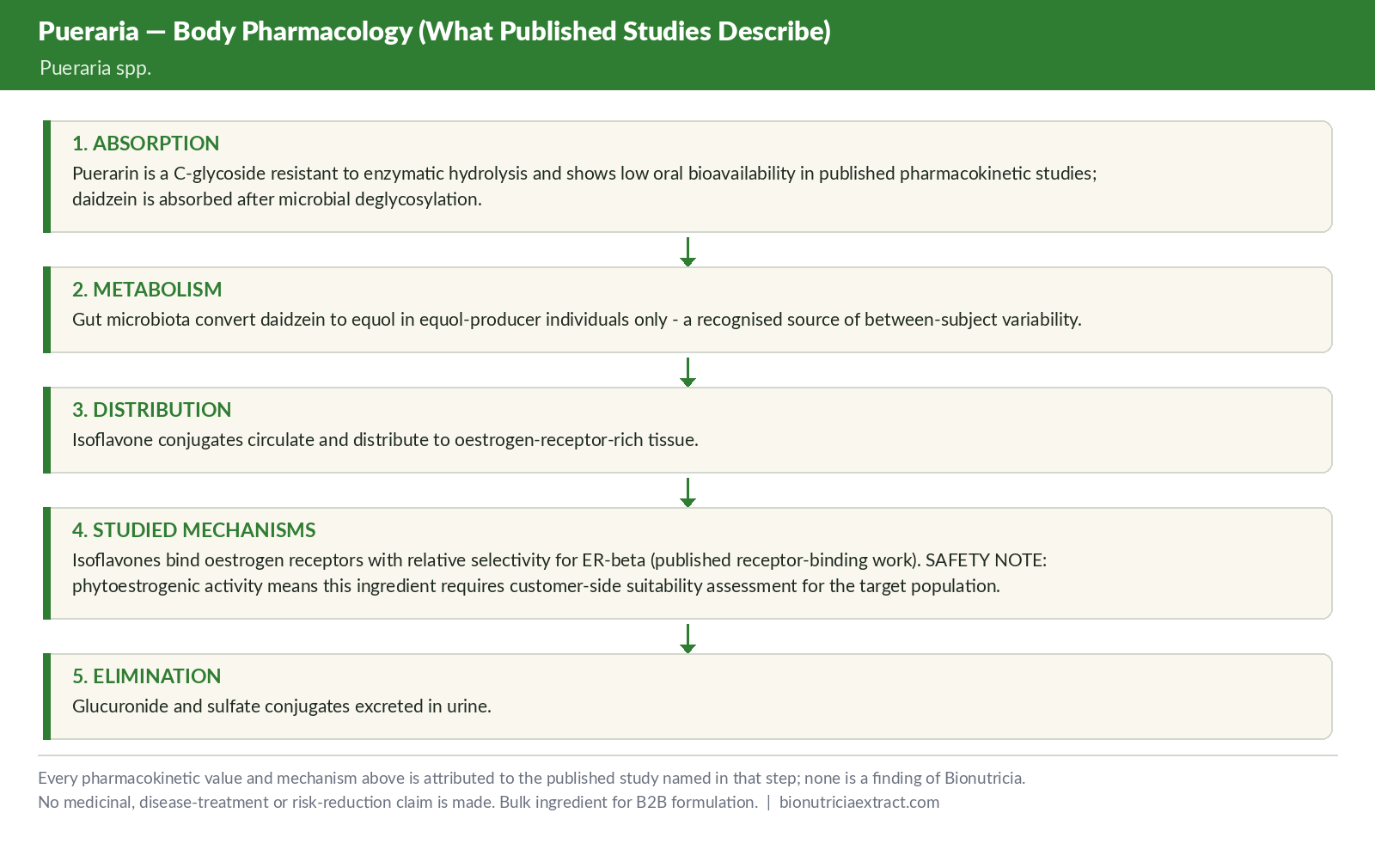
It is a phytoestrogen: miroestrol and deoxymiroestrol bind estrogen receptors ERα and ERβ with relatively high affinity for plant compounds, mimicking some actions of estradiol, while the isoflavones bind more weakly and can act as partial agonists. This estrogen-receptor activity is the accepted mechanism behind its study in menopausal complaints — and precisely why it is handled as a hormonally active ingredient. Mechanism is provided as scientific background on the botanical; it is not a claim that any finished product treats, cures or prevents a condition.
Clinical evidence
| Study | Design | Result (attributed to the study) |
|---|---|---|
| Manonai et al. (and related RCTs) | Randomised trials, postmenopausal women, ~20-50 mg/day, ~24 weeks | Improved menopausal symptom scores and vaginal-health / cytology measures vs baseline/placebo |
Trials are small; the ingredient’s estrogenic nature is central to interpreting both benefits and risks. Results are attributed to the studies, not to any finished product.
Sourcing & the commercial decision
Pueraria mirifica is not a current Bionutricia catalogue SKU. Bionutricia is a JAKIM Halal-certified botanical extract manufacturer capable of developing standardised extracts; however, because this is a hormonally active phytoestrogen, whether to carry or develop it at all is a deliberate risk-and-regulatory decision rather than a routine listing. Brands exploring it should expect strict standardisation, clear safety labelling and confirmation of local regulatory acceptance.
Frequently asked questions
What are the active compounds? Miroestrol and deoxymiroestrol (potent phytoestrogens) plus puerarin, by HPLC.
How does it work? Estrogen-receptor (ERα/ERβ) agonism — it is genuinely hormonally active.
What does the evidence show? Small RCTs (Manonai et al., ~20-50 mg/day, 24 wk): improved menopausal and vaginal measures.
Safety? Not for pregnancy/breastfeeding or estrogen-sensitive conditions; high doses linked to endometrial changes.
Does Bionutricia sell it? Not a catalogue SKU; any development is a deliberate risk-and-regulatory decision.