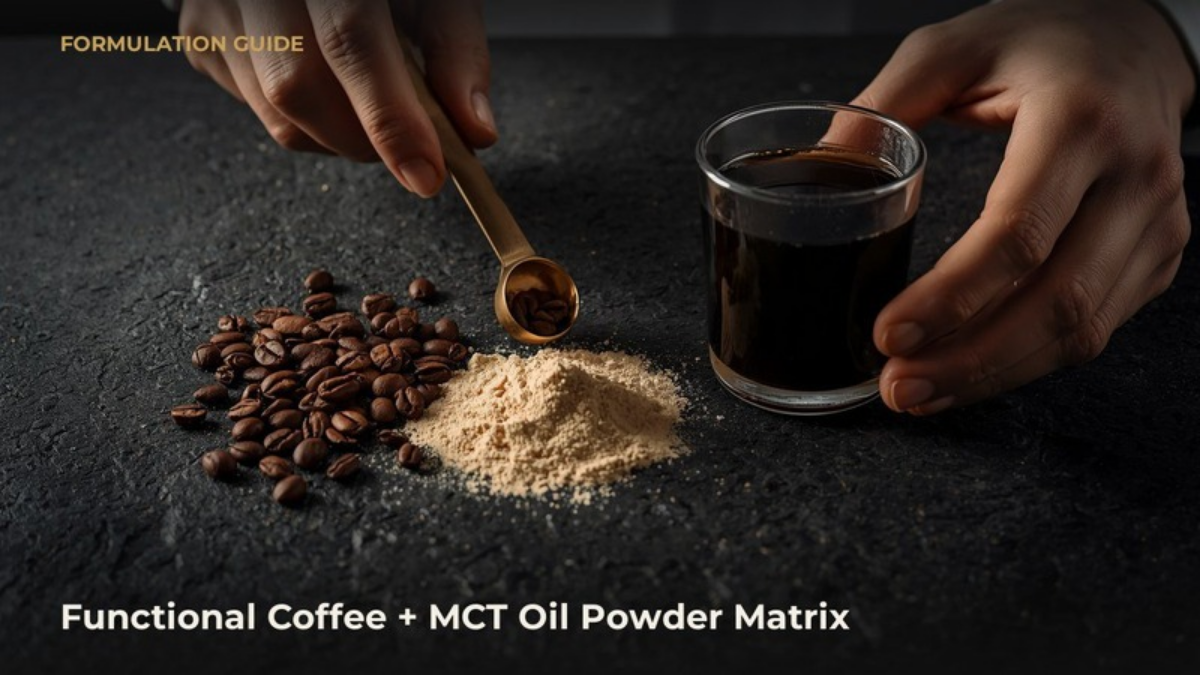
Functional Coffee and MCT Oil Powder Matrix for Sachet Drink Mixes
Formulator’s summary: A coffee and medium-chain triglyceride (MCT) oil powder matrix combines coffee (Coffea) standardised extract powder with MCT oil powder for sachet drink mixes and functional coffee. The coffee extract is described as water-dispersible without sediment; assess the complete blend for wetting, mouthfeel and separation. Use the supplier’s lot specification and COA to set assay and handling controls.
Quick facts for formulators
- Physical format: Coffee extract powder and MCT oil powder, combined as a dry matrix
- Extraction method: Coffee extract powder is spray-dried; MCT oil powder is supplied as a dry powder — review the current lot specification for production method details
- Dispersion: Coffee extract dissolves in water without sediment according to its product page; complete matrix behaviour needs testing
- Certifications: FSSC 22000, JAKIM Halal, GMP, HACCP, MESTI, and US FDA facility registration
What is a coffee and MCT oil powder matrix?
A dry coffee matrix pairs two separately specified catalogue ingredients: Coffee (Coffea) Standardized Extract Powder and Medium-Chain Triglyceride (MCT) Oil Powder. The purpose of the matrix is to bring coffee character and a lipid powder into one dry blend for sachet drink mixes. It is a formulation concept rather than an established combined product specification.
The existing Tongkat Ali, coffee and cinnamon matrix guide discusses a different combination. This article focuses on the physical and process checks needed when MCT powder is paired with coffee extract, not on a botanical-active blend.
What do the ingredient descriptions establish?
| Ingredient | Published product information | Matrix implication |
|---|---|---|
| Coffee (Coffea) extract powder | Spray-dried powder on starch hydrolysate; water dissolution without sediment is stated; 2–3% caffeine appears in the product title | Provides coffee character; obtain the current lot specification and assay documentation before setting a finished-blend target. |
| MCT oil powder | MCT oil powder is supplied as a dry powder. Review the current lot specification for carrier, MCT profile, assay and dispersion data. | Define required composition and obtain product-specific documentation before setting blend targets. |
These descriptions are ingredient-level information. They do not demonstrate that the combined blend will remain uniform, disperse completely, or retain its properties during storage. Establish those attributes in a bench blend and then verify them in the selected packing system.
How should an initial blend be designed?
A formulator should set a trial plan from the desired coffee intensity, target MCT content, intended drink preparation and sensory brief, using only the current specification of each ingredient. Do not convert an individual ingredient’s use direction into a finished-matrix percentage without a separate formulation rationale.
For a screening exercise, prepare several small batches with deliberately varied coffee-to-MCT proportions, keeping the total blend mass constant. Record formula, mixing sequence, equipment, blend time and sample identifiers. Check dry appearance and uniformity at multiple sample points, then test each blend at the intended serving mass and liquid volume. The outcome of those tests—not a generic range—should define the project’s working ratio.
What dispersion and sensory checks matter in the prepared drink?
The coffee product description states that it dissolves in water without sediment. Test the MCT powder independently and in the combined matrix for wetting, dispersion and settling behaviour. Evaluate wetting, floating powder, clumping, visible oiling, sediment or separation immediately after mixing and after a defined standing interval.
Record the beverage base, liquid temperature, mixing energy, preparation sequence and observation time. Compare the coffee aroma and taste, mouthfeel, appearance and any residual particles using a consistent sensory method. A clear ready-to-drink beverage has different visual acceptance criteria from an opaque drink; the selected application should determine the acceptance limits.
How should dry blending and process uniformity be checked?
The coffee extract is described as a spray-dried powder on starch hydrolysate. Differences in particle size, density, flow and surface characteristics between the two powders can affect distribution. First compare the materials’ current specifications and visual handling. Then choose a blending sequence and sampling plan suitable for the batch size and equipment.
Where one component is present at a lower proportion, a staged preblend can be assessed before adding it to the larger powder mass. This is a general development approach, not a validated instruction for these catalogue materials. Define a blend-uniformity method and sample from representative locations; do not rely on appearance alone to establish uniformity.
Which storage and stability checks are appropriate?
Set a finished-matrix study around the selected packaging and intended storage conditions, and track relevant attributes such as moisture, caking, flow, aroma, colour, dispersion and sensory profile. The coffee page describes airtight packing and gives storage conditions for the separate powder; the MCT page also gives its own storage guidance. Those individual details do not establish a shelf life for a coffee–MCT blend.
For sachet drink mixes, review moisture-barrier suitability and sealing integrity with the packaging specification. Retain samples from the trial and document test dates, conditions, methods and acceptance criteria. Do not assign a finished-blend shelf-life period from the shelf life of either ingredient alone.
How does a standardised extract differ from crude coffee powder?
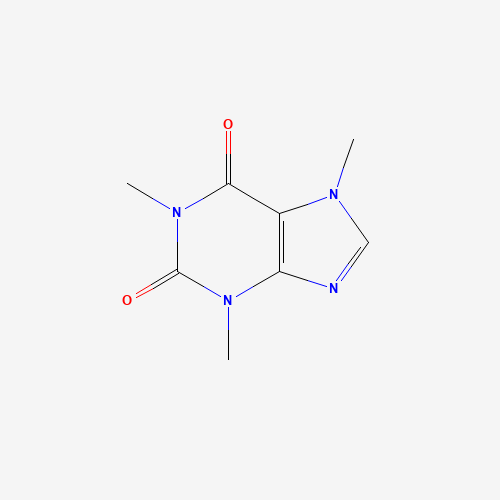
A standardised extract specifies an assay marker or measured constituent range, allowing a lot to be compared against a stated acceptance criterion. The coffee extract product title identifies 2–3% caffeine. A crude ground coffee powder is a different specification class and should not be treated as equivalent unless its own assay and purchase criteria demonstrate the required composition. The distinction concerns specification and batch documentation, not physiological effect.
For each lot, request the specification and certificate of analysis (COA), verify the stated assay basis and compare the result with the agreed acceptance range. Keep the MCT powder’s composition and carrier information as separate data points; neither should be inferred from the coffee extract specification.
What should procurement request before a pilot?
Technical qualification checklist
- Current specification and lot COA for both powders.
- For coffee extract, confirmation of the caffeine assay basis and batch result.
- For MCT powder, the MCT profile, assay basis, carrier information and any available dispersion data.
- Physical handling information needed for dry blending, such as particle size and moisture limits where published.
- Relevant certification and export-documentation requirements for the destination market.
Before pilot work, agree how blend uniformity, prepared-drink dispersion and sensory acceptance will be evaluated. These criteria should be specific to the chosen beverage and packing system, not borrowed from a different coffee premix.
Supplying coffee and MCT powder for dry beverage matrices
The catalogue lists Coffee (Coffea) Standardized Extract Powder and Medium-Chain Triglyceride (MCT) Oil Powder as separate ingredient pages. Buyers can review the product-specific information and request the relevant specification and lot COA. Related catalogue materials include Coconut Cream Powder (Spray-Dried) for a separately specified powder ingredient; its fit must be assessed against the formulation brief.
Published supply information covers bulk supply, custom specification and extract ratio, spray-dried and powder forms, COA per lot, documentation and export paperwork, and packing options. Published quality credentials include FSSC 22000, JAKIM Halal, GMP, HACCP, MESTI and US FDA facility registration. Each ingredient’s specification should be qualified separately, and the combined matrix should be assessed in its intended drink system.
Frequently asked questions
Does MCT oil powder dissolve in coffee? The product page identifies a powder form but does not report a water-dispersion result. Test the MCT powder and the combined blend in the intended coffee preparation conditions.
What starting ratio should be used for coffee and MCT powder? No validated combined ratio is published. Set a bench-screening plan using the desired coffee profile, target composition and current ingredient specifications, then record the results.
Does the coffee extract dissolve without sediment? The coffee product page describes water dissolution without sediment. That statement applies to the coffee extract itself, not automatically to a blend containing MCT powder.
What documents should be checked before a pilot? Review the current specification and lot COA for each powder. Confirm the coffee assay basis and obtain the MCT composition and carrier information needed for the project.
Can ingredient shelf-life information establish the blend’s shelf life? No. Finished-matrix shelf life must be evaluated in the selected blend and packaging system; the separate ingredient storage details do not establish it.
Request the certificates of analysis, specification sheets and samples of Coffee (Coffea) Standardized Extract Powder and Medium-Chain Triglyceride (MCT) Oil Powder.