Enzyme Blend Powder: Food-Grade Enzyme Classes, Activity Assay and Batch Documentation
Formulator’s summary: On Bionutricia’s JAKIM Halal certificate, this item is recorded plainly as “ENZYME” — a generic listing, not a single branded specification. In the bulk food-ingredient trade, an “enzyme blend powder” (or “food enzyme blend”) is a functional processing-aid category rather than a single molecule: it typically combines one or more food-grade enzyme classes — protease, amylase, cellulase and pectinase are the most established — carried on a food-grade base to a declared activity level. Bionutricia holds a current product specification, certificate of analysis and MSDS on file for a premixed, multi-enzyme compound blend — confirming this is a real, documented ingredient rather than a placeholder category. These blends are processing aids used to break down plant cell walls or hydrolyse starches and proteins during extraction and manufacturing, rather than ingredients consumed for their own nutritional content. Because the certificate listing is generic, the exact enzyme classes present, activity units and carrier ratio vary by batch and are confirmed on each certificate of analysis (COA) rather than fixed for the category; contact us for the current specification confirming those individual figures for your batch.
Quick facts for formulators
- Ingredient category: Food-grade enzyme blend / processing aid (certificate lists this item as “ENZYME”)
- Documentation on file: Product specification, certificate of analysis and MSDS confirmed on file for a premixed, multi-enzyme compound blend
- Common enzyme classes: Protease, amylase, cellulase, pectinase — exact blend composition is batch-specific; contact us for the current specification
- Function: Processing aid — breaks down plant cell walls or hydrolyses starches/proteins during extraction and manufacturing
- Activity units: Typically declared in U/g; contact us for the current specification
- Carrier/base: Commonly a food-grade starch or maltodextrin carrier; contact us for the current specification
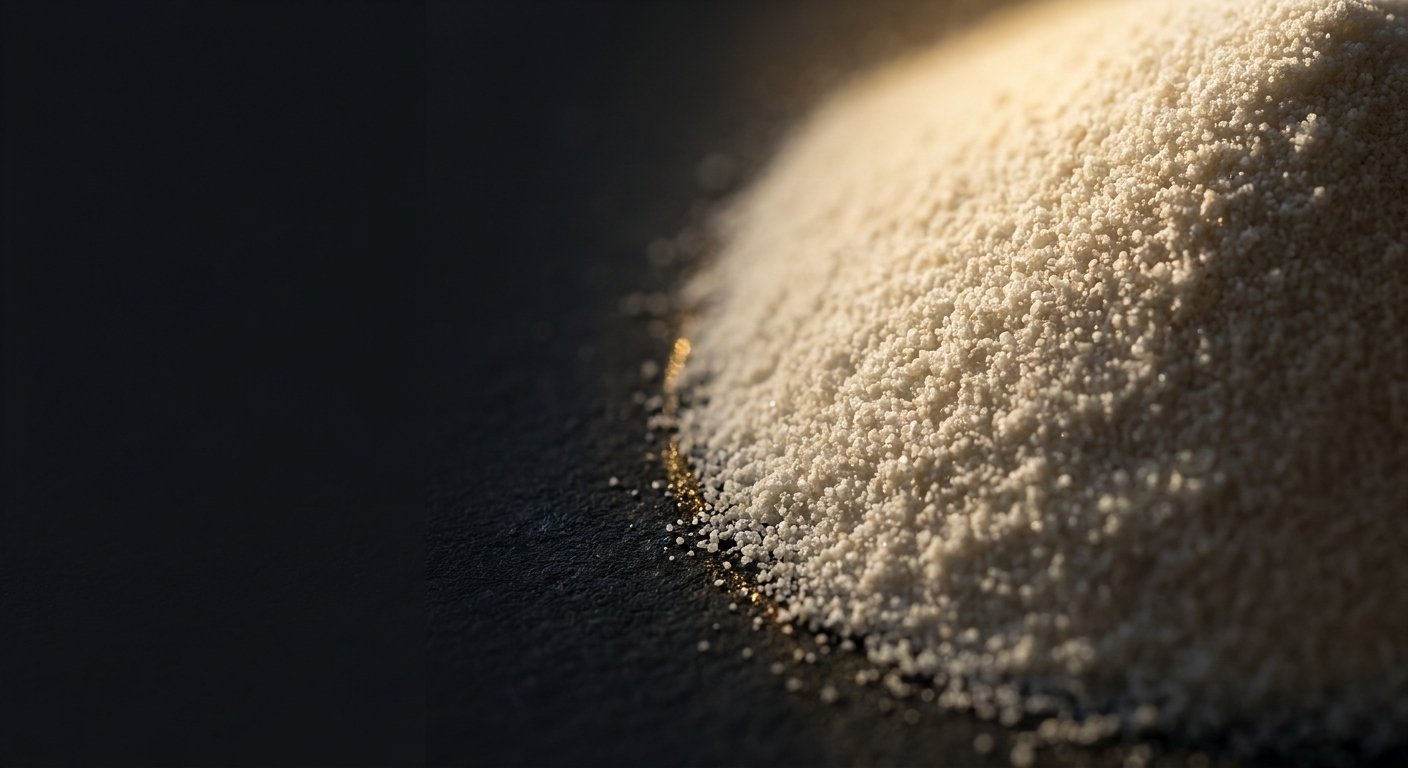
- Form: Free-flowing powder, typical of this ingredient class; contact us for the current specification
- Solubility: Water-dispersible, typical of food-grade enzyme powders; contact us for the current specification
- Certifications: FSSC 22000, JAKIM Halal, GMP, HACCP, MeSTI, US FDA facility registration
What “enzyme blend” means as a bulk ingredient category
Food-grade enzymes are frequently supplied and certified as a generic category rather than a single named compound, which is why a Halal or GMP certificate may simply list the item as “Enzyme” or “Compound Enzyme.” A single product can combine several enzyme classes in one powder so that the blend performs more than one function in a single processing step — for example, loosening plant cell walls while also breaking down starches, in one pass. The exact enzyme classes present, their relative proportions and their combined activity are set for a given application and are documented on that batch’s certificate of analysis, not fixed across every “enzyme” listing a facility might use or supply.
Because the specification sits at the batch level, a buyer sourcing an enzyme blend powder should always request the current COA for the specific lot rather than relying on the generic category name. This is standard practice across the food-enzyme trade.
The common food-grade enzyme classes in a processing blend
Most food-grade enzyme blends used in botanical and food processing are built from a small set of well-characterised enzyme classes, each targeting a different structural or nutritional component of the raw material:
- Protease: hydrolyses proteins into smaller peptides and amino acids. Used where protein-rich matrices need to be broken down or where protein turbidity needs to be reduced.
- Amylase: hydrolyses starch into simpler sugars and dextrins. Widely used wherever a starchy raw material needs to be liquefied or where dough or batter systems need starch conditioning.
- Cellulase: breaks down cellulose, the structural polysaccharide that makes up plant cell walls. Central to loosening botanical cell structure ahead of extraction.
- Pectinase: hydrolyses pectin, the gel-forming polysaccharide found in fruit and plant tissue. Commonly used to reduce viscosity and clarify plant-derived liquids.
A single commercial enzyme blend may contain one of these classes at high activity, or a combination of several at lower individual activity, depending on what the manufacturing step requires. Both approaches are legitimate ways to specify an enzyme blend; neither is inherently “better” without reference to the specific processing outcome the buyer needs.
Enzyme-assisted pre-treatment: how the blend is used in processing
Bionutricia’s own extraction facility uses an enzyme-assisted pre-treatment step ahead of extraction: an enzyme blend is applied to loosen the structural integrity of the botanical cell wall, which enhances the subsequent extraction of the desired flavour, colour or other plant compounds. In practical terms, cellulase- and pectinase-type activity targets the structural polysaccharides holding plant cell walls together, making the cell interior more accessible before mechanical or solvent-based extraction steps (such as ultrasonic treatment) are applied.
This is a processing input, not a finished consumer ingredient in itself — the enzyme blend does the structural work during manufacturing and does not necessarily remain as an active component of the finished extract. The same category of enzyme blend powder is also supplied as a standalone bulk ingredient to other manufacturers who run their own enzyme-assisted processing steps.
Activity units, assay methods and batch documentation
Food enzymes are specified by activity, not by simple weight-based purity. A gram of enzyme powder is only meaningful once its activity is known, because enzyme potency varies significantly between production lots even within the same product. This is why enzyme lots are assayed and the result reported in activity units per gram (U/g), using an assay method appropriate to that enzyme class (for example, a proteolytic activity assay for a protease, or a reducing-sugar assay for an amylase).
What a buyer should look for on an enzyme blend’s COA:
- Enzyme class(es) declared: which of protease, amylase, cellulase, pectinase (or others) are present in the blend
- Activity assay value: the U/g figure for each declared enzyme class — contact us for the current specification
- Assay method stated: the specific activity-assay method used, appropriate to the enzyme class
- Carrier/base declared: the food-grade carrier the enzyme activity is standardised onto
- Batch identification: lot number linking the COA to the specific batch, plus moisture and microbiological results
Because activity, not weight, is what a formulator is actually buying, dosing an enzyme blend by weight alone without checking the current lot’s activity assay can under- or over-dose the processing step. Re-assaying or requesting the current COA before scaling a process is standard practice.
Enzyme blend powder vs a single-enzyme concentrate
Enzyme ingredients are supplied either as a blend of several enzyme classes in one powder, or as a concentrate of a single enzyme class at very high activity. The right choice depends on the processing outcome, not on which is inherently the more “advanced” grade.
| Parameter | Enzyme blend powder | Single-enzyme concentrate |
|---|---|---|
| Composition | Multiple enzyme classes combined in one powder | One enzyme class at high activity |
| Activity declaration | Individual U/g figure per declared enzyme class | Single U/g figure for the one enzyme class |
| Typical use case | General-purpose processing aid, e.g. combined cell-wall breakdown and starch conditioning | Targeted, high-potency action on one substrate (protein, starch, cellulose or pectin) |
| Formulation flexibility | Broad-spectrum action in a single dosing step | Precise control over one specific reaction |
Solubility and formulation considerations
Food-grade enzyme powders are typically water-dispersible, which suits their use in dry powder blends and sachet drink mixes where the enzyme is added late in the process rather than exposed to prolonged heat. Enzymes are protein-based catalysts and are heat- and moisture-sensitive by nature — sustained heat or high humidity can denature the enzyme and reduce or eliminate its activity. This is a well-established property of enzymes generally, and it is the reason enzyme blends used in processing are usually added under controlled, low-heat, low-humidity conditions rather than subjected to prolonged high-temperature steps.
Within these constraints, food-grade enzyme blend powders have established roles across beverages and cordials (for example, clarifying fruit-derived liquids), bakery systems (dough and batter conditioning), dry powder blends and sachet drink mixes, and cosmetic applications that use enzymatic action rather than abrasive exfoliation. The specific application determines which enzyme class or blend ratio is appropriate, and that selection should be confirmed with the formulation team rather than assumed from the ingredient category alone.
Supplying enzyme blend powder in bulk
Bionutricia Extract operates an extraction and processing facility holding FSSC 22000, GMP, HACCP, JAKIM Halal, MeSTI and US FDA facility registration, and uses enzyme-assisted pre-treatment as part of its own extraction process. A current specification, certificate of analysis and MSDS are held on file for a premixed, multi-enzyme compound blend. For buyers sourcing enzyme blend powder as a bulk ingredient, the specific enzyme class(es), activity units, carrier and batch documentation are confirmed per lot via certificate of analysis rather than fixed to a single published specification. Bulk supply, custom specification by processing requirement, documentation and export paperwork, and packing options are available on request.
For specifications, samples, and bulk quotations, contact our team.
Related ingredient guides
- Advance Processing — Bionutricia’s enzyme-assisted pre-treatment, ultrasonic extraction and other processing steps
- Black Ginger Extract Powder – Bulk B2B Buyer’s Guide — an example extract produced using patented enzymatic ultrasonic extraction
Frequently asked questions
What does “ENZYME” mean when it appears as a generic listing on a certification document? It means the certificate covers a category of food-grade enzyme product rather than naming one specific branded formulation. Bionutricia holds a current specification, COA and MSDS on file for a premixed, multi-enzyme compound blend under this listing; the exact enzyme class, activity and blend ratio are set at the batch level and documented on that lot’s certificate of analysis.
What are the main food-grade enzyme classes used in a processing blend? The most established are protease (hydrolyses proteins), amylase (hydrolyses starch), cellulase (breaks down plant cell-wall cellulose) and pectinase (hydrolyses pectin in fruit and plant tissue). A commercial blend may contain one of these at high activity or several combined at lower individual activity, depending on the processing outcome required.
How is enzyme-assisted pre-treatment different from the finished extract itself? Enzyme-assisted pre-treatment is a processing step: an enzyme blend loosens the structural integrity of the plant cell wall to make subsequent extraction more effective. It is a manufacturing input, not necessarily an active component that remains in the finished extract. The same enzyme blend category is also sold as a standalone bulk ingredient to manufacturers who run their own processing.
How should a buyer read an enzyme blend’s certificate of analysis? Check which enzyme class(es) are declared, the activity assay value in U/g for each, the assay method used, the carrier or base the enzyme is standardised onto, and the batch/lot number. Because enzymes are specified by activity rather than weight, the current lot’s COA — not a generic spec sheet — is what should drive dosing.
What applications suit a food-grade enzyme blend powder? Established applications include beverages and cordials (such as clarifying fruit-derived liquids), bakery systems (dough and batter conditioning), dry powder blends and sachet drink mixes, and cosmetic applications using enzymatic rather than abrasive action. The right enzyme class or blend for a given application should be confirmed with the formulation team.