Coconut Cream Powder: Supply, Specifications & Applications for Food Manufacturers
Direct answer: Coconut cream powder is a spray-dried coconut cream ingredient produced from fresh coconut cream (Cocos nucifera) and supplied as a highly concentrated, shelf-stable powder for food and beverage manufacturing. It is manufactured by spray-drying fresh coconut cream into a fine powder that can be used directly or reconstituted with water to produce liquid coconut cream. Key specification parameters to review with suppliers are fat content, moisture, particle size, reconstitution properties, microbial and heavy-metal limits. The ingredient suits baking, beverages, confectionery, ice cream, plant-based foods and cooking applications; this guide covers what coconut cream powder is, the production and chemistry, typical specification parameters, application categories, packaging and storage, supplier qualification and a B2B FAQ.
FSSC 22000
GMP
HACCP
JAKIM Halal
US FDA
MeSTI
NanoVerify
What Is Coconut Cream Powder?
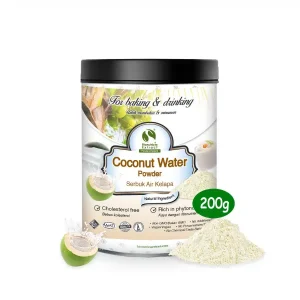
Coconut cream powder is produced by spray-drying fresh coconut cream into a fine, creamy white powder. It is highly concentrated and can be used directly in dry formulations or reconstituted with water to produce liquid coconut cream at the desired concentration. The spray-dried format saves storage space and energy compared to frozen or UHT coconut cream, with a long shelf life at ambient temperature.
For food manufacturers, coconut cream powder offers several operational advantages over liquid coconut cream: reduced shipping weight, no cold-chain requirement, consistent fat content across batches, and simplified dry-mix formulation in bakery and beverage premixes.
Available variants:
- Standard — standard formulation for general food and beverage applications
- Vegan — no dairy, no lactose, no animal-origin ingredients; suitable for plant-based and vegan product lines
Production & Chemistry
Coconut cream powder is produced by spray-drying fresh coconut cream. The production process typically involves:
- Extraction of coconut cream from fresh coconut kernel
- Homogenisation of the coconut cream to ensure uniform fat distribution
- Spray-drying at controlled inlet and outlet temperatures to produce a fine, creamy white powder with low moisture content
- Particle size standardisation and quality testing for fat content, moisture, microbial limits and sensory consistency
- Packaging into moisture-barrier bags or retail-ready packs
The fat content of coconut cream powder is a critical specification parameter. Coconut cream naturally contains a high percentage of coconut oil, and the spray-drying process must preserve this fat content while producing a stable, free-flowing powder. The fat content determines the creaminess, mouthfeel and reconstitution properties of the final product.
Reconstitution properties are also important: coconut cream powder should disperse readily in water without clumping or oiling out. Suppliers should provide reconstitution ratios and solubility data on the specification sheet.
Typical Specification Parameters
| Parameter | Why It Matters to a Buyer |
|---|---|
| Fat content | Determines creaminess, mouthfeel and reconstitution properties; critical for recipe formulation and nutritional labelling. |
| Moisture content | Impacts shelf life, caking risk and microbial stability; low moisture is essential for ambient storage. |
| Particle size / mesh | Affects dispersibility and dissolution speed in water; fine powders reconstitute faster and more uniformly. |
| Reconstitution ratio | Determines cost-in-use and finished product yield; consistent ratios ensure uniform quality across production batches. |
| Heavy metals (Pb, Cd, As, Hg) | Required for regulatory compliance and export; limits may restrict use in some markets. |
| Microbial limits (TPC, yeast & mould, E. coli, Salmonella) | Critical for food-safety acceptance; influences whether the ingredient can be used in ready-to-eat applications. |
| Bulk density | Affects packaging volume, dosing accuracy and transport costs; important for automated dosing systems. |
| Solubility / dispersibility | Determines ease of incorporation in liquid and dry-mix systems; poor solubility causes clumping or oil separation. |
| Vegan status | Confirms absence of dairy, lactose and animal-origin ingredients; critical for plant-based and vegan product lines. |
Where Food Manufacturers Use Coconut Cream Powder
- Bakery: breads, cakes, cookies, pastry fillings and coconut-flavoured cream fillings
- Beverages: coconut-flavoured drinks, coffee creamers, smoothies and powdered beverage mixes
- Confectionery: coconut-flavoured candies, fudges and fillings
- Ice cream: coconut ice cream bases, frozen desserts and dairy alternatives
- Plant-based foods: dairy alternatives, vegan formulations and plant-based cooking creams
- Cooking: curries, sauces, soups and savoury dishes requiring coconut cream
- Desserts: puddings, custards and coconut-based sweet dishes
Format, Packaging and Storage
- Typical formats: spray-dried powder in bulk packs for manufacturing or retail-ready packs for consumer sales.
- Available pack sizes: 25g, 50g, 150g, 300g, 1kg, 15kg and 25kg bulk packs.
- Packing: moisture-barrier bags for bulk, retail-ready packaging for private-label projects; custom packaging available.
- Storage: store sealed in a cool, dry place below 25°C, relative humidity below 65%, away from direct sunlight.
- Shelf life: 24 months in original sealed packaging under recommended storage conditions.
- Handling notes: protect from high heat and high humidity to prevent caking and fat oxidation.
Quick Facts for Formulators
- Base ingredient: Spray-dried coconut cream from fresh coconut (Cocos nucifera)
- Format supplied: spray-dried powder, fine and creamy white, low moisture
- Variants: Standard and Vegan (no dairy, no lactose, no animal-origin ingredients)
- Common applications: baking, beverages, confectionery, ice cream, plant-based foods, cooking, desserts
- Storage: cool, dry, moisture-protected packaging; 24-month shelf life sealed
- Certifications: FSSC 22000, GMP, HACCP, JAKIM Halal, US FDA, MeSTI
How to Qualify a Coconut Cream Powder Supplier
Checklist to request before issuing a PO:
- Lot-specific Certificate of Analysis (COA) showing fat content, moisture, microbial limits and sensory data
- Specification sheet with declared fat content, reconstitution ratio, bulk density and particle size
- Heavy-metals certificate and microbial screening report (TPC, yeast & mould, E. coli, Salmonella)
- Copies of facility certifications (FSSC 22000, GMP, HACCP, JAKIM Halal, US FDA, MeSTI)
- Packaging specification, recommended storage conditions and shelf-life data
- Declaration of carriers, stabilisers and processing aids used in the powder
- Vegan status declaration for the vegan variant (no dairy, no lactose, no animal-origin ingredients)
- Sample availability for application testing and reconstitution trials
Frequently Asked Questions
-
Q: What is the fat content of coconut cream powder?
- A: Fat content varies by grade and formulation; it is declared on the COA and specification sheet. Request the supplier’s declared fat content and confirm it meets your formulation requirements.
- A: Coconut cream powder is shelf-stable at ambient temperature, reduces shipping weight and storage costs, and offers consistent fat content across batches. It can be reconstituted with water to produce liquid coconut cream at the desired concentration.
- A: Yes. The vegan variant contains no dairy, no lactose and no animal-origin ingredients. Request the supplier’s vegan declaration and allergen statement for confirmation.
- A: Bionutricia Extract supplies coconut cream powder in 25g, 50g, 150g, 300g, 1kg, 15kg and 25kg bulk packs. Retail-ready packs are available for private-label projects. Contact sales for current MOQ and lead times.
- A: Yes. Bionutricia Extract provides private-label packing, custom formulation and contract manufacturing for coconut cream powder. Both standard and vegan variants are available for private-label projects. Discuss packaging and labelling requirements with sales.
- A: Ask for facility and product certifications relevant to your market: FSSC 22000, GMP, HACCP, JAKIM Halal, US FDA, MeSTI, and any specific export/import documentation required by the destination market.
Q: How does coconut cream powder compare to liquid coconut cream?
Q: Is the vegan variant suitable for plant-based product lines?
Q: What pack sizes are available?
Q: Can you support private-label or OEM projects?
Q: What certifications should I ask for?
Supply Coconut Cream Powder in Bulk With Bionutricia
Bionutricia Extract supplies bulk coconut cream powder to bakeries, beverage manufacturers, confectionery producers, ice cream manufacturers and plant-based food manufacturers as part of its ingredient range. For full specifications, certification documentation and a formal quotation, visit the coconut cream powder product page or request a bulk quotation directly.
Request a Bulk Quotation for Coconut Cream Powder
Request a bulk quotation — Coconut Cream Powder product page