Botanical Extracts for Cosmetic Formulation: What Changes vs an Ingestible Ingredient
It can be the same plant, the same extraction and the same drum — and still be the wrong specification. A supplement formulator cares about assay, solubility and contaminant limits. A cosmetic formulator inherits four things a food spec sheet rarely mentions: colour carry-over, odour, pH behaviour and preservative load. None of these matter much inside a capsule. All of them decide whether a cream is saleable.
The same extract, read through a different lens
| Parameter | Why an ingestible buyer cares | Why a topical buyer cares more |
|---|---|---|
| Colour | Mostly cosmetic to the concept, or hidden in a capsule | Tints the finished product; may fade unevenly; can transfer to skin or fabric |
| Odour | Masked by flavour system | Competes directly with the fragrance brief; often unmaskable at high inclusion |
| pH in solution | Rarely critical | Can shift the emulsion out of its stable window and off the skin-compatible range |
| Carrier | Allergen and label question | Allergen and label question plus a nutrient source for microbes and a texture variable |
| Microbial counts | Meet the food limit | Must not consume the finished product’s preservative capacity |
| Particle size | Dispersion and flow | Grittiness and sensory feel — perceptible on skin at sizes invisible in a drink |
| Solubility | Which beverage system it goes in | Which phase it goes in, and at what stage of the process |
1. Decide the phase before you decide the ingredient
The single most useful question is where the extract has to live: the water phase, the oil phase, or added post-emulsification at cool-down. A water-soluble powder extract goes into the water phase, but if it is heat-sensitive it may need to go in at cool-down instead — which changes how it must disperse, because you no longer have heat and prolonged agitation to help you.
Powdered extracts that are specified as soluble in water will generally disperse cleanly, but “soluble” on a food spec sheet usually means soluble at a food-relevant concentration with stirring. In an emulsion at low inclusion you are more concerned with whether it disperses without lumping and whether it stays dispersed. Ask for behaviour, not just a yes/no solubility line — and if the material is a fine powder, check the mesh figure, because grittiness is far more perceptible on skin than on the tongue.
2. Take colour seriously and early
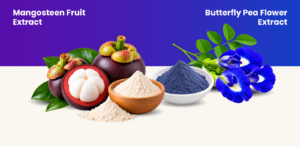
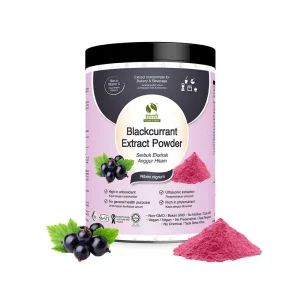
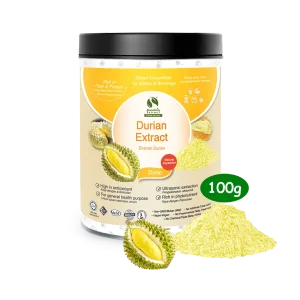
Botanical extract powders are rarely white. Depending on the plant and the process they run from off-white through tan and brown to deep pigment shades, and a colour that reads as “natural and authentic” in a functional beverage reads as “the batch has gone off” in a white cream.
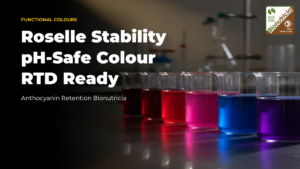
Two follow-on issues catch formulators at pilot scale. The first is inclusion-rate non-linearity: colour that is invisible at 0.1% can be obvious at 1%, and the jump is rarely proportional. The second is light stability — natural pigments, particularly anthocyanins and carotenoids, can shift or fade on shelf under light, so a formula that passes at fill can look different three months later in a clear bottle on a lit shelf. Request the colour description, and where the extract is pigment-bearing, ask about behaviour under light before committing to clear packaging.
3. Check pH twice — the extract’s own, and the formula’s
Many botanical extracts are mildly acidic in solution. At low inclusion that is usually irrelevant; at higher inclusion it can pull a formula’s pH down enough to matter. Two things then follow. Emulsifier systems have a stable pH window, and drifting outside it costs you stability. And several common preservatives are strongly pH-dependent — organic acid preservatives lose efficacy as pH rises, so a formula that drifts upward can quietly become under-preserved without any change to the preservative dose.
Ask the supplier for the extract’s pH in solution, at a stated concentration. Then measure your own formula after adding it, rather than assuming the base value holds.
4. The carrier question is different here — and bigger
Every powdered extract is carried on something. For an ingestible, the carrier is mainly an allergen and label question. In a water-containing cosmetic it is also a microbiological question, because a carbohydrate carrier is a nutrient source, and anything you add that feeds microbes draws down the preservative capacity of the formula.
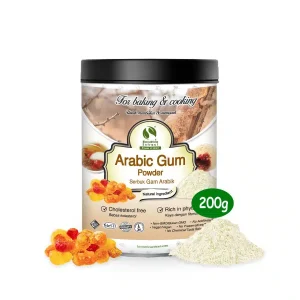
It is also a label question with more weight, because cosmetic buyers read ingredient lists closely. Bionutricia emulsifies its oil-powder range on arabic gum rather than sodium caseinate — sodium caseinate being milk-derived, a declarable allergen, and fatal to a vegan claim. For water-soluble botanical extracts, carriers vary by product; ask which one, because arabic gum and maltodextrin behave differently in an emulsion and are not interchangeable. We cover the trade-off in detail in our carrier comparison guide.
5. Preservation: test the formula you are actually selling
The most common preservation failure is not a bad preservative — it is a preservative efficacy test run on the base without the botanical extract in it. A raw material entering a water-containing product brings its own microbial baseline and its own nutrient load, and both change the answer.
Ask for the raw material’s microbial specification, look specifically at yeast and mould rather than only total count, and then run the challenge test on the finished formula with the extract at its final inclusion rate. If you later change the inclusion rate materially, that is a new formula from a preservation standpoint.
6. Documentation: where a food-grade supplier stops and you begin
This is worth being blunt about, because vagueness here wastes everyone’s time.
A food-focused extract manufacturer can give you: the botanical binomial and plant part, the extraction ratio or standardisation, the carrier, heavy-metal and microbiological limits, physical parameters, a batch Certificate of Analysis, and the manufacturing quality-system certifications behind the facility.
What sits on the cosmetic brand’s side is the cosmetic-specific regulatory layer: assigning and confirming the INCI name, the safety assessment and product information file, compliance with the cosmetic regulation of each target market, and the finished-product claim substantiation. A supplier who tells you their food certifications cover your cosmetic compliance is overselling.
What to send a supplier when you enquire
You will get a far more useful answer if the enquiry contains these six things:
- The format — leave-on cream, serum, cleanser, mask, anhydrous balm
- The phase and the addition stage — water phase, oil phase, or cool-down
- The intended inclusion rate, or a range
- The formula’s pH and its acceptable window
- Colour and odour tolerance — is a tinted product acceptable, or is white non-negotiable?
- Target markets, which determines the regulatory layer you will need to build on top
With that, a supplier can tell you quickly whether an existing grade fits or whether the material needs a different specification — instead of sending a food spec sheet and leaving you to work it out at bench scale.
Bionutricia as a source
Bionutricia Extract has manufactured standardised botanical extracts in Malaysia since 2006, in powder and liquid form, under FSSC 22000, GMP, HACCP, MeSTI, JAKIM Halal and US FDA registration, with a Certificate of Analysis on every lot and extraction performed under the granted process patent MY-188945-A. We supply the bulk ingredient; brand owners and manufacturers formulate it into their chosen finished product. For cosmetic enquiries, send the six items above and we will tell you honestly whether an existing grade fits your phase, pH and colour tolerance — or whether it does not.
Frequently asked questions
Can a food-grade extract be used in a cosmetic? Often yes, but read the spec differently. You additionally need colour intensity, odour, pH in solution, preservative compatibility and the carrier — none of which a food spec is written to answer.
Why does colour matter more topically? In a capsule or drink it is hidden or intentional. In a leave-on cream it tints the product, may fade unevenly under light, and can transfer onto skin or fabric.
Will the supplier give me an INCI name? A food-focused manufacturer can give you the binomial, plant part and carrier, from which the INCI name is assigned — but confirming the designation and its regulatory acceptability in your markets is the cosmetic brand’s responsibility.
Does the carrier matter in a cosmetic? Yes — it appears on the ingredient list, it adds a nutrient source your preservative system must cope with, and different carriers disperse and feel differently. Arabic gum and maltodextrin are not interchangeable.
What microbiological standard should the raw material meet? Whatever keeps it from eroding your finished product’s preservation. Look at yeast and mould specifically, and run the challenge test on the finished formula with the extract at its final inclusion rate.