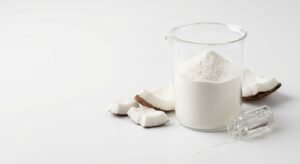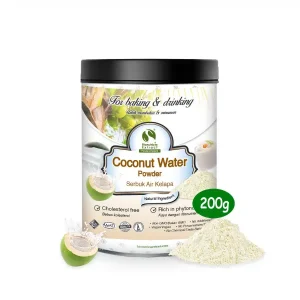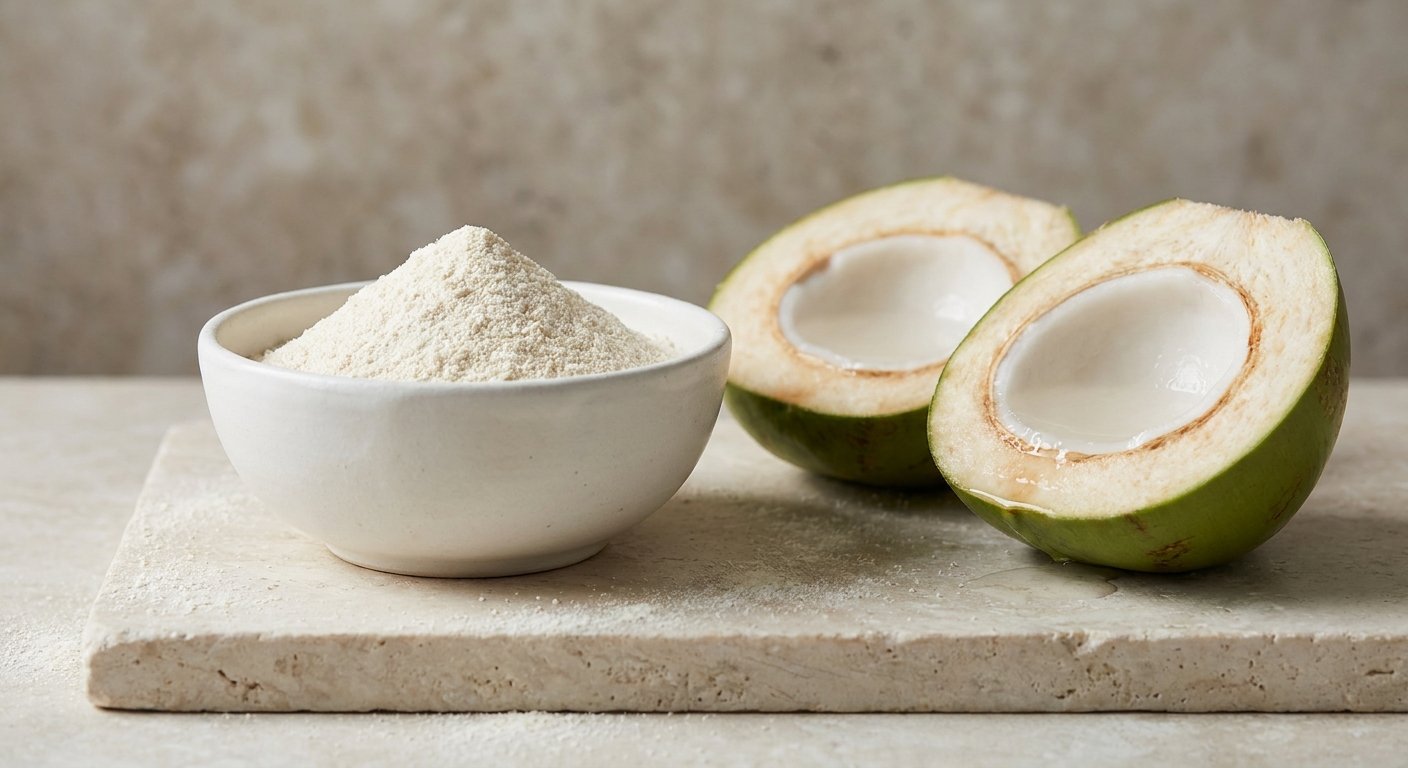
Quick answer for OEM formulators: Coconut water powder is a spray-dried or freeze-dried rework of young coconut water, standardised and carrier-blended so it reconstitutes into a clear, electrolyte-rich beverage. Specify solids (% Brix), moisture, carrier system, and electrolyte (K+, Na+) assay on the COA to ensure the powder fits your finished format and shelf-life needs.
Sourcing, specification & B2B OEM checklist
- Solids / Brix equivalent and assay method — tell suppliers the finished beverage solids and target sweetness so they can recommend the correct concentration (e.g., 5–12°Brix finished drink).
- Moisture (%) and water activity — aim for <5% moisture and aw <0.35 for multi‑year shelf stability in dry storage.
- Carrier type and % — maltodextrin, inulin, or arabic gum. Carrier choice affects solubility, mouthfeel and label claims (inulin = fibre claim; arabic gum = clean-label emulsifier).
- Electrolyte profile — potassium (K+), sodium (Na+), magnesium (Mg2+) in mg/100g and a reconstitution reference (mg/L at a given % reconstitution).
- Particle size / bulk density — for dosing accuracy and filling; request typical D50 or mesh and tapped density.
- Microbiology & contaminants — TPC, yeasts & moulds, E. coli, Salmonella; pesticide-screen and heavy-metal limits; COA and batch traceability.
- Processing method — spray-dry vs freeze-dry and any thermal concentration steps; this affects flavour and heat-sensitive vitamins.
- Packing & shelf life — recommended packaging (multi-layer barrier bags, nitrogen flush, lined drums), recommended storage conditions, and validated shelf-life or accelerated stability data.
- Regulatory & certification — Halal, FSSC/GMP/HACCP documents if needed for your market; allergen declaration (should be allergen-free if carriers are plant-based).
- Sample policy & scale — request production-representative samples (not lab-scale), MOQs for pilot and production, and production lead times.
- Analytical support — suppliers should share ICP or ion-chromatography electrolyte data and method statements for assays; request retained-sample policies.
Formulation, reconstitution & processing guidance
Design your powder-to-water ratio around target Brix and electrolyte strength. Common starting points (lab bench):
- Light rehydrated beverage: 1 part powder : 8–10 parts water (10–12% reconstitution solids)
- Standard sports/functional drink: 1:10 (approx. 8–10°Brix finished depending on carrier)
- Concentrate or syrup base: 1:3–1:5 (use lower reconstitution if downstream dilution is planned)
Practical tips:
- Solubility & dispersion — spray-dried powders with maltodextrin or arabic gum disperse faster than plain concentrates because carriers reduce stickiness and improve wettability. Instantisation tests (300–500 rpm stir at 20°C) show most commercial powders fully disperse within 30–90 seconds.
- Heat sensitivity — flavour and volatile notes in coconut water are heat-sensitive. For pasteurised or hot-fill processes, validate sensory and vitamin retention on pilot batches; consider post-fill aroma addition if heat losses are unacceptable.
- Sugar and browning — concentrated coconut solids can darken under high-heat or long-term storage; control reducing-sugar levels and use appropriate antioxidants if colour is critical.
- Anti-caking — include silica or tricalcium phosphate only after compatibility testing; carriers with higher DE maltodextrin reduce caking but change mouthfeel.
- Compatibility — test with high-protein matrices (dairy or plant-protein) for oil migration and sedimentation; emulsion-stabilising agents may be required in such systems.
Stability, packaging & QC (including research context)
To protect flavour, electrolytes and microbial quality across a multi-month shelf life, follow these controls:
- Storage conditions — store at <25°C and <60% RH; use humidity indicators for long storage lines.
- Packaging — multi-layer aluminiumised or metallised PET/PA/PE barrier pouches with desiccant / nitrogen flush for retail sachets; lined fiber drums for bulk shipments.
- Accelerated stability — run 3-month accelerated (40°C/75% RH) and 6–12 month real-time tests to measure moisture uptake, colour change and electrolyte assay drift.
- Incoming QA — verify lot COA: moisture, electrolyte assay, microbial panel and heavy metals. Retain retained samples for 12 months per supplier SLA.
- Oxidation & preservation — coconut water is low in fat but contains labile volatiles; use oxygen-impermeable primary packaging and consider low-level antioxidants if permitted by the formulation brief.
Selected peer-reviewed references (for formulation and composition)
- Research Progress in Coconut Water: A Review of Nutritional and Functional Properties (PMC) — summarizes coconut water composition including electrolytes relevant to rehydration and beverage formulation.
- Clinical study indexed on PubMed related to coconut water consumption — describes a clinical investigation; use cautiously for health claims and rely on the COA and formulation tests for product specs.
Related pages
Frequently asked questions
What reconstitution ratio should I start with for a ready-to-drink coconut water?
Begin testing at 1 part powder : 8–10 parts water (approx. 8–12°Brix depending on carrier). Adjust for target electrolyte strength and sweetness, and validate with a pilot sensory panel.
Is spray-dried coconut water powder as flavourful as freeze-dried?
Freeze-dried powders typically retain more of the delicate volatiles and fresh aroma, but modern spray-dry processes with rapid concentration and protective carriers can deliver acceptable flavour at lower cost. Specify a production-representative sample to decide.
How do I verify electrolyte content on receipt?
Request ICP or ion-chromatography assay on the supplier COA and run an in-house verification assay on incoming lots. Ask the supplier for reconstitution reference values (mg/L at specified % reconstitution).
What packaging is recommended for shelf stability?
Use multi-layer barrier pouches with nitrogen flush and desiccant for sachets or retail packs; lined drums or barrier bags for bulk. Store in cool, dry conditions <25°C.
Can coconut water powder be used in protein shakes or RTD dairy beverages?
Yes, but perform compatibility testing. High-protein matrices may change mouthfeel and can reveal oil migration or settling; stabilisers or tailored carriers may be necessary.