Orange extract powder is a 20:1 concentrated extract of the Citrus sinensis (sweet orange) fruit — the botanical source of the citrus flavanones hesperidin, narirutin and naringin documented in the published literature. Bionutricia Extract supplies it in bulk to B2B and OEM formulators from a JAKIM Halal, FSSC 22000, US FDA-registered, GMP, HACCP and MeSTI facility in Malaysia, with a Certificate of Analysis on every lot.
Quick facts for formulators
- Botanical / part: Citrus sinensis (sweet orange), fruit
- Type: concentrated extract powder, extraction ratio 20:1 — phyto-nutrient and natural flavour ingredient
- Characteristic actives: citrus flavanones — hesperidin, narirutin, naringin (literature-documented for Citrus sinensis); flavanone assay by HPLC available on request
- Form / colour / odour: free-flowing powder, light yellow, characteristic orange odour
- Solubility: water-soluble · pH: 3–5 · Moisture: <10%
- Particle size: >85% through 60 mesh
- Dosage: typically 1–8% of the finished formulation
- Pack sizes: 1 kg · 5 kg · 20 kg
- Clean label: vegan, non-GMO, gluten-free (<20 ppm), not irradiated, no Annex II allergens, not a novel food
- Shelf life: 2 years sealed, cool & dry · Origin: Malaysia
What is orange extract powder?
Sweet orange (Citrus sinensis) is the world’s most widely grown citrus fruit — roughly seven of every ten citrus fruits harvested are sweet oranges, with production centred on Brazil, China and India. Bionutricia’s ingredient is a 20:1 concentrated extract of the fruit, produced with the patented enzymatic + ultrasonic extraction process (MY-188945-A, “Process for Preparing Nutritional Powder Extract”) and spray-dried into a water-soluble, light-yellow powder: one kilogram of extract represents roughly twenty kilograms of orange fruit input. It is a different ingredient from commodity orange juice powder (spray-dried juice on a carrier, dosed for taste alone) — the 20:1 extract concentrates the fruit’s phyto-nutrient fraction alongside its natural flavour, so a formulator gets both function and a clean citrus profile from one ingredient. See the live orange (Citrus sinensis) product page.
Active compounds & characterisation
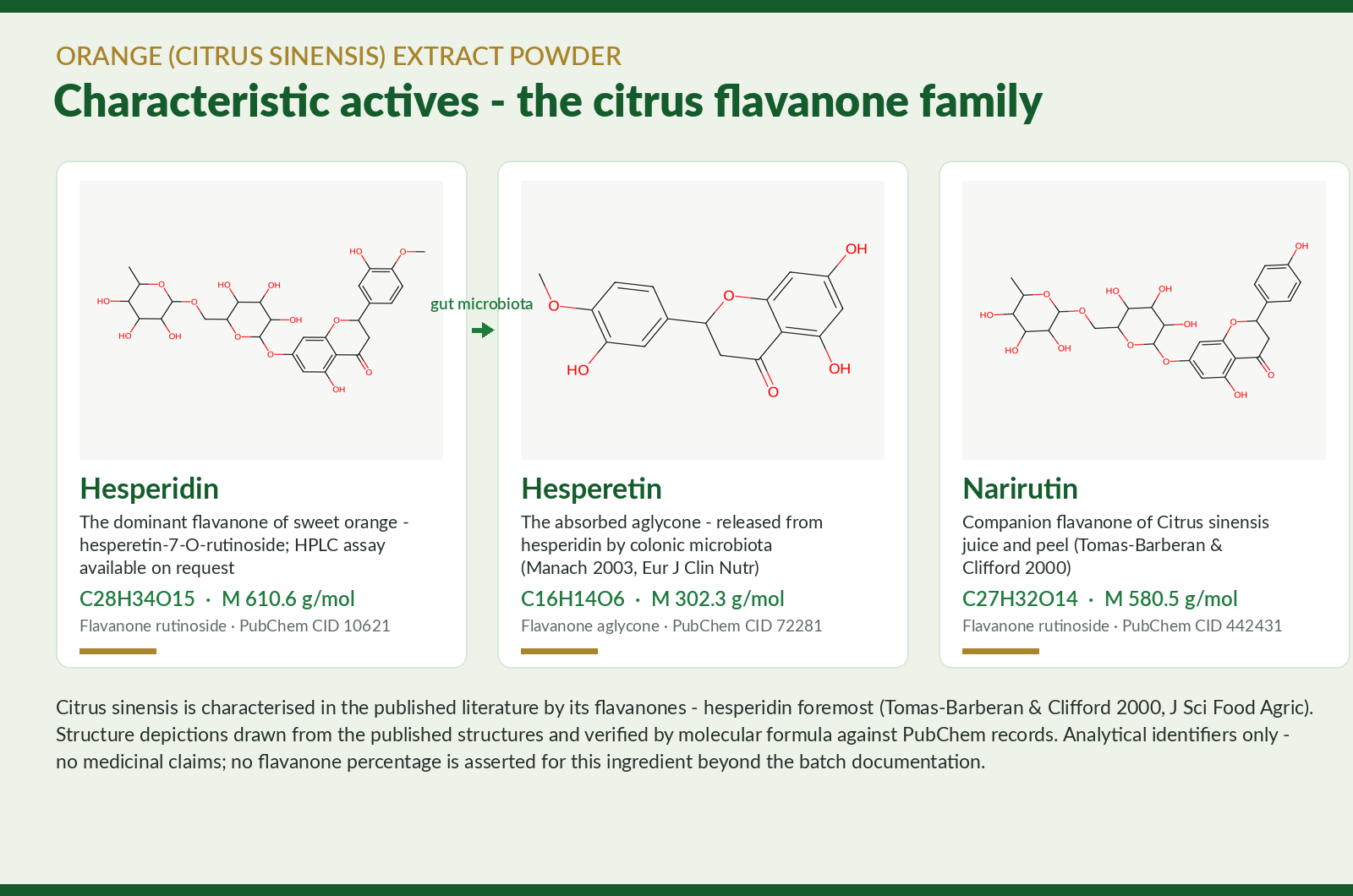
The defining phenolics of sweet orange are the citrus flavanones: hesperidin (hesperetin-7-O-rutinoside) — typically the dominant flavonoid of Citrus sinensis — with narirutin and smaller amounts of naringin, alongside carotenoids and phenolic acids (Tomás-Barberán & Clifford 2000, J Sci Food Agric). Citrus flavanone content is routinely quantified by HPLC, the same assay class named in pharmacopoeial methods for citrus materials. The house specification defines this extract on its 20:1 concentration and physical, heavy-metal and microbiological release parameters, with each lot released against its batch Certificate of Analysis; a flavanone (hesperidin) assay can be arranged on request for customers standardising a finished formula. No flavanone percentage is asserted for this ingredient beyond what the batch documentation states — figures on this page describe the published literature on Citrus sinensis, not a guaranteed content.
How citrus flavanones work in the body (mechanism)
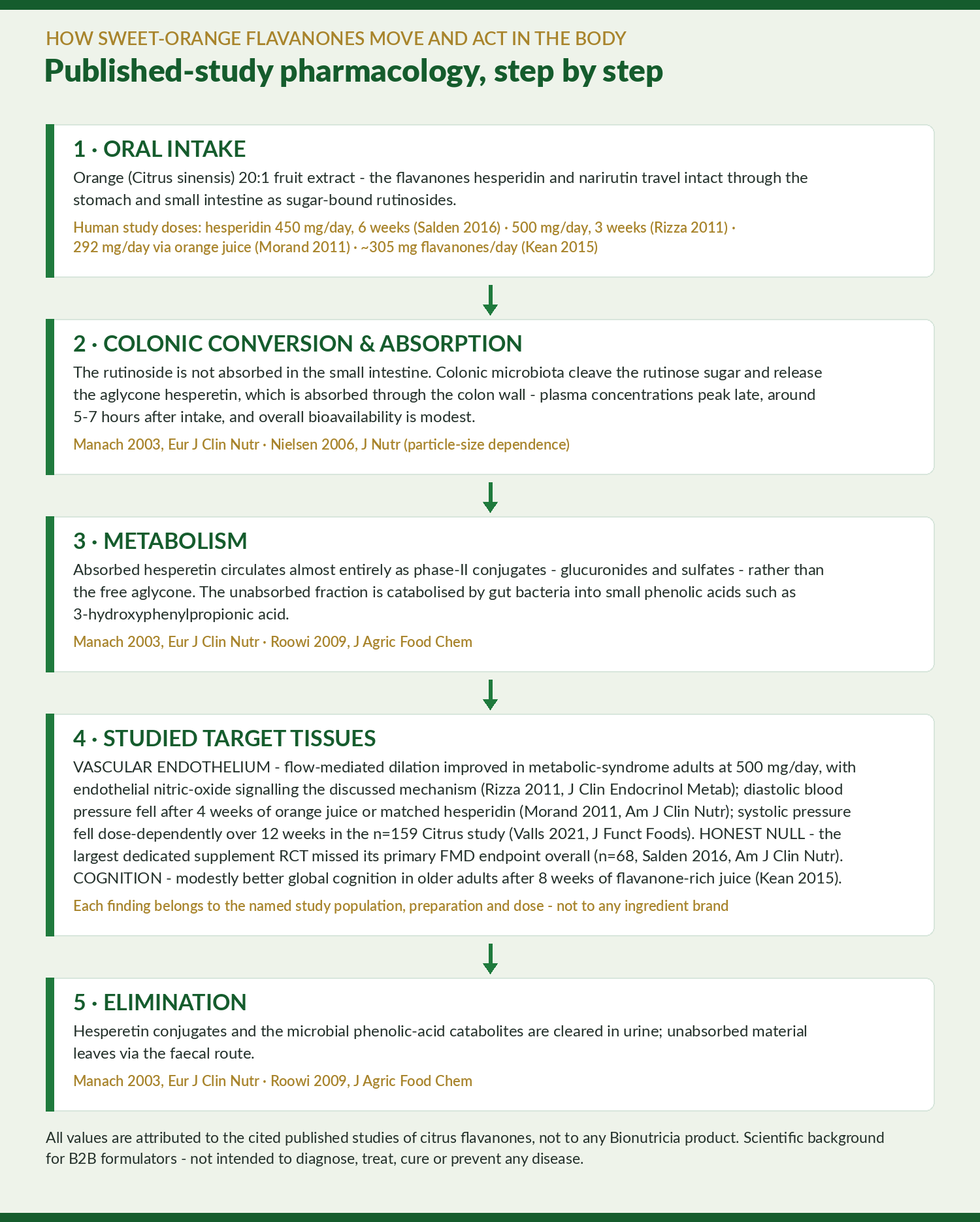
Hesperidin behaves as a prodrug of its aglycone. The intact rutinoside is not absorbed in the small intestine; it travels to the colon, where gut bacteria cleave the sugar to release hesperetin, which is absorbed and circulates as glucuronide and sulfate conjugates — human pharmacokinetics show plasma concentrations peaking late, around 5–7 hours after intake, consistent with colonic absorption (Manach et al. 2003, Eur J Clin Nutr). Mechanistic work in humans links hesperetin to endothelial nitric-oxide signalling: in the trial by Rizza and colleagues, hesperidin supplementation improved flow-mediated dilation while hesperetin activated NO production in endothelial cells studied in parallel (Rizza et al. 2011, J Clin Endocrinol Metab). Conjugates are eliminated in urine, with unabsorbed material degraded by the microbiota to phenolic acids. Mechanism is provided as scientific background on citrus flavanones, attributed to the cited studies; it is not a claim that this ingredient treats, cures or prevents any condition.
Clinical evidence on citrus flavanones
The findings below belong to the cited studies, populations and preparations, at the stated doses — they are scientific context for formulators, not performance claims for this ingredient.
| Study | Design | Result (attributed to the study) |
|---|---|---|
| Salden et al. 2016, Am J Clin Nutr | Double-blind RCT, n=68 healthy overweight adults; hesperidin 2S 450 mg/day, 6 weeks | Primary endpoint missed: no significant change in fasting or postprandial flow-mediated dilation in the whole group; in participants with baseline FMD ≥3%, postprandial endothelial function improved and adhesion molecules (sVCAM-1, sICAM-1) fell — an honestly mixed result |
| Rizza et al. 2011, J Clin Endocrinol Metab | Randomized placebo-controlled crossover, n=24 adults with metabolic syndrome; hesperidin 500 mg/day, 3 weeks | Flow-mediated dilation improved significantly vs placebo; circulating inflammatory markers (hs-CRP, SAA) decreased |
| Morand et al. 2011, Am J Clin Nutr | Crossover RCT, n=24 healthy overweight men; orange juice or hesperidin 292 mg/day, 4 weeks each | Diastolic blood pressure decreased significantly after both the orange-juice and hesperidin periods vs control, supporting the flavanone as the active fraction |
| Valls et al. 2021 — “Citrus study”, J Funct Foods | Parallel RCT, n=159 adults with pre-/stage-1 hypertension; 500 mL/day orange juice vs hesperidin-enriched juice vs control drink, 12 weeks | Systolic blood pressure fell dose-dependently with hesperidin exposure; the enriched-juice arm showed the largest reduction |
| Kean et al. 2015, Am J Clin Nutr | Crossover RCT, n=37 healthy older adults; flavanone-rich orange juice (≈305 mg flavanones/day), 8 weeks | Global cognitive function score modestly but significantly better after the flavanone-rich period than the low-flavanone control |
Evidence appraisal: the hesperidin literature is genuinely mixed — the largest dedicated supplement trial (Salden 2016) missed its primary endpoint, while vascular signals recur across smaller and juice-based trials at roughly 300–500 mg flavanones/day. The cited trials used purified hesperidin or orange juice, not this extract; the batch COA is the objective quality metric for this ingredient.
Typical specification
| Parameter | Value |
|---|---|
| Botanical source / part | Citrus sinensis (sweet orange), fruit |
| Type / ratio | Concentrated extract powder, 20:1 — phyto-nutrient & natural flavour |
| Appearance / colour | Free-flowing powder, light yellow |
| Odour | Characteristic |
| Characteristic actives | Citrus flavanones (hesperidin, narirutin, naringin — literature-documented); HPLC assay on request |
| Solubility | Soluble in water |
| pH | 3–5 |
| Moisture | < 10% |
| Particle size / mesh | > 85% through 60 mesh |
| Dosage | 1–8% of the finished formulation (typical) |
| Heavy metals | As < 0.1 ppm · Pb < 0.2 ppm · Hg < 0.05 ppm |
| Microbiology | APC < 10⁴ cfu/g · Y&M < 10³ cfu/g · coliforms < 10² cfu/g · E. coli absent |
| Clean label | Vegan · non-GMO · gluten-free (<20 ppm) · not irradiated · no Annex II allergens · not a novel food |
| Certifications | JAKIM Halal, FSSC 22000, US FDA registered, GMP, HACCP, MeSTI |
| Shelf life | 2 years sealed, cool & dry |
| Pack sizes | 1 kg, 5 kg, 20 kg |
| Country of origin | Malaysia |
Figures are typical specification values; the batch Certificate of Analysis carries the release data for each production lot. Full specification on request.
Applications
Bionutricia supplies the bulk ingredient for B2B formulation; brand owners and manufacturers formulate it into their chosen finished format — functional beverages and juice systems, sachet drink mixes and effervescents, capsules and tablets, gummies, bakery and confectionery, dairy and ice-cream, jams and dessert premixes. Because the extract is 20:1, water-soluble and naturally flavour-active, it works double duty: a compact 1–8% dose delivers the citrus phyto-nutrient fraction and a clean orange note in one addition, at a pH (3–5) that sits comfortably in acidified beverage systems.
Why source orange extract from Bionutricia?
Bionutricia Extract has manufactured botanical extracts in Malaysia since 2006, running the patented enzymatic + ultrasonic extraction process (MY-188945-A) under a full halal and international food-safety stack — JAKIM Halal, FSSC 22000, US FDA registration, GMP, HACCP and MeSTI — and issuing a Certificate of Analysis with every lot. The orange extract is freshly made to order; pre-order packing takes about 1–2 weeks. MOQ and pricing are provided on quotation via the product page.
Frequently asked questions
What characterises the extract, and is a COA available? It is a 20:1 Citrus sinensis fruit extract released against physical, heavy-metal and microbiological specifications, with a Certificate of Analysis issued per lot; a citrus-flavanone (hesperidin) HPLC assay can be arranged on request.
Is this the same as orange juice powder? No. Juice powder is spray-dried juice on a carrier, dosed for taste. This is a 20:1 concentrated fruit extract that carries the phyto-nutrient fraction of the fruit alongside its natural flavour, for functional as well as sensory formulation.
Which actives is sweet orange known for? The published literature characterises Citrus sinensis by its flavanones — hesperidin foremost, with narirutin and naringin — plus carotenoids and phenolic acids; the clinical research summarised above was performed on those flavanones, not on this specific extract.
Is the orange extract halal? Yes — it is JAKIM Halal certified, produced in a facility that also holds FSSC 22000, US FDA registration, GMP, HACCP and MeSTI; documentation accompanies each shipment.
What finished formats can a brand owner make? Bionutricia supplies the bulk ingredient; customers formulate it into beverages, sachets, capsules, tablets, gummies, bakery, confectionery and dairy applications in their own facilities.
What is the typical dosage? Typically 1–8% of the finished formulation, adjusted to the flavour intensity and function the application needs.
What are the pack sizes, MOQ and lead time? 1 kg, 5 kg and 20 kg packs; freshly made pre-order packing takes about 1–2 weeks; MOQ and tiered pricing on quotation.
How should it be stored? Sealed in hygienic containers, cool and dry, away from pest infestation; shelf life is 2 years when properly stored.
Request a bulk orange extract quote →