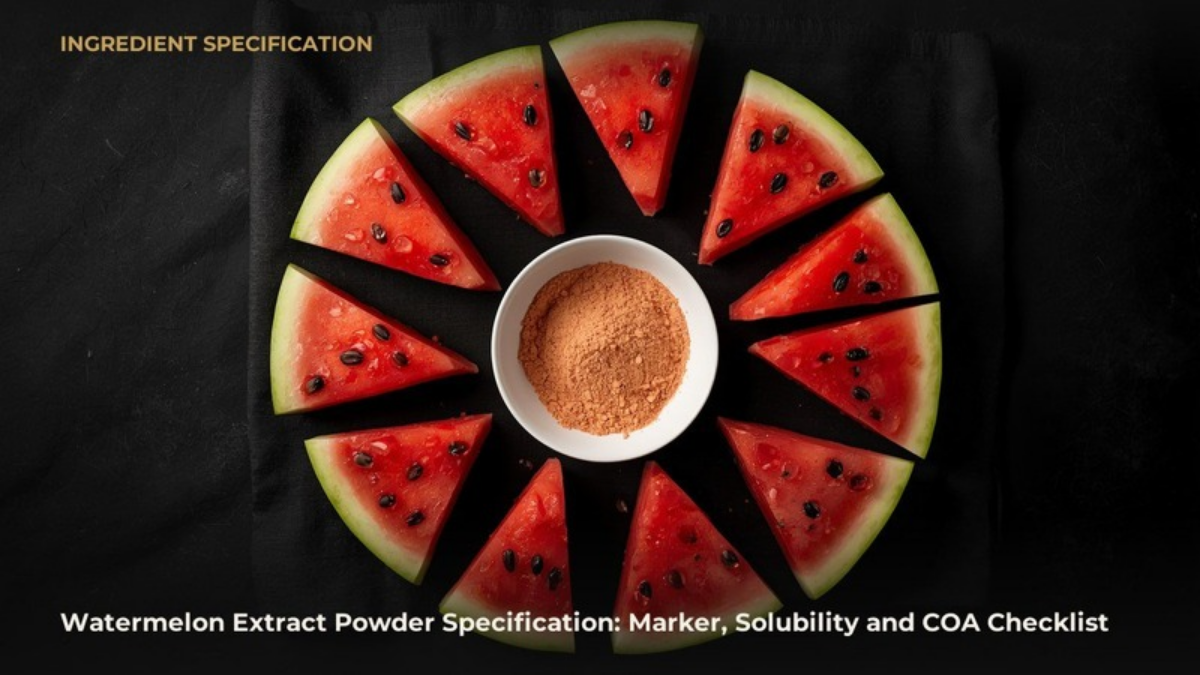
Watermelon Extract Powder for Food and Beverage Formulation: COA and Marker Specification
Formulator’s summary: Watermelon (Citrullus lanatus (Thunb.) Matsum) Extract Powder is listed for beverages and food at 2–6% of total weight. The product page does not specify solubility; its powder may clump with heat or moisture, and sediment might occur, so test dispersion in the customer’s base. L-citrulline is named as a marker constituent; verify any lot target against the current specification.
Quick facts for formulators
- Physical format: powder.
- Marker: L-citrulline is named on the product page; a percentage assay is set only where the grade specification defines one.
- Solubility or dispersion: define a test in the target base, recording powder-to-liquid ratio, water temperature, mixing time, clarity and sediment.
- Storage: the sample lot certificate states 2 years when properly stored; follow its cool, dry, sealed-container instructions.
- Certificate of analysis: the sample lot certificate reports colour, form/texture, odour, moisture, pH, microbiology and heavy metals.
What does the product specification establish?
The catalogue item is Watermelon (Citrullus lanatus (Thunb.) Matsum) Extract Powder. Its product page names watermelon flavour and colour and identifies L-citrulline among the material’s constituents. Buyers should not infer a target marker value from the botanical name or from other watermelon ingredients; set any marker target against the current grade specification.
The product page lists a general addition direction of 1–5 tablespoons or 2–6% of total weight, with use depending on the formulation. Treat this as catalogue guidance rather than a validated rate for every beverage or food matrix. The page also notes that colour, taste and texture may vary between batches and that sediment can occur; specify project acceptance criteria against the current grade and intended application.
Which marker and assay details should a buyer check?
L-citrulline is named in the product information. A buyer requiring a quantified marker should request the current specification and ask whether the purchased grade has a defined L-citrulline target, which assay method applies, and whether each lot reports the result. Where no marker target is specified for the grade, record that in the purchase specification rather than assuming a percentage.
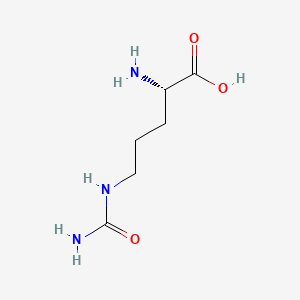
The chemical structure of L-citrulline is shown above for identity reference. PubChem lists the IUPAC name as (2S)-2-amino-5-(carbamoylamino)pentanoic acid, formula C6H13N3O3 and molecular weight 175.19 g/mol. These are compound identity data, not a product assay result.
How should solubility and dispersion be qualified?
The product information lists water and beverages among suggested applications. Define a dissolution test for the target base and planned addition level, recording the powder-to-liquid ratio, water temperature, mixing method and time, visual clarity, settling and any residue. Repeat the test in the complete formula, because other ingredients may alter the appearance. Keep a buyer’s own formulation observation separate from a supplier’s specification statement.
How should colour and flavour stability be checked?
The product page notes that colour, taste and texture may vary between batches. Colour and flavour stability should be tested in the finished product under the intended storage and light conditions, comparing a retained reference sample at set intervals against the same sample at time zero. Record the method and acceptance observation in the purchase specification for the target formula.
What does the sample lot certificate report?
The sample certificate of analysis is for a specific tested lot and applies to that batch only. It reports identity-related sensory and physical checks, moisture and pH, microbial limits and heavy metals. L-citrulline and solubility values, where a buyer’s specification requires them, are agreed separately. A certificate’s values apply to its tested lot and are not a guaranteed specification for future lots.
| Certificate item | Sample lot result or limit | Buyer review point |
|---|---|---|
| Colour, form/texture, odour | Light pink; powder; characteristic odour — each marked “Complies” | Compare against the current approved grade and agreed sensory description. |
| Moisture content | Specification: <8%; result marked “Complies” | Request the numerical result and compare it with the applicable lot specification. |
| pH value | Specification: 4–6; result marked “Complies” | Confirm the test preparation and acceptance limits in the current specification. |
| Microbiology | Total plate count NMT 104 cfu/g; yeast and mould NMT 103 cfu/g; coliform NMT 102 cfu/g; E. coli absent in 1 g | Review the actual lot results and the destination-market requirements. |
| Heavy metals | Mercury NMT 0.02 ppm; arsenic NMT 0.5 ppm; lead NMT 0.01 ppm | Confirm the tested lot, method and acceptance limits required by the buyer’s quality system. |
| L-citrulline marker | Result shown only where the lot certificate includes this assay | Request an assay value if it is part of the current agreed specification. |
| Solubility | Result shown only where the lot certificate includes this test | Agree a test method and acceptance observation for the target formulation. |
NMT means “not more than”; cfu means colony-forming units; ppm means parts per million. The sample certificate is dated March 2026 and states a 2-year shelf life when properly stored. Match the certificate to a delivery using the batch identification on the copy supplied with that delivery.
How does a standardised extract differ from crude fruit powder?
A standardised extract is specified by a named marker, an assay method and a target range, and each lot’s certificate of analysis reports the corresponding result. A crude fruit powder is specified by identity and agreed physical or compositional parameters, without a marker target. The distinction is one of specification and quality control, not a claim about physiological effect.
| Specification element | Standardised extract | Crude fruit powder | This watermelon grade |
|---|---|---|---|
| Marker | Named marker with a defined target range | No marker target | L-citrulline is named; a percentage applies only if the grade specification defines a target |
| Assay method | Defined in the approved specification | Only where an agreed parameter requires one | Confirm the method in the current grade specification |
| Lot certificate | Reports the marker result for each lot | Reports the agreed parameters | Reports the sample parameters listed above |
What should be in a watermelon powder COA checklist?
- Confirm the product name, botanical identity, material form and lot identifier.
- Check that the certificate corresponds to the same lot as the supplied material.
- Review appearance, moisture, pH, microbiology and heavy-metal fields against the current agreed specification.
- If L-citrulline is a required marker, confirm its assay method, target or range, units and lot-specific result in writing.
- For solubility-sensitive applications, agree a reproducible test method and report conditions alongside the result.
- Check storage instructions and shelf-life documentation for the applicable lot.
COA refers to certificate of analysis. A certificate applies to the tested sample from the same batch only. Keep the lot-specific document and the approved specification together in the incoming-material record.
Supplying watermelon extract powder and related ingredients in bulk
The catalogue lists watermelon extract powder and L-citrulline powder as separate entries; they should not be treated as interchangeable specifications. For beverage matrices, the catalogue also lists Coconut Water Powder as a separate powder ingredient.
Ask for the current specification, the certificate of analysis for the lot, and documentation for the required grade. The published certification wording includes FSSC 22000, JAKIM Halal, GMP, HACCP, MESTI and US FDA facility registration. Product-specific acceptance criteria should be agreed against the current documents and intended application. The product information specifies the original sealed packaging for storage but does not state bulk packing options.
Frequently asked questions
What marker value should a buyer verify for watermelon extract powder? L-citrulline is named in the product information. Confirm whether the current grade defines a marker target; if it does, request the assay method and the lot-level result.
Is this watermelon powder soluble in water? The product information lists water and beverages among its applications. Test the powder in the target base and document the mixing conditions, clarity and sediment.
What tests appear on the sample certificate? It reports colour, form/texture, odour, moisture, pH, microbial limits and heavy-metal limits. Request an L-citrulline assay or a solubility result separately if the specification needs one.
Can a sample certificate’s values be assumed for every lot? No. A certificate applies to its tested sample from the same batch. Check the certificate supplied for each lot against the current specification.
How should a buyer distinguish a marker-standardised extract from crude fruit powder? Check whether the specification defines a named marker, assay method and target range, and whether the lot certificate reports that assay. Without those elements, do not assume a marker percentage or batch-to-batch marker target.
Request the certificate of analysis, specification sheet and a sample of Watermelon (Citrullus lanatus (Thunb.) Matsum) Extract Powder.