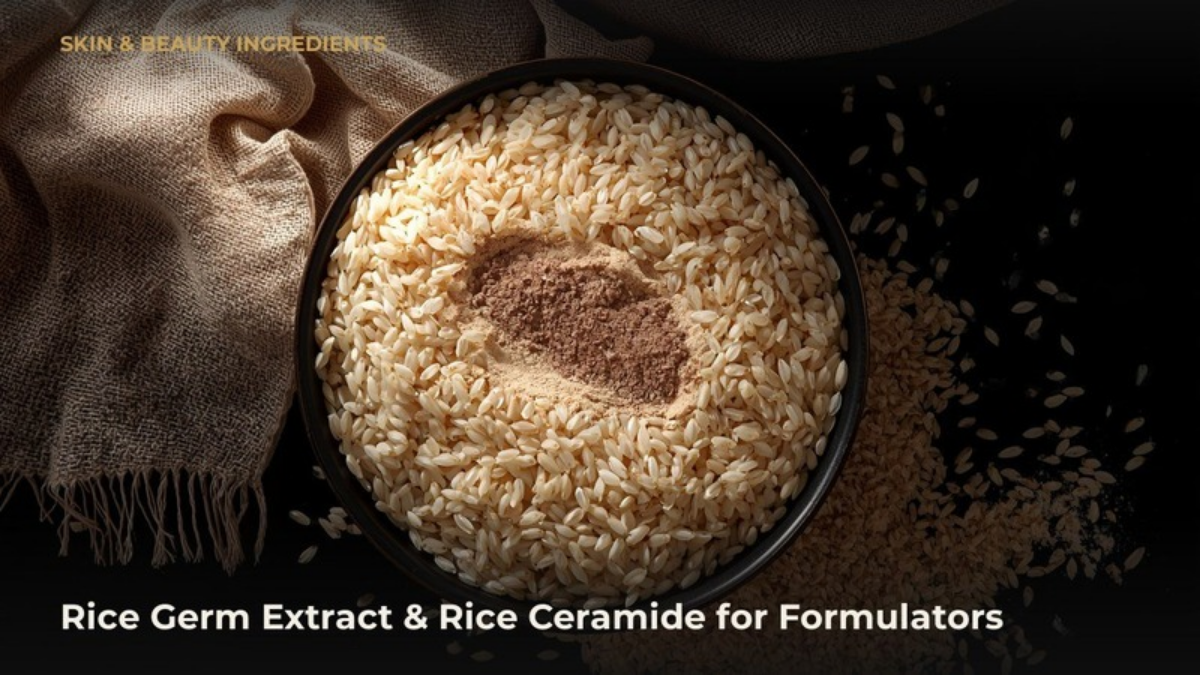
Rice Germ Extract and Rice Ceramide for Skin-and-Beauty Formulation: Evidence and Buyer Checks
Formulator’s summary: Rice germ extract (gamma-oryzanol) and rice ceramide are distinct Oryza sativa ingredient categories discussed in two human studies, but their tested materials are not identical to the catalogue products. The articles below separate study findings from product specifications; neither trial provides a dose, and neither result establishes a claim for a catalogue ingredient.
Quick facts for formulators
- Subjects: Rice germ extract associated with gamma-oryzanol, and rice ceramide
- Study materials: Enriched rice bran oil containing gamma-oryzanol and phytosterol esters; oral rice ceramides
- Catalogue specification: Product-specific values are stated only where available from the relevant product information
What is the scope of this ingredient review?
This guide addresses two rice-derived ingredient topics for R&D and procurement: rice germ extract associated with gamma-oryzanol, and rice ceramide. The human studies reviewed here concern distinct intervention materials. Their results are not specifications for, or evidence about, any Bionutricia catalogue ingredient.
The live catalogue content retrieved for this run did not provide a dedicated rice germ extract or rice ceramide product page or buyer guide. Brown rice powder is a separate catalogue item; its page describes brown rice as a grain with bran and germ layers, but does not specify a gamma-oryzanol assay or identify it as a standardised rice germ extract. See the Brown Rice (Oryza sativa L.) Powder page for that distinct ingredient.
What did the human studies examine?
| Study | Material and design | Participants and follow-up | Reported observations | Interpretation boundary |
|---|---|---|---|---|
| Jinnin et al., The Journal of Dermatology, 2026. DOI: 10.1111/1346-8138.70307 | Placebo-controlled, randomised, double-blind, parallel-group study of rice bran oil enriched with gamma-oryzanol and phytosterol esters | 70 healthy Japanese men and women; 12 weeks | Stratum corneum water content was significantly higher than baseline at weeks 4, 8 and 12, and higher than placebo at weeks 8 and 12. UV spot scores fell at week 4 in placebo and at weeks 8 to 12 in the test group; redness scores fell earlier in the test group. Subjective skin satisfaction rose in the test group at weeks 4, 8 and 12, not in placebo. | The intervention was an enriched oil with two actives, not gamma-oryzanol alone and not rice germ extract powder. No gamma-oryzanol amount is stated in the abstract. |
| Nutrients, 2022;14(13):2737. PMID: 35807914 | Open-label prospective study of oral rice (Oryza sativa) ceramides; no placebo or control group | 50 volunteers with monthly follow-up; dose not stated | Reported changes included hydration, sebum, firmness, elasticity and wrinkle severity at the left cheek, dorsal neck and right inner forearm; reductions in transepidermal water loss, melanin index and erythema index. Older participants were reported to respond more. | Without a control group, the result cannot be separated from expectation or seasonal change. No dose is stated. |
These are ingredient-level study reports, not efficacy claims for any catalogue product. The two study materials differ from one another and from the brown rice powder page’s described product. The rice ceramide study’s open-label design also limits attribution of observed changes.
How should formulators distinguish the ingredients and specifications?
Gamma-oryzanol is named in the supplied study summary as part of rice bran oil enriched with phytosterol esters. That intervention does not establish the composition or assay of a rice germ extract powder. A buyer assessing a proposed material should check the ingredient identity, physical form, assay marker, standardisation basis and lot documentation against the purchase specification.
For rice ceramide, identify the stated rice ceramide material and its assay basis from the supplier’s current specification. The human study describes oral rice ceramides but does not state a dose in the abstract. Neither that study nor the enriched-oil study establishes the form, marker percentage, solubility, certifications or packaging of a catalogue item.
A standardised extract is defined by a specified marker and assay acceptance range with lot-level evidence, whereas crude botanical powder is identified by the plant material and form without an equivalent marker specification unless its documentation says otherwise. Procurement should require the certificate of analysis (COA) per lot to confirm the marker and assay where applicable; no marker percentage should be inferred from the name of an ingredient.
What should a buyer verify before qualification?
- Confirm botanical identity and the exact ingredient material: rice germ extract, rice bran oil, or rice ceramide.
- Check physical form and assay marker only against the current product specification.
- Review the lot COA and agreed acceptance criteria for any standardised marker.
- Request supporting specification, quality and export documentation relevant to the intended application.
- Assess sensory, dispersion, compatibility and stability in the intended cosmetic or other formulation matrix.
Keep study material, catalogue identity and finished formulation specifications as separate records. Study outcomes should not be transferred to a supplier product unless the intervention and the supplied material are shown to match and the claim is separately substantiated.
Supplying rice ingredients and related catalogue materials
The published catalogue page retrieved for this run is Brown Rice (Oryza sativa L.) Powder; it is not presented as rice germ extract or rice ceramide. Other related catalogue ingredients for a formulator to review independently include Tocotrienol Oil Powder (Natural Vitamin E) and White Fungus (Tremella fuciformis) Extract Powder. Their product pages should be treated as separate specifications, not as substitutes for the study materials discussed above.
Bionutricia Extract publishes bulk ingredient supply, COA per lot, documentation and export paperwork, and packing options. Published quality credentials include FSSC 22000, JAKIM Halal, GMP, HACCP, MESTI and US FDA facility registration. Buyers should qualify each ingredient against its own current specification and intended application.
Frequently asked questions
Did the gamma-oryzanol study test rice germ extract powder? No. It tested rice bran oil enriched with gamma-oryzanol and phytosterol esters. The abstract does not state the gamma-oryzanol amount.
What dose of gamma-oryzanol was used? The abstract does not state a gamma-oryzanol amount, so no dose can be reported from that source.
What were the limitations of the rice ceramide study? It was an open-label prospective study without a placebo or control group, so expectation or seasonal change cannot be separated from the reported observations. The abstract gives no dose.
Do these human studies establish efficacy for a catalogue ingredient? No. The study materials are not established as identical to a catalogue product, and the findings should not be transferred to a supplier’s ingredient.
Request product documentation
Request the specification and certificate of analysis for Brown Rice (Oryza sativa L.) Powder. Rice germ extract and rice ceramide are discussed as study topics here, not as verified catalogue product pages.