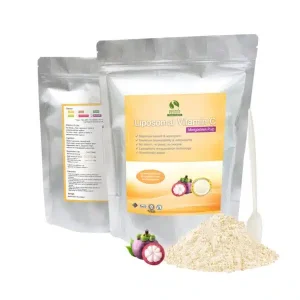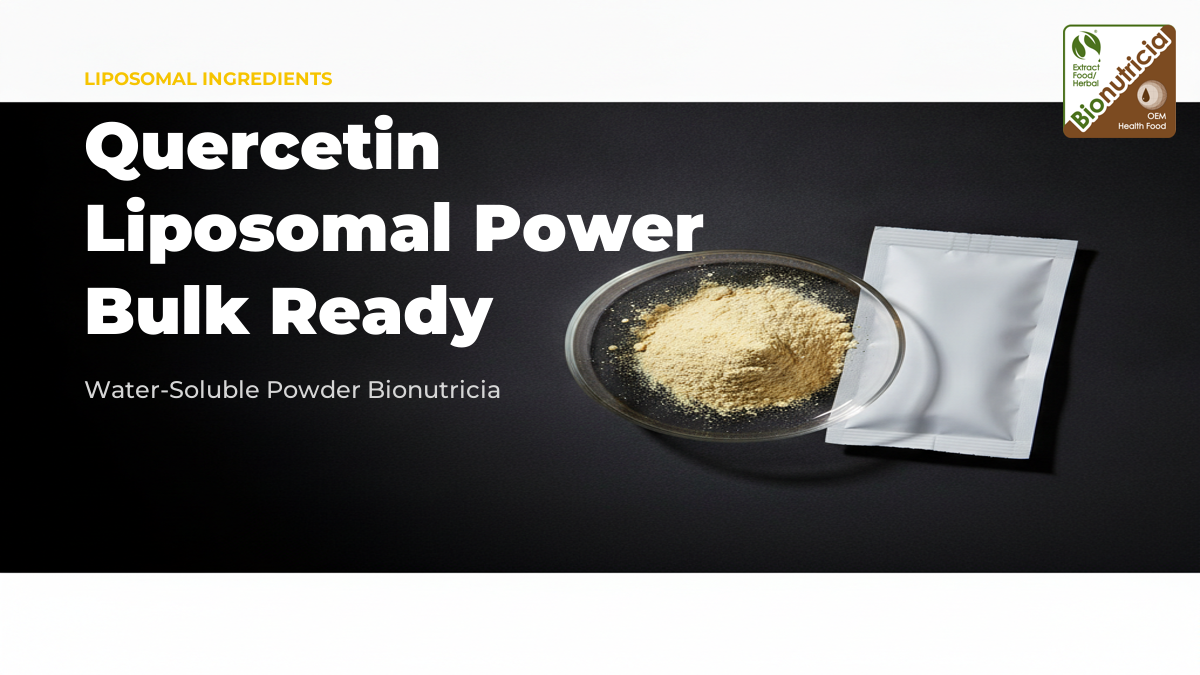
Liposomal quercetin powder is a water-soluble form of the flavonol quercetin, carried in a phospholipid matrix and dried into a light yellow powder. Quercetin’s commercial problem has always been the same one: as a raw crystalline aglycone it is practically insoluble in water, so it sinks, sediments and grits in any drinkable format. This ingredient exists to remove that obstacle. The buyer’s risk is that “liposomal” is an unregulated descriptor in the ingredient trade — so the things worth contracting on are the assayed quercetin load, the stated solubility and the contaminant limits, not the label on the drum.
Three ways quercetin reaches a formulation
| Route | How it works | What it means for your formulation |
|---|---|---|
| Quercetin aglycone (95%+ powder) | Extracted, typically from Sophora japonica buds, and purified to a high-assay crystalline powder | Highest active per gram and lowest cost per unit of quercetin, but practically insoluble in water. Works in capsules and tablets; unusable in a clear drink |
| Quercetin dihydrate or rutin-derived glycosides | Quercetin in a glycoside or hydrate form | Somewhat better handling, but the assay is diluted by the sugar moiety and dissolution is still limited for beverage use |
| Liposomal quercetin powder (this ingredient) | Quercetin carried in a phospholipid matrix, then dried into a powder | Lower assay per gram — Bionutricia’s specification states 45–55% quercetin — but the powder is water-soluble, which is what makes sachets, effervescents and beverages practical |
Where the activity comes from
Quercetin is a flavonol — C15H10O7 — built on the flavone backbone with five hydroxyl groups positioned on the A and B rings and the central pyranone. That hydroxylation pattern, particularly the catechol arrangement on the B ring, is what gives quercetin its well-documented radical-scavenging and metal-chelating chemistry in laboratory systems. It is also the source of the commercial difficulty: the planar, extensively hydrogen-bonded crystal is stable and stubbornly water-repellent, which is why formulators reach for carrier systems rather than the raw aglycone when the format has to dissolve.
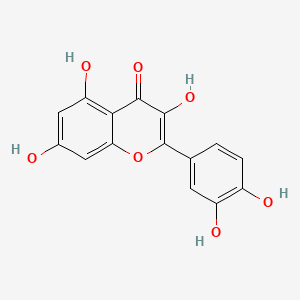
Bionutricia’s specification assays quercetin at 45–55% and states that the powder is soluble in water at pH 5–7. Read the assay for what it is: a quercetin content figure on the finished powder. It says nothing on its own about absorption in humans, which is a separate question requiring work on the finished product.
What this ingredient is not
- It is not a 95% quercetin powder. The specification states 45–55%. If you are comparing quotes, normalise them to cost per gram of quercetin, not cost per kilogram of powder.
- It is not an absorption claim. Water solubility is a measured physical property. Enhanced bioavailability in humans is a claim that needs evidence generated on your material, and this specification does not assert it.
- It is not free-flowing. The specification describes the powder as non-free-flowing, so dosing accuracy on a high-speed sachet line needs to be proven with a real trial rather than assumed.
Specification: what to check and why it matters
| Parameter | Bionutricia specification | Why a buyer checks it |
|---|---|---|
| Quercetin content | 45–55% | Sets inclusion rate and true cost per unit of active |
| Appearance | Light yellow powder, non-free-flowing | Drives handling, blending and filling equipment; also colour carry-over |
| Solubility | Soluble in water | The reason the format exists. Verify in your own base and at your own temperature |
| Moisture | <10% | Caking risk, microbial stability and shelf life in your pack |
| pH | 5–7 | Mildly acidic to neutral; check compatibility with an acidified beverage base |
| Particle size | >95% through 20 mesh | Coarser than a typical 60-mesh extract — affects dissolution rate and mouthfeel |
| Heavy metals | Arsenic <0.1 ppm; lead <0.2 ppm; mercury <0.05 ppm; cadmium <0.5 ppm; antimony <0.5 ppm | A fuller metals panel than many botanical specifications. Ask for lot results, not just limits |
| Microbiology | Aerobic plate count <10⁴ CFU/g; yeast & mould <10³ CFU/g; coliforms <10² CFU/g; E. coli absent in 1 g | Standard hygiene envelope for a dried preparation |
| Recommended dosage | 480–960 mg | A formulation starting range from the specification, not a clinically established dose |
| Pack sizes | 1 kg, 5 kg, 10 kg | Order a 1 kg pack for handling and dissolution trials before bulk |
Figures above are taken from Bionutricia’s product specification for liposomal quercetin powder, Version 01, January 2024. These are specification limits; reconcile them against the certificate of analysis for your lot.
Regulatory and compliance position
The specification states:
- Non-GMO
- Not irradiated
- Not a novel food
- Suitable for vegetarians and vegans
- Halal
- Free of the declarable allergens
- Gluten-free at <20 ppm
- Country of origin: Malaysia
- Safety data sheet available on request
What the clinical literature actually shows
Human work on quercetin is mostly small and mostly in the exercise and antioxidant space. In a randomised, single-blind crossover study published in Frontiers in Nutrition, Tsao and colleagues gave 12 physically active healthy men 1,000 mg of quercetin per day for seven days, with a 14-day washout between arms. Compared with placebo, the quercetin arm cycled longer to exhaustion in a second exercise bout (37.29 versus 30.72 minutes), showed a blunted post-exercise insulin response, and had higher total antioxidant capacity and superoxide dismutase activity with lower malondialdehyde, interleukin-6 and creatine kinase.
Source: Tsao J-P, Bernard JR, Hsu H-C, Hsu C-L, Liao S-F, Cheng I-S. Short-Term Oral Quercetin Supplementation Improves Post-exercise Insulin Sensitivity, Antioxidant Capacity and Enhances Subsequent Cycling Time to Exhaustion in Healthy Adults: A Pilot Study. Frontiers in Nutrition. 2022.
Where buyers use this material
- Sachet and stick-pack drink powders, including effervescent bases
- Ready-to-mix sports and recovery formulations
- Immune and everyday-wellness blends where a dissolving format is preferred
- Chewables and gummies where a gritty aglycone would be detectable
- Combination formulas with vitamin C or zinc in a drinkable format
Sourcing checklist before you commit to a lot
- Request the certificate of analysis for the specific lot, not only the specification sheet.
- Normalise every competing quote to cost per gram of quercetin, not per kilogram of powder.
- Ask for the botanical origin, encapsulation method and phospholipid source in writing.
- Run a dissolution and sensory trial in your own base at your own fill temperature.
- Check the metals panel against your destination market’s limits.
- Trial the 1 kg pack on your real filling line before committing to bulk, given the non-free-flowing behaviour.
- Confirm halal certificate scope and validity if you are shipping into a certified market.
Why buyers work with Bionutricia
Bionutricia Manufacturing Sdn Bhd has produced botanical extracts and finished supplement formats in Malaysia since 2006 and now supports more than 239 brand partners. The plant operates under JAKIM Halal certification, FSSC 22000, GMP, HACCP, MeSTI and NanoVerify, and holds patent MY-188945-A for its encapsulation work. Because extraction, encapsulation and finished-format manufacturing sit in one facility, a pilot sachet or beverage can be built from the same lot of powder that will later supply the production run.
Frequently asked questions
The specification states 45–55% quercetin. Compare quotes on cost per gram of quercetin rather than per kilogram of powder.
The specification states the powder is soluble in water, at a specification pH of 5–7. Quercetin is yellow, so expect colour in the finished drink, and always trial in your own base.
The specification does not make that claim, and neither do we on its behalf. It states water solubility as a physical property. Any absorption claim needs evidence generated on your finished formulation.
Arsenic below 0.1 ppm, lead below 0.2 ppm, mercury below 0.05 ppm, cadmium below 0.5 ppm and antimony below 0.5 ppm, with E. coli absent in 1 g. Request the lot certificate for actual results.
The specification gives 480–960 mg as a recommended range. That is a starting point for formulation, not an established clinical dose.
The specification states the material is halal, suitable for vegetarians and vegans, non-GMO, not irradiated, allergen-free and gluten-free below 20 ppm.
1 kg, 5 kg and 10 kg. Start with 1 kg for handling, dissolution and sensory work.
Not directly. The studies were run on other quercetin materials, and the exercise trial cited above was a 12-person pilot. Claims on your finished product must follow your market’s rules and are best supported by your own data.
Ready to specify it? See the Liposomal Quercetin Powder bulk product page for the specification snapshot, pack sizes and a quotation request.
Tell us the format you are building and we will send the documentation your dossier needs. Contact the Bionutricia ingredient team.