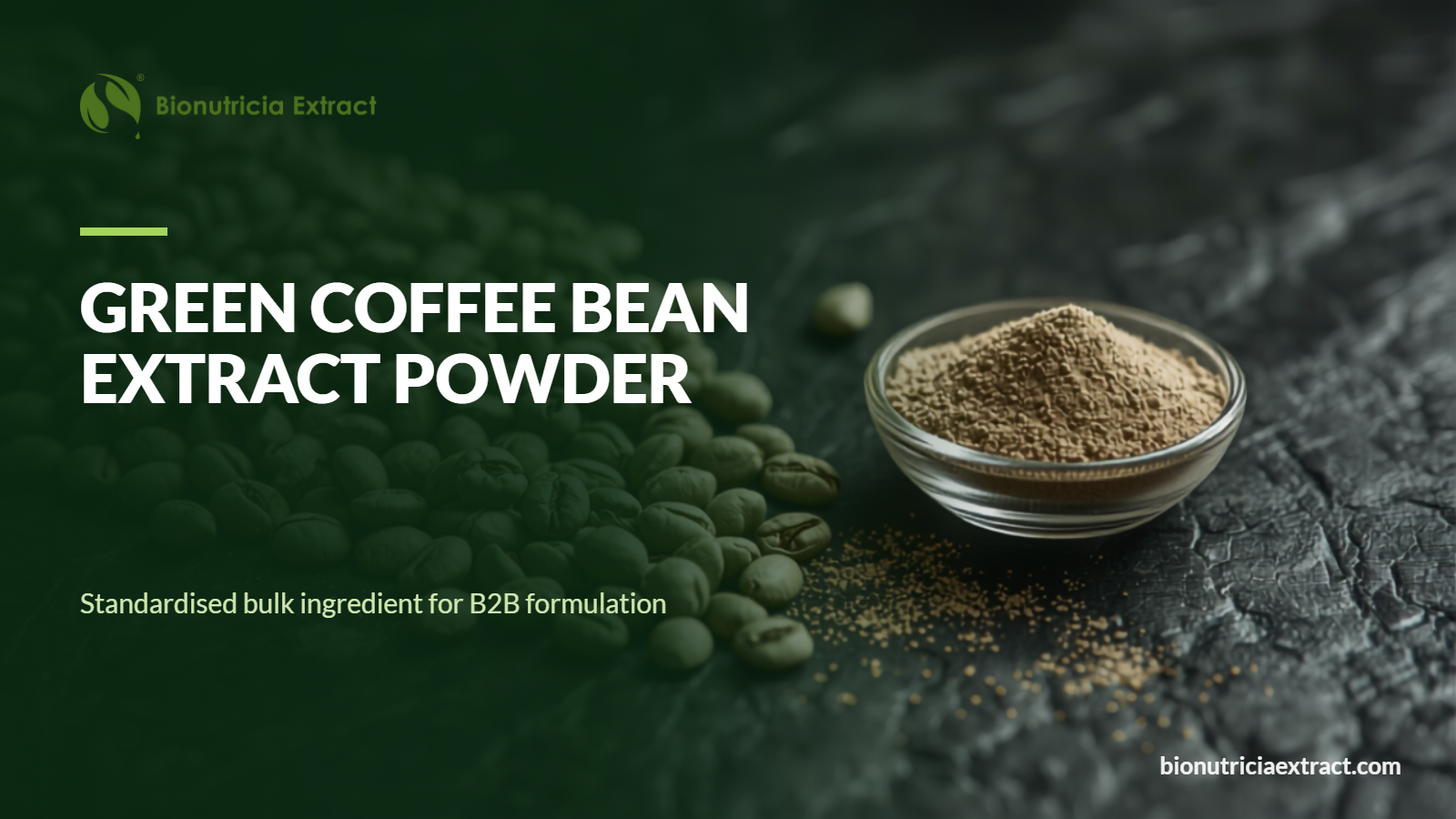
Green coffee bean extract powder is a water-soluble 100:1 extract of green (unroasted) Coffea beans, naturally containing chlorogenic acid and supplied as a stable light-brown powder for B2B and OEM use. It is manufactured in bulk by Bionutricia Extract (Bionutricia Manufacturing Sdn Bhd), a JAKIM Halal, FSSC 22000, GMP, HACCP and MeSTI manufacturer in Malaysia, with a Certificate of Analysis on every lot.
Quick facts for formulators
- Botanical / part: Coffea, seed (green/unroasted bean)
- Extraction ratio: 100:1 · ultrasonic (water) extraction
- Signature phytonutrient: chlorogenic acid — stated compositionally on the house spec
- Form / colour / odour: free-flowing light-brown powder, characteristic odour
- Solubility: soluble in water · pH: 5–6 · Dosage: 250–1000 mg · Particle: >95% / 60 mesh
- Moisture: 2–8% · Pack sizes: 1 kg · 5 kg · 20 kg
- Certifications: JAKIM Halal · FSSC 22000 · GMP · HACCP · MeSTI · COA per lot
- Clean label: vegan, non-GMO, gluten-free (<20 ppm), not irradiated, no listed allergens
- Shelf life: 24 months sealed, cool & dry · Origin: Malaysia
- Heavy metals: As ≤1 · Pb ≤2 · Cd ≤1 · Hg ≤0.05 ppm · Microbial: within limits
What is green coffee bean extract powder?
Green coffee bean extract is made from the seeds of the Coffea plant that have not been roasted. Roasting develops coffee's flavour but also lowers its naturally occurring chlorogenic acid; by extracting the green bean, that phytonutrient is better retained. Bionutricia's green coffee bean extract is a 100:1 extract concentrated by a patented ultrasonic extraction process and dried into a stable, free-flowing light-brown powder that dissolves in water. Chlorogenic acid is named compositionally on the house specification and confirmed on each batch Certificate of Analysis — this is a statement about what the material contains, not a physiological claim. The result is a consistent, easy-to-handle raw material in place of variable bean inputs.
What is it used for in formulation?
It is supplied as a bulk raw ingredient to brand owners and manufacturers, who formulate it into their own finished products: supplement premixes and capsules, energy and metabolic-support blends, sachet drink powders and ready-to-drink beverages — as well as tablets, gummies or any other finished format the brand chooses to produce. Its water solubility and neutral handling make it well suited to both dry-blend and beverage systems. The powder is typically dosed at 250–1000 mg per serving, adjusted to the target format. Bionutricia supplies the bulk ingredient for B2B formulation; brand owners formulate it into their chosen finished dosage form.
Typical specification
| Parameter | Value |
|---|---|
| Botanical source / part | Coffea, seed (green/unroasted bean) |
| Extraction ratio | 100:1 |
| Signature phytonutrient | Chlorogenic acid (compositional) |
| Appearance / colour | Free-flowing powder, light brown |
| Odour | Characteristic |
| Solubility in water | Soluble |
| pH | 5–6 |
| Moisture | 2–8% |
| Particle size / mesh | > 95% through 60 mesh |
| Dosage | 250–1000 mg |
| Heavy metals (As, Pb, Cd, Hg) | As ≤ 1 ppm, Pb ≤ 2 ppm, Cd ≤ 1 ppm, Hg ≤ 0.05 ppm |
| Microbial (APC, Y&M, coliform, E. coli) | APC ≤ 10⁴ cfu/g, Y&M ≤ 10³ cfu/g, coliforms ≤ 10² cfu/g, E. coli absent |
| Certifications | JAKIM Halal, FSSC 22000, GMP, HACCP, MeSTI |
| Shelf life | 24 months sealed, cool & dry |
| Pack sizes | 1 kg, 5 kg, 20 kg |
| Country of origin | Malaysia |
Why buy green coffee extract from Bionutricia?
Bionutricia Extract has manufactured standardized botanical extracts since 2006 under a full halal and international food-safety stack (JAKIM Halal, FSSC 22000, GMP, HACCP, MeSTI), issuing a Certificate of Analysis on every lot. Its patented (MY-188945-A) enzymatic + ultrasonic extraction process concentrates the green bean into a clean, water-soluble powder that retains chlorogenic acid — without added preservatives or artificial colours. Bulk OEM supply, custom standardisation and packing are available for brand owners and manufacturers, and the same range includes a separate roasted coffee flavour extract for beverage and dessert use.
How to specify it on your purchase order
Most disputes over a botanical extract come from a specification that was never written down properly, not from a manufacturing failure. Before you raise a purchase order for green coffee bean extract powder, put the following in writing so that both sides are describing the same material:
| State this | Why it matters |
|---|---|
| Extraction ratio | The ratio defines how much raw botanical stands behind each kilogram of powder. Two products with the same botanical name and different ratios are not interchangeable. |
| Marker or assay basis | Name the compound the assay is run against and the method used, so a percentage on one COA can be compared with a percentage on another. |
| Particle size / mesh | Fixes the flow, dispersion and blending behaviour you will get in your own process, and is the parameter most often left off an enquiry. |
| Carrier declaration | The carrier or emulsifier belongs on the specification so that allergen, vegan and halal status can be assessed by your regulatory team. |
| Pack size | Bionutricia supplies in 1 kg, 5 kg and 20 kg packs. State which you want, because it affects lead time and packing. |
| Halal and market status | Confirm the certification you require for your destination market before the first shipment, not after it. |
| Documents required | Say up front whether you need a specification sheet, a batch COA, a flow chart, an MSDS or a halal certificate, and in whose name. |
Quality control and documentation
Green coffee bean extract powder is released against a house specification and a batch-specific Certificate of Analysis. The COA carries the lot number you are actually receiving, and confirmatory testing is performed by ISO/IEC 17025-accredited third-party laboratories rather than in-house alone.
The routine panel covers identity and assay, moisture, particle size, heavy metals (arsenic, lead, mercury, cadmium) and a microbial panel comprising total plate count, yeast and mould, coliforms and the absence of E. coli and S. aureus in a stated sample weight. Contaminant screening beyond that panel — pesticide residues and mycotoxins in particular — is risk-based rather than universal: it is applied where the matrix carries meaningful risk, or where the destination market requires it. If your market needs a specific residue or mycotoxin result, ask at the enquiry stage and we will confirm what is already in place for this material and arrange the rest.
All of it sits inside a certified food-safety system — FSSC 22000, GMP, HACCP, JAKIM Halal, US FDA registration and MeSTI, together with NanoVerify certification — operated from our Sungai Buloh, Selangor facility, with export through Port Klang.
How the extract is manufactured
Bionutricia manufactures its extracts using a patented enzymatic and ultrasonic process (MY-188945-A, “Process for Preparing Nutritional Powder Extract”). Enzymatic pre-treatment opens the plant matrix so that target constituents are released at lower temperature, and ultrasonic energy improves mass transfer without the long, hot hold times that degrade heat-sensitive compounds. The result is a higher and more controlled active yield, a shorter cycle and a lower energy and effluent burden than conventional long-soak extraction.
The concentrate is then dried to a stable, standardised powder. Process parameters, enzyme systems and solvent details are proprietary and are not published; what we do publish is the specification the finished powder is held to, and the batch COA that evidences it. Where an emulsifier is required for a powder, Bionutricia uses arabic gum and never sodium caseinate or synthetic emulsifiers — sodium caseinate is milk-derived, which makes it a declarable allergen and complicates vegan, dairy-free and halal review.
Storage, shelf life and handling
Keep the material in its original sealed packaging, in a cool, dry place away from direct sunlight, and reseal promptly after sampling. Botanical extract powders are hygroscopic to varying degrees: the most common cause of caking, colour drift and a failed moisture retest is a container left open on a humid factory floor, not a fault in the powder.
Bring sealed packs to ambient temperature before opening, so that condensation does not form on cold powder. Retain a sealed sample of each lot in your own store for the duration of your finished product’s shelf life; it is the fastest way to settle a question about a batch later. Stated shelf life applies to unopened material stored under the recommended conditions, and the specific figure for the lot is given on the specification sheet.
Need a specification sheet and COA for green coffee bean extract powder?
Related guides
Frequently asked questions
Is it halal certified? Yes — JAKIM Halal (verifiable on the Halal Malaysia portal), plus FSSC 22000, GMP, HACCP, MeSTI; COA per lot.
What is it standardized to / is a COA available? 100:1 water-soluble green-bean extract that naturally contains chlorogenic acid (named compositionally on the house spec); moisture 2–8%, pH 5–6; COA per lot.
Is it water-soluble? Yes — soluble in water, dosed 250–1000 mg per serving.
Green vs roasted coffee? Green coffee is unroasted, so it retains more naturally occurring chlorogenic acid; a separate roasted coffee flavour extract is also available.
Clean-label option? Vegan, non-GMO, gluten-free (<20 ppm), not irradiated; no listed allergens.
Applications? Supplement blends, energy and metabolic-support formulas, functional beverages — and any finished format the brand owner chooses to produce.
Pack sizes & OEM? 1 kg · 5 kg · 20 kg; bulk MOQ and pricing on quotation. Bionutricia supplies the bulk ingredient for B2B formulation; brand owners formulate it into their chosen finished format.
Samples? Paid samples for serious B2B enquiries; bulk supply and custom standardisation available.