Freeze Dry vs Spray Dry for Botanical Extracts — Which Preserves Actives Better?
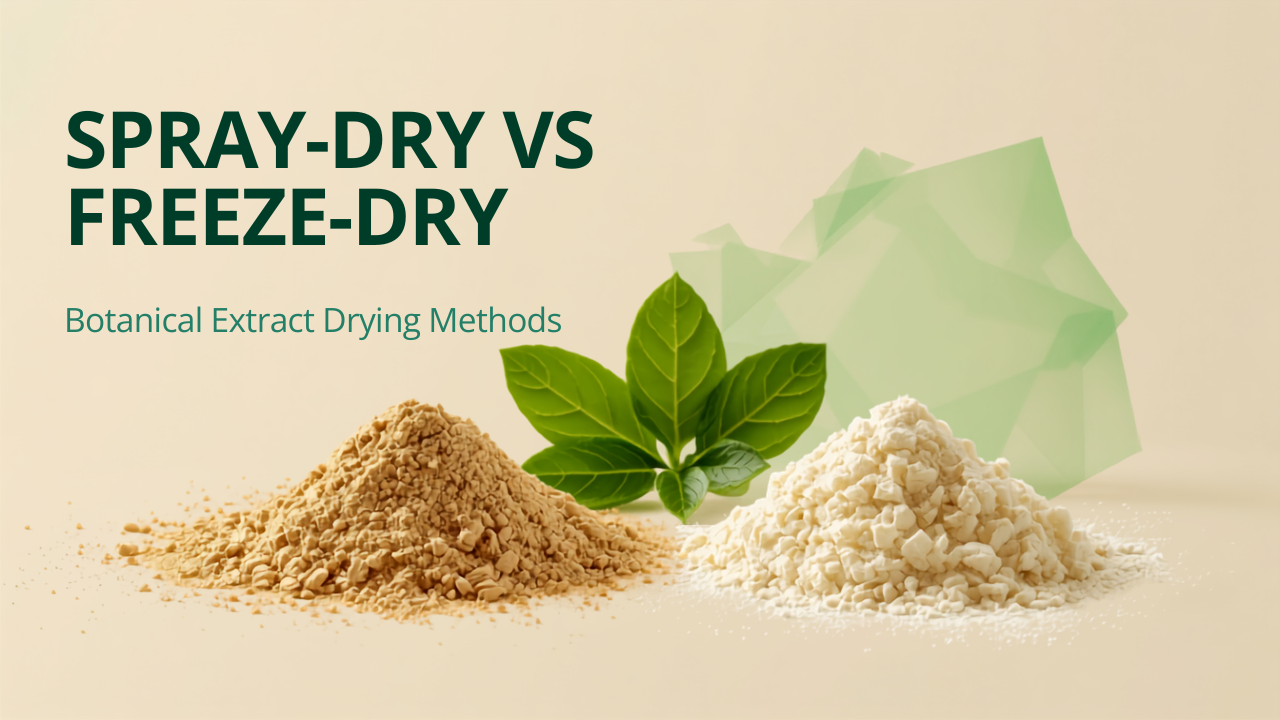
The difference between freeze drying and spray drying for plant extracts is heat and speed. Freeze drying (lyophilisation) removes water by freezing the extract and drawing off the ice under vacuum at very low temperatures, which is gentle on heat-sensitive actives but slower and more costly. Spray drying atomises a liquid extract into a stream of hot air, evaporating the water in seconds to produce a free-flowing powder — faster and more economical at scale, but with brief exposure to heat. Which one “preserves actives better” depends on the ingredient: delicate, heat-labile compounds and natural pigments often favour freeze drying, while robust extracts destined for large-volume, cost-sensitive applications are well served by spray drying. Bionutricia Extract, Southeast Asia’s only manufacturer with Herbosomal® technology, advises on and operates both approaches from its FSSC 22000-certified facility in Sungai Buloh, Selangor.
Quick comparison
- Freeze drying: very low temperature, gentle on actives — best for heat-sensitive compounds, pigments, aromatics; slower and costlier
- Spray drying: brief hot-air exposure, fast and continuous — best for robust extracts, large volumes, cost-sensitive lines
- No universal winner: the right method is chosen per ingredient, matched to the stability of the target compounds
- Also matters: our patented enzymatic + ultrasonic extraction (Malaysian patent MY-188945-A) lifts active yield before drying begins — and Herbosomal® encapsulation handles delivery
- MOQ & pricing: on quotation · COA: every batch, either method
What is the difference between freeze drying and spray drying for plant extracts?
Both are dehydration methods that turn a liquid botanical extract into a stable powder, but they work in opposite temperature regimes:
| Factor | Freeze drying (lyophilisation) | Spray drying |
|---|---|---|
| How it works | Freeze the extract, then sublimate ice under vacuum | Atomise liquid into hot air; water flashes off in seconds |
| Temperature exposure | Very low; well below ambient | Brief exposure to hot air |
| Best for | Heat-sensitive actives, delicate pigments, aromatics | Robust extracts, large volumes, cost-sensitive lines |
| Throughput | Slower, batch-based | Fast, continuous, high volume |
| Relative cost | Higher | Lower per kg at scale |
| Typical powder | Porous, light, may need milling | Free-flowing, uniform particles; often needs a carrier |
Freeze drying — the gentle route for delicate actives
Freeze drying is the method of choice when an extract contains compounds that degrade with heat, or natural colours and aromatics you want to keep intact. Because the water is removed while the material stays frozen, thermal stress is minimal, which helps retain heat-labile actives, colour and aroma. Freeze-dried powders tend to be light and porous and rehydrate readily. The trade-offs are time and cost: the cycle is slower and more energy-intensive than spray drying, so freeze drying is typically reserved for premium ingredients, botanicals with fragile pigments (such as certain flower and fruit extracts), and applications where preserving the native profile justifies the extra expense.
Spray drying — fast, uniform and economical at scale
Spray drying is the workhorse of large-volume ingredient manufacturing. A liquid extract is pumped through an atomiser into a chamber of hot air; the fine droplets lose their water almost instantly, and because each droplet is tiny, the actual time the material spends warm is very short. The result is a consistent, free-flowing powder that is easy to blend, dose and package. A carrier such as maltodextrin or gum acacia is often added to aid drying and stability. Spray drying is the practical, cost-effective choice for robust extracts produced in quantity — and for many botanicals the brief, controlled heat exposure preserves the actives perfectly well.
Which preserves actives better? It depends on the ingredient
There is no single winner. The right method is chosen per ingredient by matching the drying process to the stability of the target compounds. Heat-sensitive actives, natural pigments and volatile aromatics generally favour freeze drying; stable, high-volume extracts favour spray drying. Two other levers matter alongside the drying step: the extraction method and the delivery format. Bionutricia Extract uses its patented enzymatic + ultrasonic extraction process — Malaysian patent MY-188945-A, “Process for Preparing Nutritional Powder Extract” — a faster, greener route that supports higher active-compound yield than conventional extraction, so more of the valuable compounds are present before drying even begins. That is the step most buyers overlook: no drying method can recover an active the extraction never released. And for actives where absorption is the priority, our Herbosomal® liposomal encapsulation and sustained-release technology (a registered trademark, patent-pending PI2023005773) is designed to deliver up to 2× bioavailability; see What Is Herbosomal® Encapsulation?. Choosing extraction, drying and format together — not in isolation — is how you protect actives end to end.
How Bionutricia Extract helps you choose
From our Selangor facility we advise on the best drying route for each botanical and produce to your specification under OEM or private label. Every batch — freeze-dried or spray-dried — ships with a Certificate of Analysis and is made under our seven certifications: JAKIM Halal, FSSC 22000, US FDA registered, GMP, HACCP, MeSTI and NanoVerify. Whether you need a premium freeze-dried flower extract with its native colour intact, or an economical spray-dried powder for a large-volume line, we match the process to your active, your budget and your target markets across Malaysia, the GCC, the UK and the USA. MOQ and pricing on quotation.
Frequently Asked Questions
Q: What is the difference between freeze drying and spray drying for plant extracts?
A: Freeze drying removes water by freezing the extract and sublimating the ice under vacuum at very low temperatures — gentle but slower and costlier. Spray drying atomises the liquid into hot air, flashing off the water in seconds — fast and economical at scale, with brief heat exposure.
Q: Which method preserves actives better?
A: It depends on the ingredient. Heat-sensitive actives, delicate pigments and aromatics generally favour freeze drying; robust, high-volume extracts are well served by spray drying, where the heat exposure is very brief.
Q: Is spray drying bad for the actives?
A: Not necessarily. Because each droplet is tiny, the material spends very little time warm, and for many botanicals the actives are preserved well. A carrier is often added to aid drying and stability.
Q: Do you offer both freeze drying and spray drying?
A: Yes. Bionutricia Extract advises on and operates both, choosing the route per ingredient and producing to your specification under OEM or private label.
Q: Does the extraction method matter as much as the drying method?
A: Yes. Our patented enzymatic + ultrasonic extraction process (Malaysian patent MY-188945-A) supports higher active-compound yield before drying begins, and Herbosomal® encapsulation can further protect and deliver actives. Extraction, drying and format are best chosen together.
Related Guides
Ready to choose the right drying process for your botanical extract? Contact Bionutricia Extract for bulk pricing, COA, and FSSC 22000 documentation. Email: ng@bio-nutricia.com | bionutriciaextract.com/contact