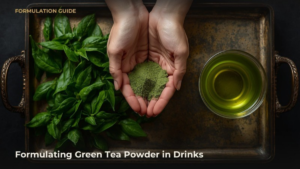
Matcha powder in Malaysia is sourced two ways: imported Japanese-grown stone-milled green tea powder, or blends manufactured locally around it — and for food, beverage and cafe businesses the practical questions are grade, halal status and reliable bulk supply. Matcha is shade-grown green tea (Camellia sinensis) whose whole leaf is milled to a fine powder, so you consume the leaf itself rather than an infusion. Good matcha is vivid green, finely milled, and for the Malaysian market should come with halal certification and a certificate of analysis.
What is matcha powder?
Tea plants destined for matcha are shaded for weeks before harvest, which raises chlorophyll and L-theanine in the leaf — the source of matcha’s colour and its smooth, umami taste. The leaves are steamed, dried, destemmed and milled to a micron-fine powder. Grades run from ceremonial (highest, for drinking straight) through premium latte grades to culinary grade for baking and ice cream, at very different price points.
Choosing matcha grades for a Malaysian F&B business
Cafes and beverage brands in Malaysia mostly need latte/premium culinary grade — vivid colour and clean taste that survive milk and sugar — rather than ceremonial grade, whose subtlety is lost in a latte. For bakery, ice cream and confectionery, culinary grade delivers the flavour at workable cost. Ask for colour and taste samples at your actual recipe dose, and check the harvest/milling dates: matcha fades from vivid green to olive as it ages.
Matcha, pandan matcha and local alternatives
A distinctly Malaysian angle is blending matcha with pandan — the “Asian vanilla” — for a local flavour signature. Our pandan matcha powder is a ready bulk blend, and our guides to pandan vs matcha and what pandan matcha is cover the flavour logic. For green colour without tea, moringa powder is the caffeine-free local option.
How to buy matcha powder in Malaysia in bulk: a checklist
- Grade honesty — ceremonial/latte/culinary defined by taste and colour at your dose, not by label.
- Freshness — harvest and milling dates; nitrogen-flushed or foil packing.
- Halal certification — JAKIM or a JAKIM-recognised foreign body; essential for Malaysian retail and HoReCa.
- Certificate of analysis — identity, moisture, heavy metals, microbial limits, and radiation screening documentation for Japanese-origin lots where required.
- Colour stability — request colour data over shelf life; green fades with light, heat and oxygen.
- MOQ, lead time and packing — 1 kg foil bags to bulk cartons; cold, dark storage.
Bulk matcha and matcha blends from a Malaysian supplier
Bionutricia Extract supplies matcha powder and pandan-matcha blends to Malaysian and regional F&B businesses — cafes, beverage brands, bakeries and OEM formulators — from a GMP, HACCP and FSSC 22000 certified, JAKIM halal-certified facility, with a COA on every batch. We handle blend development (matcha with pandan, gula or dairy systems) and OEM private-label packing from pilot MOQs upward.
Frequently asked questions
Is matcha powder halal?
Pure matcha is plant material; certification depends on the processing facility and any blend ingredients. Bionutricia Extract’s matcha products are handled in a JAKIM halal-certified plant.
What grade of matcha should a cafe in Malaysia buy?
Latte/premium culinary grade for drinks, culinary grade for bakery. Ceremonial grade is for drinking straight and is wasted in milk drinks.
How should matcha be stored in a tropical climate?
Airtight, cold and dark — refrigerated once opened. Heat and humidity dull the colour and flavour fast in Malaysia’s climate.
What is the MOQ for bulk matcha powder?
MOQs vary by grade and blend — contact us for pricing and lead times.
Building a matcha menu or product line in Malaysia? Talk to our team for samples, blends and bulk quotations.