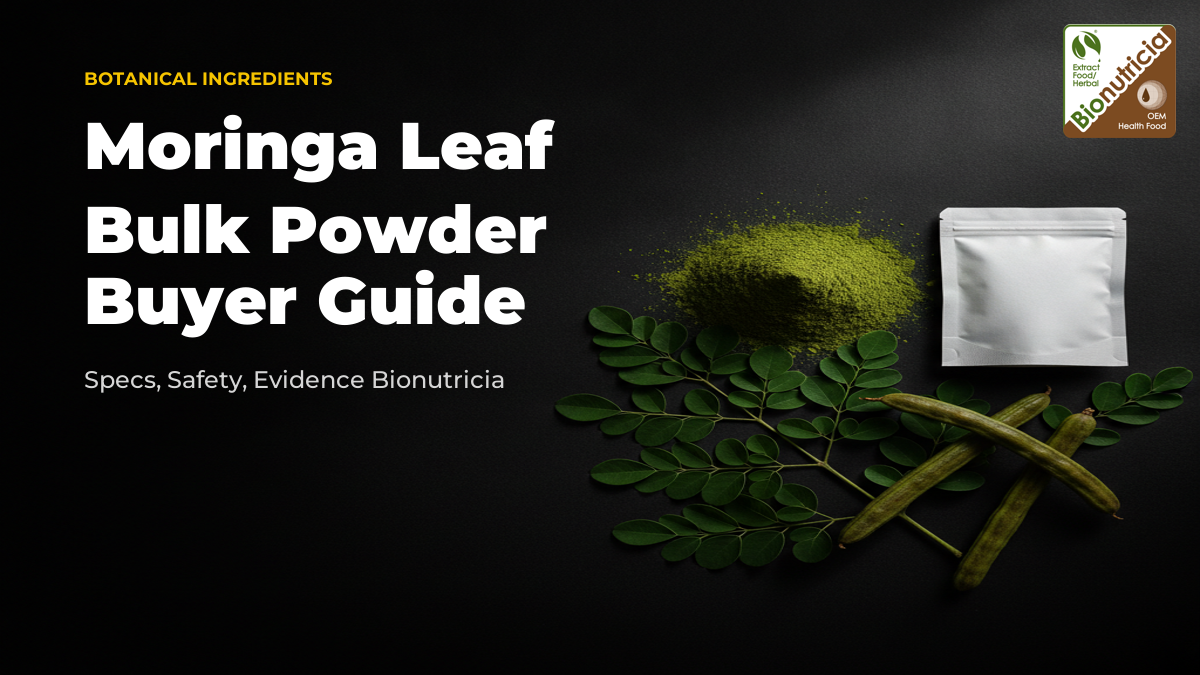
Moringa leaf powder is dried, milled Moringa oleifera leaf — a raw botanical ingredient, not a standardised extract. That distinction matters more here than for most ingredients on this site: there is no assayed active-compound percentage on the specification, because this is a whole-leaf powder sold on identity and cleanliness, not on a guaranteed potency figure. For a buyer, the practical risk sits less in efficacy claims and more in contaminant control — leaf powders concentrate whatever the plant absorbed from its soil and water, so the heavy-metal limits on the certificate of analysis matter as much as anything else on the sheet.
Where moringa sits versus a standardised extract
| Format | How it is made | What it means for your formulation |
|---|---|---|
| Moringa leaf powder (this ingredient) | Leaves dried and milled to a green powder, no extraction or standardisation step | Lowest cost per kilogram, carries the whole leaf’s fibre, chlorophyll and micronutrient profile, but no guaranteed active-compound percentage |
| Moringa leaf extract | Solvent or water extraction, sometimes concentrated to a stated ratio | Smaller inclusion weight for an equivalent dose of extractable compounds, higher cost, and typically an extraction-ratio or marker-compound spec |
| Standardised moringa extract (e.g. glucomoringin- or isothiocyanate-standardised) | Extracted and assayed to a named marker compound | The only format that lets you make a compound-content claim with a number behind it; also the most expensive and least commonly stocked |
Where the activity comes from
Moringa oleifera leaf is a complex matrix rather than a single active. The compound most often discussed in the research literature is quercetin, a flavonol also found in this article’s sibling guide on liposomal quercetin — present in moringa leaf as glycosides rather than as the free aglycone. Quercetin (C15H10O7) carries five hydroxyl groups across its two aromatic rings, and it is that hydroxylation pattern that accounts for the antioxidant chemistry commonly attributed to moringa leaf extracts in laboratory studies.
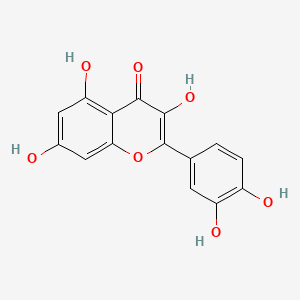
Bionutricia’s specification for this material states no extraction ratio and no standardised marker-compound percentage. It is described simply as moringa leaf powder, for use as a raw ingredient in health supplements.
What this ingredient is not
- It is not a standardised extract. There is no marker-compound percentage on the specification. If you need one for a label claim, ask about an extract, not this powder.
- It is not held to extract-grade heavy-metal limits. The specification’s metal ceilings are notably looser than Bionutricia’s purified extracts (arsenic up to 5 ppm here versus fractions of a ppm on standardised extracts), which is typical of whole-leaf raw materials but must be checked against your market’s rules.
- It is not a diabetes treatment. A cited trial below reports a glycaemic effect in a research setting; that is not the same as a medical claim you may make on a food supplement.
Specification: what to check and why it matters
| Parameter | Bionutricia specification | Why a buyer checks it |
|---|---|---|
| Scientific name / plant part | Moringa oleifera, leaves | Confirms species and plant part — moringa seed and root material have a different safety profile |
| Form | Powder | No extraction ratio or standardisation; priced and specified as a raw ingredient |
| Appearance | Green powder | Colour carry-over into finished blends and beverages |
| Moisture | <10% | Governs caking and microbial stability |
| pH | 5–7 | Near-neutral; unlikely to shift a finished blend’s pH materially |
| Particle size | >95% through 60 mesh | Finer than the liposomal actives in this range — relevant to mouthfeel and blend uniformity |
| Heavy metals | Arsenic ≤ 5 ppm; lead ≤ 10 ppm; cadmium ≤ 0.3 ppm; mercury ≤ 0.5 ppm | Notably wider limits than a purified extract, reflecting normal whole-leaf uptake from soil. Always request lot-specific results and compare to your market’s ceiling |
| Microbiology | Total plate count ≤ 10⁴ CFU/g; yeast & mould ≤ 10³ CFU/g; enterobacteria ≤ 10² CFU/g; E. coli, Salmonella and Staphylococcus absent | Standard hygiene envelope for a dried leaf material |
| Recommended dosage | 500–1000 mg, quantum satis | A formulation starting range from the specification, not a clinically established dose |
| Pack sizes | 100 g, 1 kg, 5 kg | The 100 g pack is enough for early sensory and colour trials |
Figures above are taken from Bionutricia’s product specification for moringa leaf powder, Version 03, August 2024. These are specification limits; reconcile against the certificate of analysis for your lot, particularly the heavy-metal panel.
Regulatory and compliance position
The specification states:
- Non-GMO
- Not irradiated
- Not a novel food
- Suitable for vegans
- Halal
- Free of the declarable allergens
- Gluten-free at <20 ppm
- Country of origin: Malaysia
What the clinical literature actually shows
The most directly relevant recent human study is a prospective, randomised, placebo-controlled trial by Leone and colleagues (2025), which enrolled 32 patients with type 2 diabetes and gave one group moringa leaf powder alongside standard care for four weeks, against a placebo-controlled comparison group. The moringa group showed improvements in glycaemic control measures relative to placebo over the study period.
Source: Leone A, et al. Randomised, placebo-controlled trial of moringa leaf powder in type 2 diabetes patients (n = 32, 4 weeks), 2025.
Where buyers use this material
- Green superfood blends and daily greens powders
- Everyday-wellness capsule and tablet formulations
- Smoothie and functional-food inclusions where colour and a “whole food” position are wanted
- Combination blends with other leafy or algae-based ingredients
- Animal feed and nutraceutical premixes (subject to separate specification review)
Sourcing checklist before you commit to a lot
- Request the certificate of analysis for the specific lot, not only the specification sheet.
- Pay particular attention to the heavy-metal results — leaf powders vary lot to lot with growing conditions.
- Confirm this is leaf material only, not a blend with seed, root or stem.
- If your claim needs a marker-compound percentage, ask about a standardised extract instead of this raw powder.
- Run your own colour and sensory trial in the finished blend — moringa’s flavour and green colour carry strongly.
- Check your destination market’s specific rules on any glycaemic or wellness claim before drafting label copy.
- Confirm halal certificate scope and validity dates if shipping into a certified market.
Why buyers work with Bionutricia
Bionutricia Manufacturing Sdn Bhd has produced botanical extracts and finished supplement formats in Malaysia since 2006 and now supports more than 239 brand partners. The plant operates under JAKIM Halal certification, FSSC 22000, GMP, HACCP and MeSTI. For a raw leaf material like this one, the value for buyers is consistent lot-to-lot testing and documentation — including the heavy-metal panel that matters most for a whole-leaf ingredient — backed by a facility that can also extract or standardise the same leaf if your formulation later needs that instead.
Frequently asked questions
No. The specification carries no extraction ratio or marker-compound percentage. It is a raw, milled leaf powder.
None. If your claim or dossier requires a guaranteed compound percentage, ask about a standardised moringa extract instead of this leaf powder.
Because this is a whole-leaf raw material rather than a purified extract, and leaves naturally take up more soil-derived metals than an extraction process leaves behind. Always check lot results against your specific market’s ceiling.
Not on the basis of the cited research alone. The trial referenced was a small, short, clinically supervised study in diagnosed diabetes patients, and most markets do not permit disease-management claims on a food supplement. Take local regulatory advice before drafting any claim.
500–1000 mg on a quantum satis basis. Treat this as a formulation starting point, not a clinically established dose.
The specification states halal, suitable for vegans, non-GMO, not irradiated, allergen-free and gluten-free below 20 ppm.
100 g, 1 kg and 5 kg. The 100 g pack is enough for colour and sensory screening before a bulk order.
Moringa leaf is reported in the research literature to contain flavonol glycosides including quercetin derivatives, but the specification does not assay or guarantee a quercetin percentage — it is a whole-leaf powder, not a standardised extract.
Ready to specify it? See the Moringa Leaf Powder bulk product page for the specification snapshot, pack sizes and a quotation request.
Tell us your format and target market and we will send the documentation your review needs, including the full heavy-metal panel. Contact the Bionutricia ingredient team.