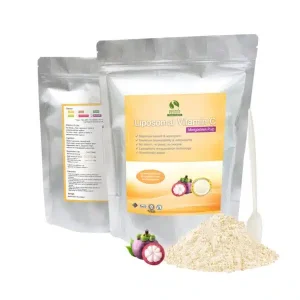
Liposomal glutathione powder is a water-soluble, creamy-white ingredient in which L-glutathione is carried in a phospholipid matrix and dried for use in supplements and drinkable formats. Glutathione is the reason the format exists: as a free tripeptide it is chemically fragile — it oxidises readily and is extensively broken down in the gut — so carrier systems are the industry’s usual answer. The buyer’s difficulty is that “liposomal” is not a controlled term in the ingredient trade. What you can verify and contract on is the assayed L-glutathione load, the stated solubility, and the contaminant and microbiological limits on the certificate of analysis.
Three ways glutathione reaches a formulation
| Route | How it works | What it means for your formulation |
|---|---|---|
| Reduced L-glutathione (98%+ powder) | Fermentation-derived tripeptide, purified to a high-assay powder | Highest active per gram and lowest cost per unit of glutathione, but hygroscopic, sulphurous in odour, and sensitive to oxidation in a wet system |
| S-acetyl glutathione | Glutathione with an acetyl group on the cysteine sulphur | More stable to oxidation, but a different regulatory and cost position, and a different assay basis on the label |
| Liposomal glutathione powder (this ingredient) | L-glutathione carried in a phospholipid matrix, then dried to a powder | Lower assay per gram — Bionutricia’s specification states 40–50% L-glutathione — but the powder is water-soluble, which is what makes sachets and drinkable beauty formats workable |
Where the activity comes from
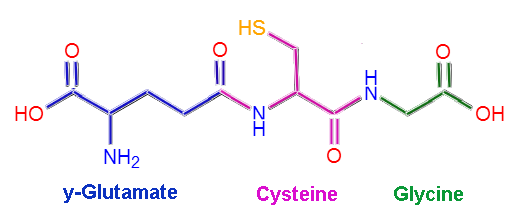
Glutathione is not a plant extract — it is a tripeptide, γ-L-glutamyl-L-cysteinylglycine (C10H17N3O6S), assembled from glutamic acid, cysteine and glycine. Almost everything commercially interesting about it traces back to one atom: the free thiol (–SH) group on the cysteine residue. That thiol is what allows glutathione to act as the cell’s principal redox buffer and as a substrate in phase II conjugation reactions. It is also its weakness, because two thiols readily oxidise to the disulphide form, GSSG, on exposure to air, metals or heat. An unusual γ-linkage between the glutamate and cysteine residues gives the molecule some resistance to common peptidases, but not enough to survive digestion intact in any quantity.
Bionutricia’s specification assays L-glutathione at 40–50% on the finished powder and states that the powder is soluble in water at a specification pH of 4–5. Note that the assay names L-glutathione specifically — if your dossier needs the reduced-to-oxidised ratio at the point of manufacture, that must be requested separately.
What this ingredient is not
- It is not a 98% glutathione powder. The specification states 40–50%. Compare quotes on cost per gram of L-glutathione, not per kilogram of powder.
- It is not a skin-whitening claim. Glutathione is marketed heavily in that space, but this specification makes no efficacy claim of any kind, and cosmetic or medicinal claims are tightly controlled in most markets.
- It is not a free-flowing powder. The specification describes it as non-free-flowing, which matters on an automated sachet or capsule line.
Specification: what to check and why it matters
| Parameter | Bionutricia specification | Why a buyer checks it |
|---|---|---|
| L-glutathione content | 40–50% | Sets inclusion rate and true cost per unit of active |
| Appearance | Creamy white powder, non-free-flowing | Handling, blending and filling behaviour; also colour neutrality in a finished drink |
| Solubility | Soluble in water | The commercial reason for the format. Verify in your own base, at your own temperature |
| Moisture | <10% | Glutathione systems are moisture-sensitive; this drives caking and shelf life |
| pH | 4–5 | Acidic, which generally favours thiol stability. Check compatibility with your base |
| Particle size | >95% through 20 mesh | Coarser than a typical extract — affects dissolution rate and mouthfeel |
| Heavy metals | Arsenic <0.5 ppm; lead <0.05 ppm; mercury <1 ppm; antimony <0.15 ppm; cadmium <1 ppm | Note the lead limit is notably tight while mercury is comparatively loose — check each against your destination market’s ceilings |
| Microbiology | Aerobic plate count <10⁴ CFU/g; yeast & mould <10³ CFU/g; coliforms <10² CFU/g; E. coli absent in 10 g; Salmonella absent in 10 g; Staphylococcus absent in 25 g | A fuller pathogen panel than most botanical specifications, which is what buyers in regulated markets ask for |
| Recommended dosage | 480–960 mg | A formulation starting range from the specification, not a clinically established dose |
| Pack sizes | 50 g, 150 g, 1 kg, 5 kg | The 50 g pack makes early stability and sensory screening cheap |
Figures above are taken from Bionutricia’s product specification for liposomal glutathione powder, Version 02, April 2023. These are specification limits; reconcile against the certificate of analysis for your lot.
Regulatory and compliance position
The specification states:
- Non-GMO
- Not irradiated
- Not a novel food
- Suitable for vegans
- Halal
- Free of the declarable allergens
- Gluten-free at <20 ppm
- Country of origin: Malaysia
- Safety data sheet available on request
What the clinical literature actually shows
Human data on oral liposomal glutathione is limited but it does exist. A study published in the European Journal of Clinical Nutrition (PubMed identifier 28853742) gave healthy adults oral liposomal glutathione for four weeks and reported increases in blood glutathione stores alongside changes in markers of immune function.
Source: oral liposomal glutathione supplementation trial, European Journal of Clinical Nutrition, PubMed 28853742 (n = 12, four weeks, pilot, no placebo control).
Where buyers use this material
- Beauty-from-within drink sachets and stick packs
- Ready-to-mix wellness and detox-positioned powders
- Chewables and gummies where a sulphurous raw tripeptide would be detectable
- Combination formulas with vitamin C, NAC or botanical antioxidants
- Liquid concentrate and shot formats
Sourcing checklist before you commit to a lot
- Request the certificate of analysis for the specific lot, not only the specification sheet.
- Ask specifically for the reduced-to-oxidised glutathione position, and how it is measured.
- Normalise competing quotes to cost per gram of L-glutathione.
- Run a stability trial in your own finished format, not just in water — this molecule is the one most likely to drift on shelf.
- Check the metals panel line by line against your destination market, particularly mercury.
- Confirm the pathogen testing matrix matches what your customer’s questionnaire requires.
- Confirm halal certificate scope and validity dates if you are shipping into a certified market.
Why buyers work with Bionutricia
Bionutricia Manufacturing Sdn Bhd has produced botanical extracts and finished supplement formats in Malaysia since 2006 and now supports more than 239 brand partners. The plant operates under JAKIM Halal certification, FSSC 22000, GMP, HACCP, MeSTI and NanoVerify, and holds patent MY-188945-A for its encapsulation work. For an oxidation-sensitive ingredient, the practical advantage is that encapsulation and finished-format manufacturing happen in the same facility, so the time and handling between powder and finished pack are under one quality system.
Frequently asked questions
The specification states 40–50% L-glutathione. Compare quotes on cost per gram of L-glutathione rather than per kilogram of powder.
The specification names L-glutathione as the assayed compound but does not state a reduced-to-oxidised ratio. Request that figure in writing if your technical file needs it.
The specification states the powder is soluble in water, at a specification pH of 4–5. Trial it in your own base and at your own fill temperature before scale-up.
Arsenic below 0.5 ppm, lead below 0.05 ppm, mercury below 1 ppm, antimony below 0.15 ppm and cadmium below 1 ppm, with E. coli and Salmonella absent in 10 g and Staphylococcus absent in 25 g.
The specification gives 480–960 mg as a recommended range. Treat it as a formulation starting point, not an established clinical dose.
Not on the basis of this specification, which makes no efficacy claim. Cosmetic and medicinal claims around glutathione are tightly controlled in most markets — take local regulatory advice before writing any label copy.
The specification states the material is halal, suitable for vegans, non-GMO, not irradiated, allergen-free and gluten-free below 20 ppm.
50 g, 150 g, 1 kg and 5 kg. The 50 g pack is usually enough for stability and sensory screening.
Ready to specify it? See the Liposomal Glutathione Powder bulk product page for the specification snapshot, pack sizes and a quotation request.
Tell us your format and shelf-life target and we will send the documentation your technical review needs. Contact the Bionutricia ingredient team.