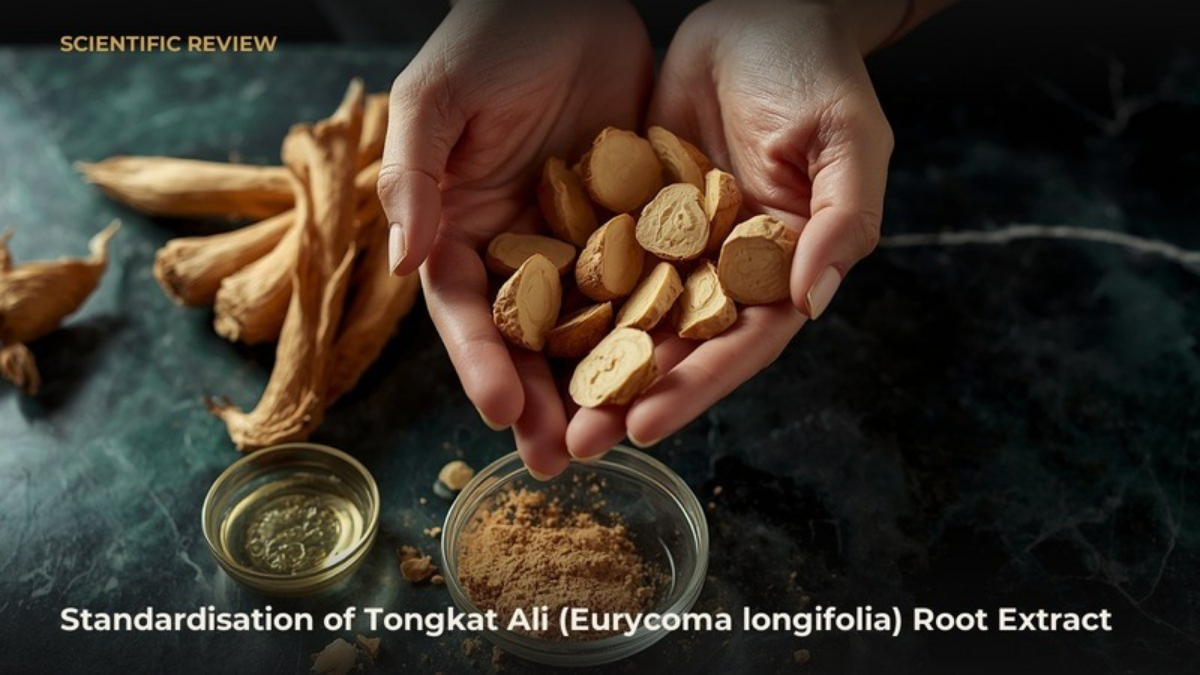
Standardisation of Tongkat Ali (Eurycoma longifolia) Root Extract: Eurycomanone Marker Range and Human Study Evidence
Author: Vitthia Rama Murti, Registered Pharmacist (RPh 15632)
Reviewed by: Dr Yong Yi Yi, signed off 25 October 2026
Review date: 25 October 2026
Evidence grade: B
Bionutricia has a commercial interest in this subject: Bionutricia Extract sells a Tongkat Ali root extract powder stated to be standardised to 1–3% eurycomanone (see the disclosure of commercial interest).
Abstract
Background. Tongkat Ali (Eurycoma longifolia Jack) root extracts are often specified by a marker compound, eurycomanone. A commercial hot-water root extract is stated to be standardised to a 1–3% eurycomanone range. Human studies of the species exist, but most address male hormonal, sexual and physical outcomes, and the extracts they used are not always identified by marker content.
Objective. To review how the eurycomanone standardisation of a Tongkat Ali root extract relates to the published human study evidence for Eurycoma longifolia, and to grade that evidence for this extract.
Methods. PubMed was searched on 25 October 2026 using two human-clinical phrasings, and one unfiltered marker phrasing. Records were read at abstract level. Human randomised controlled trials (RCTs) and reviews of human trials on Eurycoma longifolia were included. Multi-ingredient products in which the Eurycoma extract could not be separated were excluded.
Results. Ten records were included: five RCTs (14 to 83 participants, each counted as its abstract states) and five reviews or meta-analyses. The RCTs reported outcomes for immune markers, testosterone, erectile function, strength, and the absorption of propranolol. A meta-analysis of five RCTs reported higher total testosterone with supplementation. A meta-analysis of two RCTs found no significant pooled difference in erectile function. The immune-marker RCT used a different commercial extract, Physta®. The only abstract in this set that quantifies eurycomanone reports 0.0272 ± 0.0026% in a water-based extract, which is below the lower end of the 1–3% range.
Conclusion. The evidence is graded B. Human trials exist for the species, but the cited trials mostly do not state the marker content of the extract they used, and the only quantified eurycomanone value in them is 0.0272 ± 0.0026% (PMID 21054461), below the 1–3% range. The record does not show that this standardisation predicts any clinical outcome.
Review methodology
Database and search date. PubMed, searched on 25 October 2026.
Search terms, word for word.
- “Eurycoma longifolia tongkat ali” (human clinical evidence only)
- “Eurycoma longifolia Physta extract randomized trial” (human clinical evidence only)
- “eurycomanone standardized extract quality marker content HPLC Eurycoma longifolia” (no human-only filter)
Included. Human randomised controlled trials of Eurycoma longifolia were included where the abstract reports a result for an outcome. Systematic reviews and meta-analyses of human trials on Eurycoma longifolia were included where the abstract states that the review assesses human clinical trials of the species. Each review is reported as its abstract describes it, and no per-trial result is attributed to a review whose abstract does not give one. Ten records met these criteria: PMIDs 23419023, 26816234, 36013514, 26365449, 28259255, 33541567, 33559971, 33445146, 21054461 and 37697053.
Excluded.
- PMID 26595135: a multi-ingredient performance supplement (T+) containing long jack root with beta-alanine and branched-chain amino acids. The Eurycoma effect cannot be separated from the other ingredients.
- PMID 34794202: CitruSlim, a blend of Citrus bergamia and Eurycoma longifolia. The Eurycoma effect cannot be separated from the citrus component.
- PMID 32358510: a systematic review of ingredients in testosterone and erectile dysfunction supplements. Its abstract reports no Eurycoma-specific finding.
Assessment. Each included abstract was read for design, number of participants, population, dose and form, duration, and the outcome as the abstract reports it. Grades follow the A to D scheme set out for this series.
Summary of study findings
PMID 23419023: systematic review (Ulbricht et al., 2013)
Design: systematic review with an evidence-based grading rationale. Outcome, in the abstract’s wording: “consolidates the safety and efficacy data available in the scientific literature using a validated, reproducible grading rationale.”
PMID 26816234: randomised, double-blind, placebo-controlled parallel study (George et al., 2016)
Design: RCT, 4 weeks, double-blind, placebo-controlled, parallel. Participants: 126 screened; 84 with lower Scoring of Immunological Vigor scores; 83 completed; 40 analysed in the Tongkat Ali group and 41 in placebo. Population: middle-aged Japanese men and women. Dose and form: 200 mg/day of Physta® standardised root water extract versus rice powder placebo. Outcome, in the abstract’s wording: “At week 4, the SIV and immunological grade were significantly higher in the TA group than those in P group (p < 0.05).” The abstract also states “No severe adverse events were observed.” Physta® is a different commercial extract.
PMID 36013514: systematic review and meta-analysis (Leisegang et al., 2022)
Design: PRISMA systematic review; nine studies in the review and five RCTs in the meta-analysis. Population: healthy men and hypogonadal men. Outcome, in the abstract’s wording: “a significant increase (SMD = 1.352, 95% CI 0.565 to 2.138, p = 0.001) in the total testosterone levels in men receiving E. longifolia supplementation.” The abstract concludes that the evidence “supports the possible use of E. longifolia supplementation for enhancing testosterone production.”
PMID 26365449: systematic review and meta-analysis of RCTs (Kotirum et al., 2015)
Design: meta-analysis of RCTs against placebo. Participants: two studies, 139 in total. Population: men with erectile dysfunction. Outcome, in the abstract’s wording: “No significance between group difference was found in the mean WMD of the change in the 5-item version of the international index of erectile function (IIEF-5) at week-12 (0.91; 95% CI: -1.50 to 3.33 with I(2)=89.5%, P-value=0.002) with statistical heterogeneity.” A subgroup with lower baseline scores showed “significant improved IIEF-5 score of 2.15 (95% CI 1.03-3.27).”
PMID 28259255: systematic review of clinical studies (Thu et al., 2017)
Design: systematic review of human clinical studies published 2000 to 2014; 150 articles screened and 11 included. Population: men with male sexual disorders. Outcome, in the abstract’s wording: “Among them, 7 studies revealed remarkable association between the use of EL and the efficacy in the treatment of male sexual disorders, and remaining 4 studies failed to demonstrate sufficient effects on male sexual health.” The abstract also states “there is convincing evidence for the prominence of EL in improving the male sexual health.”
PMID 33541567: six-month, double-blind, placebo-controlled RCT (Leitão et al., 2021)
Design: four-arm RCT, 6 months, double-blind, placebo-controlled. Participants: 45 men randomised (aged 47.38 ± 5.03 years). Population: men with androgen deficiency of aging males (ADAM). Dose: 200 mg Eurycoma longifolia supplement. Outcome, in the abstract’s wording: “Erectile function demonstrated improvements in both interventions; however, the most significant results were obtained by men allocated to concurrent training + Eurycoma longifolia.” The abstract’s conclusion is that the combination “increased total testosterone levels in men with ADAM.”
PMID 33559971: double-blind, placebo-controlled RCT (Chan et al., 2021)
Design: placebo-controlled, double-blind, matched-pair RCT, 2 weeks. Participants: 32 young males, aged 24.4 ± 4.7 years. Population: healthy young males. Dose: 600 mg/day Eurycoma longifolia or placebo. Outcome, in the abstract’s wording: “significant interaction and time effects for testosterone (F1,30 = 9.04, p = .005), free testosterone (F1,30 = 7.13, p = .012) and estradiol (F1,30 = 8.07, p = .008) levels in favour of the treatment group, while luteinising hormone, follicle-stimulating hormone and sexual hormone-binding globulin did not.”
PMID 33445146: six-month, double-blind, placebo-controlled RCT of exercise and Eurycoma (Leitão et al., 2021)
Design: four-group RCT, 6 months, double-blind, placebo-controlled. Participants: 45 men included (47.6 ± 5.2 years). Population: men with androgen deficiency of aging male. Intervention: Eurycoma longifolia supplementation. Outcome, in the abstract’s wording: “the isokinetic peak torque of the knee extensors increased in the CT (14%) and CT + EL (17%) groups (p = 0.040; p = 0.006, respectively).” Symptom score: “Subjects of the CT (27.3%) and CT + EL (36.1%) groups decreased the symptomatology of ADAM (p = 0.005).”
PMID 21054461: randomised, single-blinded crossover pharmacokinetic study (Salman et al., 2010)
Design: placebo-controlled, single-blinded, randomised crossover study. Participants: 14 healthy non-smoking young males. Dose and form: 200 mg of a water-based extract stated as “0.0272 ± 0.0026%eurycomanone”, given with 80 mg propranolol. Duration: single dose. Outcome, in the abstract’s wording: “When propranolol was administered with E. longifolia, its bioavailability (AUC0-∞) decreased by 29% while C(max) was reduced by 42% and T(max) was significantly prolonged by almost 86%.” This is the only record in the set that quantifies eurycomanone.
PMID 37697053: systematic review of testosterone boosters (Morgado et al., 2024)
Design: systematic review of 52 studies covering 27 proposed testosterone boosters, including 3 Eurycoma longifolia and Withania somnifera. Population: athletes, men with late-onset hypogonadism, infertile men and healthy men. Outcome, in the abstract’s wording: “Eurycoma longifolia and Withania somnifera possibly effective for healthy men.”
Evidence-quality assessment
Grade: B. Grade B applies because the record contains human randomised controlled trials with material limits on size or population. It includes five human RCTs and two meta-analyses of RCTs, and those limits are set out below.
Consistency across studies. The outcomes differ across trials: immune markers, testosterone, erectile function, strength, and drug absorption. On testosterone the studies agree in direction: PMID 36013514 reports “a significant increase” in total testosterone, PMID 33559971 reports “significant interaction and time effects for testosterone”, and PMID 33541567 reports “increased total testosterone levels in men with ADAM” (a combined training and Eurycoma arm). The strength, immune-marker and drug-absorption outcomes each come from a single trial. The erectile-function meta-analysis found no significant pooled difference, with high heterogeneity (I² = 89.5%). The testosterone meta-analysis found a significant increase. The systematic review at PMID 28259255 describes the evidence as “convincing”, while its own count is 7 positive and 4 non-positive studies. This review does not adopt that wording.
Study design. Five RCTs and two meta-analyses are a design base above a single trial. Trial sizes are small: 14 participants (PMID 21054461), 32 (PMID 33559971), 45 randomised (PMID 33541567) and 45 included (PMID 33445146), against 81 analysed and 83 completed in the Physta® study (PMID 26816234). Several trials used multi-arm or combined-intervention designs, which makes it hard to isolate the extract.
Size. No trial in this set is large. The meta-analyses pool small trials.
Directness to this extract. Most of the cited trials do not state the marker content of the extract they used. The only quantified eurycomanone value in them is 0.0272 ± 0.0026% (PMID 21054461), in a water-based extract, below the lower end of the 1–3% range. The immune-marker RCT used Physta®, a different commercial extract.
Transfer to format and population. The trial populations are healthy young males, middle-aged Japanese adults, and men with androgen deficiency or erectile dysfunction. None matches a general consumer population. Results for one population or extract cannot be carried over to another without this caveat.
Grade A is not assigned. It requires consistent findings from more than one human RCT, or a meta-analysis of such trials. The findings agree in direction on testosterone only; the erectile-function meta-analysis (PMID 26365449) found no significant pooled difference, and the strength, immune-marker and drug-absorption outcomes each come from a single trial. Grade C would apply only to uncontrolled, open-label or observational human evidence, and grade D only if no human trial existed. Neither applies, because human RCTs exist. The grade is therefore B.
Limitations
Records were assessed from their published abstracts rather than from full texts.
Further limitations of the evidence itself:
- Marker content is stated in the abstracts for one extract only. The 1–3% eurycomanone range of the product cannot be tied to any trial outcome.
- The immune-marker RCT tested Physta®, which is a different extract.
- Most trials are small, and the testosterone and erectile-function evidence is mixed.
- Several trials used multi-arm or combined-intervention designs, so the Eurycoma effect cannot always be separated from exercise or other ingredients.
- Several abstracts omit the dose, form or duration, so the dose-to-outcome link cannot be checked for those records.
- The systematic reviews cover different date ranges.
Conclusion
The record supports the statement that human randomised trials and reviews of Eurycoma longifolia exist, mainly on male hormonal and sexual outcomes, and that one trial reports immune-marker changes with a different commercial extract. It supports a grade of B for the species.
The record does not support a claim that a 1–3% eurycomanone standardisation predicts any clinical outcome. Most of the cited trials do not state the marker content of the extract they used, and the only quantified eurycomanone value in them, 0.0272 ± 0.0026% (PMID 21054461), is below the stated range. The record also does not establish that the marker range is a reliable proxy for the activity seen in the trials.
References
- Ulbricht C, Conquer J, Flanagan K, Isaac R, Rusie E, Windsor RC. An evidence-based systematic review of tongkat ali (Eurycoma longifolia) by the Natural Standard Research Collaboration. Journal of dietary supplements. 2013;10(1):54-83. PMID: 23419023. doi:10.3109/19390211.2012.761467
- George A, Suzuki N, Abas AB, Mohri K, Utsuyama M, Hirokawa K, et al. Immunomodulation in Middle-Aged Humans Via the Ingestion of Physta® Standardized Root Water Extract of Eurycoma longifolia Jack–A Randomized, Double-Blind, Placebo-Controlled, Parallel Study. Phytotherapy research : PTR. 2016;30(4):627-35. PMID: 26816234. doi:10.1002/ptr.5571
- Leisegang K, Finelli R, Sikka SC, Panner Selvam MK. Eurycoma longifolia (Jack) Improves Serum Total Testosterone in Men: A Systematic Review and Meta-Analysis of Clinical Trials. Medicina (Kaunas, Lithuania). 2022;58(8). PMID: 36013514. doi:10.3390/medicina58081047
- Kotirum S, Ismail SB, Chaiyakunapruk N. Efficacy of Tongkat Ali (Eurycoma longifolia) on erectile function improvement: systematic review and meta-analysis of randomized controlled trials. Complementary therapies in medicine. 2015;23(5):693-8. PMID: 26365449. doi:10.1016/j.ctim.2015.07.009
- Thu HE, Mohamed IN, Hussain Z, Jayusman PA, Shuid AN. Eurycoma Longifolia as a potential adoptogen of male sexual health: a systematic review on clinical studies. Chinese journal of natural medicines. 2017;15(1):71-80. PMID: 28259255. doi:10.1016/S1875-5364(17)30010-9
- Leitão AE, Vieira MCS, Pelegrini A, da Silva EL, Guimarães ACA. A 6-month, double-blind, placebo-controlled, randomized trial to evaluate the effect of Eurycoma longifolia (Tongkat Ali) and concurrent training on erectile function and testosterone levels in androgen deficiency of aging males (ADAM). Maturitas. 2021;145:78-85. PMID: 33541567. doi:10.1016/j.maturitas.2020.12.002
- Chan KQ, Stewart C, Chester N, Hamzah SH, Yusof A. The effect of Eurycoma Longifolia on the regulation of reproductive hormones in young males. Andrologia. 2021;53(4):e14001. PMID: 33559971. doi:10.1111/and.14001
- Leitão AE, Vieira MCS, Gomes DA, Boing L, Pelegrini A, Luiz E, et al. Exercise associated or not to the intake of Eurycoma longifolia improves strength and cardiorespiratory fitness in men with androgen deficiency. Complementary therapies in clinical practice. 2021;42:101301. PMID: 33445146. doi:10.1016/j.ctcp.2020.101301
- Salman SA, Amrah S, Wahab MS, Ismail Z, Ismail R, Yuen KH, et al. Modification of propranolol’s bioavailability by Eurycoma longifolia water-based extract. Journal of clinical pharmacy and therapeutics. 2010;35(6):691-6. PMID: 21054461. doi:10.1111/j.1365-2710.2009.01147.x
- Morgado A, Tsampoukas G, Sokolakis I, Schoentgen N, Urkmez A, Sarikaya S. Do “testosterone boosters” really increase serum total testosterone? A systematic review. International journal of impotence research. 2024;36(4):348-364. PMID: 37697053. doi:10.1038/s41443-023-00763-9
- Kreipke VC, Allman BR, Kinsey AW, Moffatt RJ, Hickner RC, Ormsbee MJ. Impact of Four Weeks of a Multi-Ingredient Performance Supplement on Muscular Strength, Body Composition, and Anabolic Hormones in Resistance-Trained Young Men. Journal of strength and conditioning research. 2015;29(12):3453-65. PMID: 26595135. doi:10.1519/JSC.0000000000000995
- Hancke J, Srivastava S, Caceres DD, Burgos RA, Alarcon P. An exploratory double-blind, randomized, placebo-controlled study to assess the efficacy of CitruSlim on body composition and lipid parameters in obese individuals. Phytotherapy research : PTR. 2021;35(12):7039-7049. PMID: 34794202. doi:10.1002/ptr.7331
- Kuchakulla M, Narasimman M, Soni Y, Leong JY, Patel P, Ramasamy R. A systematic review and evidence-based analysis of ingredients in popular male testosterone and erectile dysfunction supplements. International journal of impotence research. 2021;33(3):311-317. PMID: 32358510. doi:10.1038/s41443-020-0285-x
Disclosure of commercial interest
What the company sells. The Bionutricia Extract product line lists “Tongkat Ali Root (Longjack) Standardized Extract Powder 1-3% Eurycomanone”. It is an ingredient supplied by Bionutricia Extract, the ingredient-supply arm. Its stated actives and standardisation are: a pure 200:1 Tongkat Ali root (Eurycoma longifolia) standardised extract powder, standardised to 1–3% eurycomanone, made by a patented extraction process (MY-188945-A).
Naming. The literature names this material Eurycoma longifolia Jack or tongkat ali. The product names it Tongkat Ali Root (Longjack). These refer to the same material.
Related items in the line. The line also lists a “Tongkat Ali (Longjack) Extract Chewable Tablet With Ginger & Guarana”, made from the same patented-process standardised extract. Chewable tablets are one of the finished formats that bionutricia.com manufactures, as distinct from the ingredient supplied by Bionutricia Extract. The line also lists “Black Tongkat Ali (Polyalthia bullata)” and “Red Tongkat Ali (Stema tuberosa)”. These are different species and are not covered by this review.
Physta®. The extract in PMID 26816234 is named in the literature as a different commercial extract. It is not a product in the Bionutricia Extract line.
This review was not commissioned or paid for by a third party. Its findings and evidence grade were not altered to favour any product. Nothing here is medical advice, and nothing here claims that any product treats, prevents or cures any condition. For formats, quantities or quotations, please arrange a meeting with our nutrition specialist.
Author biography
Vitthia Rama Murti, Registered Pharmacist (RPh 15632). Subject scope: formulation, excipients, stability, tolerability and safety; clinical evidence: human trials, indications, dosing and clinical outcomes.
Assigned reviewer
Dr Yong Yi Yi holds a PhD in Science from Monash University, in food science and technology, microbiology and chemistry, and a BSc (Hons) in Medical Bioscience from Monash University. Subject scope: food science and technology, microbiology, fermentation and probiotics, analytical chemistry and method validation, and medical bioscience.
Review history
Date written: 25 October 2026.
Reviewed by: Dr Yong Yi Yi, 25 October 2026.
Date reviewed: 25 October 2026.