Maltodextrin vs Arabic Gum — Choosing a Spray-Dry Carrier
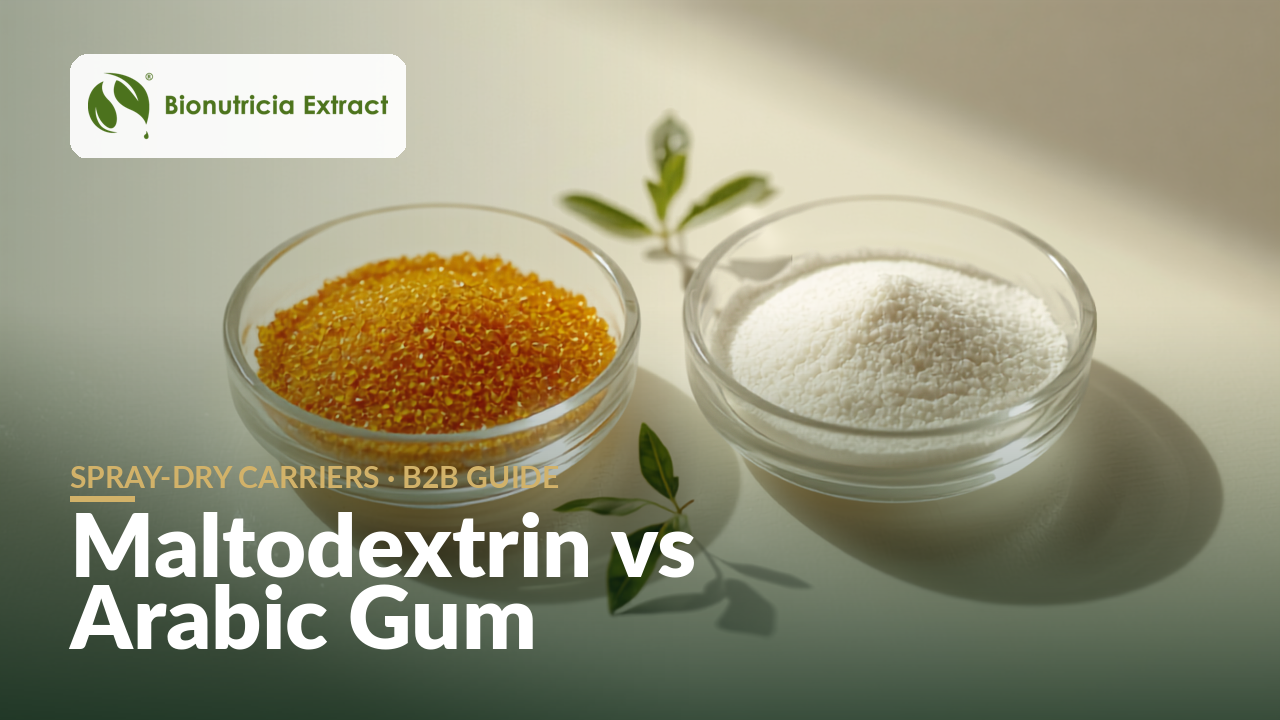
When a liquid extract or an oil is spray-dried into a powder, a carrier is usually added to help it dry, protect the actives and flow freely. The two most common choices behave very differently. Maltodextrin is a cheap, starch-derived carbohydrate that dries well but barely emulsifies and carries a high glycaemic load. Arabic gum (gum acacia) is a natural tree exudate that both carries and emulsifies, is rich in soluble dietary fibre, has a low glycaemic impact and is prized for clean-label positioning. That difference is why Bionutricia Extract emulsifies its entire oil-powder range on arabic gum — never sodium caseinate or synthetic emulsifiers — so those powders can be vegan, dairy-free and allergen-free.
Carrier choice in one minute
- Carrier = drying aid: helps a liquid extract or oil form a stable, free-flowing powder
- Maltodextrin: low cost, dries well, little emulsifying power, high glycaemic profile
- Arabic gum (gum acacia): carries and emulsifies, ≥90% soluble dietary fibre, low glycaemic, clean-label
- Oil powders need an emulsifier: the default sodium caseinate is milk-derived — an allergen that blocks vegan/dairy-free/halal-clean claims
- Bionutricia oil powders: emulsified on arabic gum only, so they can claim vegan, dairy-free, allergen-free
- Pack sizes: 1 kg, 5 kg, 20 kg · MOQ & pricing: on quotation · COA: every batch
What a carrier does in spray drying
Spray drying atomises a liquid into hot air, flashing off the water in seconds to leave a powder. Many extracts — and all oils — will not form a good powder on their own: they turn sticky, clump on the chamber wall, or leave the actives exposed to air and moisture. A food-grade carrier solves this. It raises the solids content so the droplets dry cleanly, encapsulates and protects the actives, and gives the finished powder reliable flow and shelf stability. The carrier is not an inert filler chosen at random; it shapes the powder’s solubility, its allergen and dietary status, its glycaemic profile and, for oils, whether a stable powder forms at all. That is why the carrier decision deserves as much attention as the extract itself.
Maltodextrin — cheap and effective, with trade-offs
Maltodextrin is a carbohydrate produced from starch (typically corn, tapioca or wheat). It is inexpensive, highly soluble and dries predictably, which makes it a workhorse carrier for robust, water-based extracts produced at scale. Its limitations matter for premium and clean-label lines, though. Maltodextrin has essentially no emulsifying ability, so it cannot, by itself, turn an oil into a stable powder. It contributes little beyond bulk — no meaningful fibre — and it has a high glycaemic index, which sits awkwardly with low-sugar and metabolic-health positioning. And because it is a refined starch derivative, many brands see it as the opposite of clean-label. For the right, cost-sensitive water-based product it is perfectly serviceable; for oils and premium claims it often falls short.
Arabic gum (gum acacia) — carrier and emulsifier in one
Arabic gum, also called gum acacia (Acacia senegal), is a natural exudate harvested from acacia trees. Its stand-out property is that it is both a carrier and an emulsifier: its branched glycoprotein structure wraps around oil droplets and holds them stable, which is exactly what an oil powder needs. It is also rich in soluble dietary fibre (Bionutricia’s arabic gum assays at ≥90% total dietary fibre), has a low glycaemic impact, and is widely accepted as a clean-label, natural ingredient. For B2B buyers building vegan, high-fibre, low-sugar or premium-natural products, arabic gum does several jobs at once — stabiliser, fibre source and clean-label story — where maltodextrin would only add bulk.
Maltodextrin vs arabic gum, side by side
| Factor | Maltodextrin | Arabic gum (gum acacia) |
|---|---|---|
| Source | Refined starch (corn / tapioca / wheat) | Natural acacia tree exudate |
| Emulsifies oil? | No — needs a separate emulsifier | Yes — carrier and emulsifier in one |
| Dietary fibre | Negligible | High soluble fibre (≥90% in our gum) |
| Glycaemic profile | High | Low |
| Clean-label perception | Refined / processed | Natural, widely accepted |
| Relative cost | Lower | Higher |
Why this decides your allergen and vegan claims — especially for oils
The carrier question becomes decisive the moment you spray-dry an oil. An oil will not become a stable powder without an emulsifier, and the industry default is sodium caseinate — which is milk-derived. That single choice carries three consequences: it introduces a declarable Annex II milk allergen, it removes any vegan or dairy-free claim, and it complicates halal review because it is animal-derived. Bionutricia takes the other road: every oil powder we make is emulsified on arabic gum, never sodium caseinate, maltodextrin or any synthetic emulsifier. That is precisely why our oil powders can be positioned as vegan, dairy-free and allergen-free, and why arabic gum’s dual role is more than a technical footnote — it is the reason the clean claims hold. The carrier for any given water-based botanical extract is chosen per ingredient and documented on its specification.
How Bionutricia Extract helps you choose
From our FSSC 22000-certified facility in Sungai Buloh, Selangor, we match the carrier to the ingredient, the claim and the cost target, and we produce to your specification under OEM or private label. Our patented enzymatic + ultrasonic extraction (Malaysian patent MY-188945-A) sets up a cleaner extract to dry, and the carrier choice is stated on the specification and confirmed on every Certificate of Analysis — see How to Read a Botanical Extract Certificate of Analysis. Brand owners and manufacturers then formulate the bulk powder into their chosen finished format — sachets, capsules, tablets, gummies, beverages, bakery or dairy lines. Bionutricia supplies the bulk ingredient for B2B formulation; brand owners and manufacturers formulate it into their chosen finished format. Every powder ships under seven certifications: JAKIM Halal, FSSC 22000, US FDA registered, GMP, HACCP, MeSTI and NanoVerify.
Frequently Asked Questions
Q: What is a carrier in a spray-dried extract powder?
A: A carrier is a food-grade material added before spray drying to help a liquid extract or oil form a stable, free-flowing powder. It supports drying, protects the actives and improves flow and shelf stability. Maltodextrin and arabic gum are two of the most common carriers.
Q: What is the difference between maltodextrin and arabic gum as carriers?
A: Maltodextrin is an inexpensive starch-derived carbohydrate that dries well but has little emulsifying ability and a high glycaemic profile. Arabic gum both carries and emulsifies, is rich in soluble dietary fibre, has a low glycaemic impact and is prized for clean-label positioning.
Q: Why does arabic gum matter for oil powders?
A: Oil powders need an emulsifier to turn oil into a stable powder. The industry default, sodium caseinate, is milk-derived — a declarable allergen that complicates vegan, dairy-free and halal positioning. Bionutricia emulsifies its entire oil-powder range on arabic gum instead, so those powders can be vegan, dairy-free and allergen-free.
Q: Is arabic gum clean-label?
A: Yes. Arabic gum (gum acacia, Acacia senegal) is a natural, recognised food ingredient, high in soluble dietary fibre and widely accepted as clean-label. It is a common reason buyers choose it over synthetic emulsifiers or refined starch carriers.
Q: Which carrier should I choose?
A: It depends on the ingredient, the claim and the cost target. Maltodextrin can suit robust, cost-sensitive water-based extracts; arabic gum suits oil powders and clean-label, higher-fibre, low-glycaemic positioning. We advise per ingredient and document the choice on the specification and Certificate of Analysis.
Related Guides
Choosing a carrier for your spray-dried powder? Contact Bionutricia Extract for specifications, COA and FSSC 22000 documentation. Email: ng@bio-nutricia.com | bionutriciaextract.com/contact